The rational solution
More dialogue with China can make the EU economically competitive again










The outbreak of the crisis in Ukraine, followed by the crisis in the Middle East, has amplified the Cold War mentality and the fallacious logic of confrontation between opposing blocs. Suffering most from the consequences of such an approach are the peoples of Europe, who are forced to make major sacrifices in their daily lives to endure the results of many sanctions, tariffs and trade restrictions targeting Russia. Rightly, many observers have defined the European Union's sanctions and tariffs as having a "boomerang" effect, affecting firstly peoples of EU member states. These measures are all unnecessary, enacted by certain European leaders and at the mercy of the United States, with the sole aim of hitting and harming Russia.
The EU must abandon such logic as soon as possible and take another path — dialogue. When trade ties between major powers present critical issues, they can only be resolved by talking and dialogue in order to reach compromises. Any other solution, all the more so at a historical stage when the global order is shifting from a unipolar world to a multipolar architecture, is only conducive to tensions and misunderstandings. In all this, EU-China relations play a significant role in promoting stability, peace and security not only in Europe but also in broader Eurasia.
It is incumbent on us to consider the fears of European citizens, who in recent years have been suffering the negative consequences of at least four unprecedented challenges: a large-scale war in Eastern Europe; internal polarization within the EU between individual governments; the breakdown of economic ties with Russia; and a worrying start to a trade war with China. The result of these contingencies coincided with a combination of economic deterioration and political instability.
European competitiveness, downsized and torn apart by nefarious political dynamics, much more in line with the needs of the US than those of the European people, has also suffered. For example, the recent closure policies implemented by Brussels have undermined European imports of gas from Russia (thus altering the energy plans of most European economic powers such as Germany), damaged the automotive sector, with tariffs that prevent the continent's auto giants from working with their Chinese counterparts. Moreover, most importantly, they are dumping all the costs on the shoulders of the people.
European competitiveness will not regain vigor by implementing serious and urgent measures such as tariffs and duties. On the contrary, it is crucial for the continent's industries to break out of the so-called middle technology trap identified by Mario Draghi in his report on the vision of the future of European competitiveness. For the former president of the European Central Bank, the European high-tech industry has remained in an average technology limbo. And it has chosen to stay there deliberately — as in the case of German automotive — for fear of leaving the field it knew. The EU needs a different approach to foreign economic relations to become competitive again. Certainly, Brussels needs domestic reforms and investment in critical areas, but little or nothing will have a major effect without first shaping a clear vision for foreign economic relations. A vision that should not be exclusively on the demand of the US, but, on the contrary, should abandon any Cold War mentality and engage in dialogue with everyone: including and above all with China.
Not least because the US, in the economic sphere, plays its own game. A game within which all others — including Europe — are considered strategic rivals. Put another way, in the economic sphere the US considers the EU a competitor, and this will most likely be even better understood when US President-elect, Donald Trump, takes office. He may also impose sanctions on US imports from Europe (as he has repeatedly threatened to do in the election campaign). Not only that. Recently, under the Joe Biden-led administration, the US has adopted legislation, such as the US CHIPS and Science Act and the Inflation Reduction Act, both of 2022, which respectively authorized $280 billion in new funding to promote domestic research and semiconductor manufacturing, as well as tax incentives to develop the clean energy and manufacturing sectors. The EU could only watch helplessly the capital flight to the US and, more recently, was forced again by its US partner to plunge into a dangerous and counterproductive trade war with China.
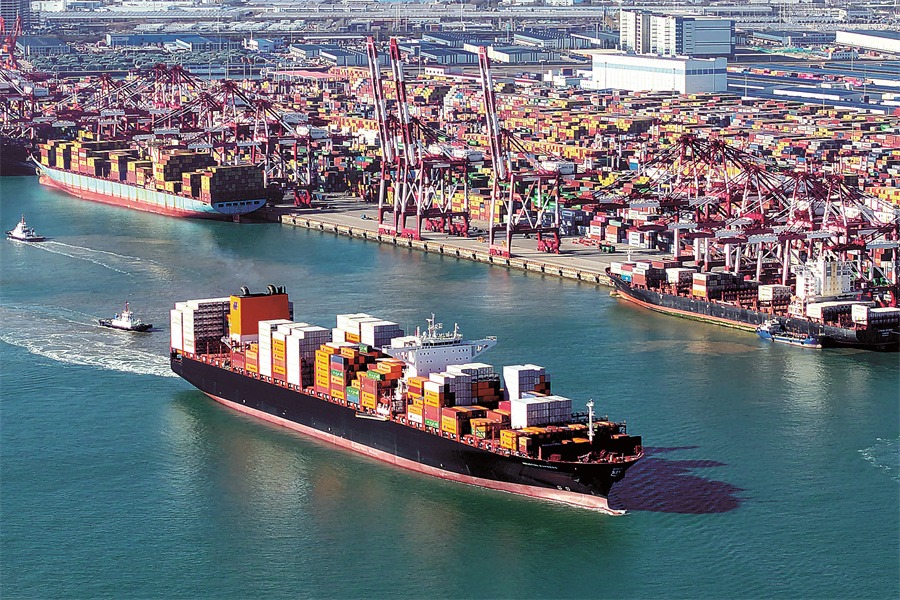
It only takes a look at the numbers to see that China and the EU cannot and should not decouple, much less fight a trade war. In 2023, despite the global trade crisis, China-EU trade reached $783 billion, with trade averaging nearly $1.5 million per minute. The stock of bilateral investment between China and the EU exceeds $250 billion, and companies on both sides continue to view each other's markets favorably. According to the Business Confidence Survey 2024 published by the European Union Chamber of Commerce in China, 40 percent of European companies surveyed plan to make China one of their top three destinations, unchanged from 2023. At the same time, the 2023 Annual Report of the China Chamber of Commerce to the EU shows that more than 80 percent of surveyed Chinese companies expect to improve their business in Europe.
Given the delicate international situation, the EU should not listen to US sirens urging it to isolate itself economically from China. Europe's major export-oriented economies — and Italy is one of them — need export markets, and China, from this perspective, is the largest export market for many large European companies (which also need access to China's vast manufacturing base).
China and the EU should address the real needs of their companies, resolve crises through dialogue and negotiation, and firmly promote international cooperation to address challenges, jointly promoting multilateralism and global governance. The EU's competitiveness will shine again the moment Brussels stops flattening itself to Washington's positions and, on the contrary, becomes the bearer of the interests of the peoples of Europe.

The author is a member of Earth Charter International China. The author contributed this article to China Watch, a think tank powered by China Daily. The views do not necessarily reflect those of China Daily.
Contact the editor at editor@chinawatch.cn.