



Decades of bilateral fossil study unearths discoveries









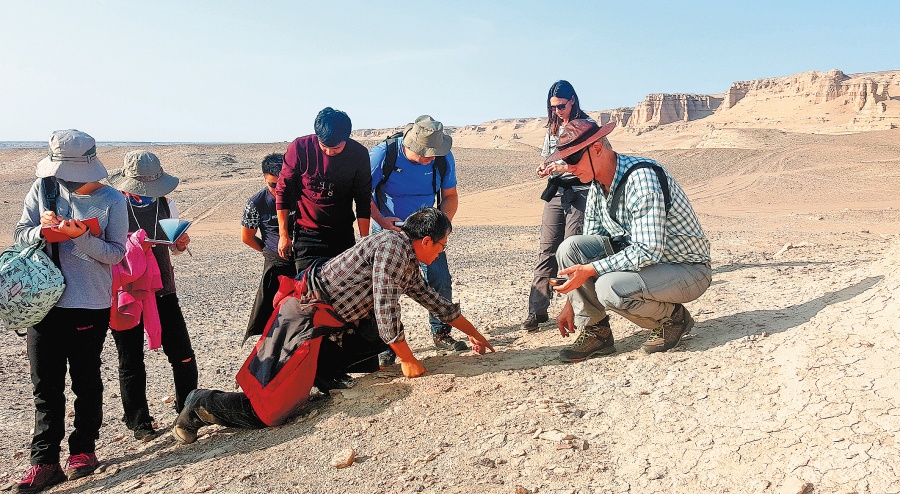
Despite being nearly 20,000 kilometers apart and on different continents, over the past 20 years Chinese and Brazilian scientists have worked together to find many similarities in the pterosaur fossils found in either country.
Since 1997, Wang Xiaolin and his team from the Institute of Vertebrate Paleontology and Paleoanthropology of the Chinese Academy of Sciences have discovered numerous pterosaur fossils in the western part of Liaoning province, dating back around 125 to 120 million years ago within the Jehol Biota period.
"Sinopterus (a pterosaur fossil found in China) is very similar to Tapejara found in Brazil, belonging to the Tapejaridae family, marking the first discovery of this pterosaur group outside Brazil," Wang said.
Pterosaurs, flying reptiles, share close evolutionary ties with dinosaurs and crocodiles, with their scientific name meaning "winged lizard". Pterosaurs are one of the most representative groups of vertebrates from the Mesozoic Era, roughly spanning from about 230 million years ago to 66 million years ago, and there have been discoveries in the Xinjiang Uygur autonomous region, the Inner Mongolia autonomous region, Liaoning and Hebei provinces and other regions of China.
"Because both China and Brazil are crucial sites for pterosaur fossil discoveries worldwide, and fossil morphology comparison is vital in paleontological research, scientists from both countries started in-depth collaboration in 2003 to enhance pterosaur research," Wang said.
"This collaboration allows both sides to efficiently observe specimens and gather research data, facilitating a more comprehensive study of pterosaurs," he added.
Chinese and Brazilian scientists have identified 17 species of pterosaur fossils, publishing numerous academic papers on pterosaurs and dinosaurs in top international journals like Nature, Science, and Proceedings of the National Academy of Sciences.
Last year, based on research on pterosaur fossils from the Jehol Biota in western Liaoning, Chinese and Brazilian scientists jointly established a new genus and species within the Chaoyangopteridae family, naming it Amizade Beauty Dragon, or Meilifeilong Youhao in Chinese, symbolizing the 20-year-long friendly cooperation between scientists from both countries in the field of pterosaur and other paleontological research.
In 2004, a Brazilian pterosaur research team visited China for the first time. Wang led Brazilian Academy of Sciences academicians Alexander Wilhelm Armin Kellner and Diogenes de Almeida Campos to survey major fossil sites in Liaoning province and Inner Mongolia. Since then, Kellner has visited China multiple times, conducting field surveys in Xinjiang, Shandong and other regions alongside Chinese scientists.
In 2018, during an academic conference in Hefei, Anhui province, Kellner, who is also director of the National Museum of Brazil, shared the news of the devastating fire at the museum. The Society of Vertebrate Paleontology of China subsequently issued a proposal urging support for the reconstruction of the National Museum of Brazil, leading to donations of specimens from Chinese museums, universities and research institutions.
"Over the past 20 years, scientific and cultural exchanges have built a bridge for collaborative research between Brazil and China," said Kellner, who is also a professor at the Federal University of Rio de Janeiro.
Chinese scientists have identified over 50 species of pterosaurs, accounting for nearly a quarter of all known pterosaur species worldwide. Wang and Kellner have become the two scientists with the most named pterosaurs in the world.
Wang said that after the discovery of the Hamipterus and its eggs and embryos, the research findings of Chinese and Brazilian paleontologists were hailed as the most exciting discovery in pterosaur research in over 200 years.
Paleontological experts Wang and Zhou Zhonghe have posited that western Liaoning is the origin and radiation center of several pterosaur groups in the Cretaceous Period. As research progresses among scientists from both sides, this viewpoint has been further supported.
Due to the outstanding contributions made by the two Chinese scientists to pterosaur research in Brazil, Wang and Zhou were elected Corresponding Members of the Brazilian Academy of Sciences in 2013 and 2015, respectively.
yandongjie@chinadaily.com.cn


- F1 Chinese Grand Prix returns with major upgrades
- Taiwan's 'goodwill mission' criticized as futile bid for 'independence' support
- Chinese biotech innovator Jacobio Pharma reports its 2025 annual results
- Xinyang aims to become open gateway in southern Henan, says NPC deputy
- Honor launches its latest foldable smartphone Magic V6
- Students and teachers from Colorado plant 'Panda Friendship Bamboos' in Chongqing





