



Writing the village as universe
Previously shortlisted in 2022, winning novelist's experiment with style finally clinches him the coveted prize, Yang Yang reports.










Born in a village in Zibo, Shandong province in 1986, Wei focuses on the village as his subject.
His recent titles include The Rural Trilogy — Yu Shi Wu Qu (which roughly translates as "don't do other things than suggested by traditional Chinese almanacs"), Doushi Renmin Qunzhong (The Masses), and Wang Nenghao (the name of the principal character), which was shortlisted for the 2022 Blancpain-Imaginist Literary Prize.
After Wang Nenghao, Wei was searching for a new way to write another novel about the village. He says that after the trilogy, there were still a great many things in Xinliu village that he had not written about previously.
"Even if it's a small village with only a few hundred households, it's a very complex little universe, which motivates me to continue writing about it," he says.
In the end, he found the answer, to "dissect" the little-known village from different perspectives, as the title of his book indicates.
"The idea (for the title) is actually quite simple: to deconstruct the two Chinese characters for 'village' into four parts, and see how they could be rearranged to sound smoother. I chose this title as the novel seeks to describe different aspects of a village," Wei says.
Wanting to break free from the constraints of the traditional novel, Wei made bold structural changes in his latest work.
The novel is divided into two parts. The first part, Aspects, places specific focus on some of the people, things and places in the village, revealing both the genealogies of characters in Xinliu, and the vicissitudes of life.
The second part, A Year, takes a nonfictional approach to documenting the events, large and small, such as agricultural work, weddings and funerals, providing a panoramic depiction of the authentic rural landscape of the present.
In the second part, Wei introduces his own perspective, leading readers through significant events in rural life.
"It was a bit like making a documentary," he says.
Inspired by the writing style of German-English novelist, essayist, poet and scholar W.G. Sebald, which combines elements of memoir, fiction, history and biography, in Tu Guang Cun Mu, Wei explores a style that blurs the boundary between fiction and nonfiction.
Like scenes from a documentary, the multitude of living beings and everyday life in Xinliu village unfold gradually in the 400-page novel. Over 100 characters, through different festivals and seasons, experience birth, aging, sickness, and death, joy and sorrow, separations and reunions — behind each face is an endless story.
"Villages may seem similar to one another, and you don't know how the villagers survive and live. Perhaps after reading my novel, readers may understand how they live and die, which might have been my original intention in writing," Wei says.
"The work is vivid and powerful. Wei Sixiao possesses a deep understanding and affection for the land, yet he avoids sentimentality, using the most simple, compassionate and humorous tone to accurately depict the lives of the villagers," says Joan Chen, commenting on the book.
"This allows us to feel intense, indescribable emotion and sentiment, reflecting the era and society through a tapestry of lives. I particularly enjoy the dialogues between the first-person narrator 'I' and the mother in the book, where they exchange all sorts of gossip about the city, the village, relatives and acquaintances, that bring a smile to the reader's face."
Death is one of the topics Wei often covers in his work, especially rural funerals, which he says are like a festival gathering, attended by a lot of relatives and friends.
"When faced with death, people often experience poetic moments. My view of funerals has changed over the years. I used to dislike insincerity of the wailing, but now I see it can comfort the deceased person's close family, even if the tears aren't real."
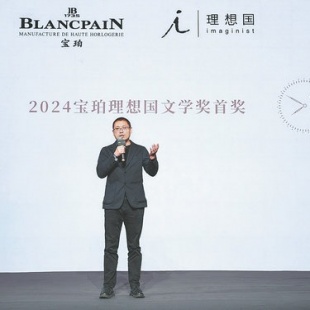
Opened for entries on April 15, the 2024 Blancpain-Imaginist Literary Prize received 115 works of fiction, a record number of submissions, says Liu Ruilin, founder of Imaginist. Five, including Tong Mo's novel Dadi Zhongxin De Ren (People at the Center of the Earth), short story collection Guowang De Youxi (The King's Game) by Datouma, and Laoshi Haoren (Honest, Good People) by Gu Xiang were shortlisted, with the five judges commenting that they "demonstrate the young writers' keen insight into reality and an impressively expansive view".




















