AI has potential to revolutionize education









The world is in the midst of the "Fourth Industrial Revolution" and may soon enter the "Fifth Industrial Revolution". At the same time, the rapid development of emerging technologies such as artificial intelligence has been impacting education at all levels, from primary and secondary to higher education.
Countries around the world are trying to find ways to more flexibly use AI in education, so as to impart education to students in remote areas and teach people the skills needed to build successful careers in the 21st century. China has become a leader in the application of AI in education and training by developing smart learning systems and intensifying research on AI. China is also working with other countries to advance the use of AI in education globally.
The fourth United Nations Sustainable Development Goal is to "ensure inclusive and equitable quality education and promote lifelong learning opportunities for all". In this context, organizations such as UNESCO are exploring ways to use AI to realize the SDG4.
AI can be used to meet individual learners' needs and provide one-to-one tutoring for students, as well as to facilitate lifelong learning. To achieve the SDG4, online classes using AI can be organized to teach students in different parts of the world, translate the course content into students' preferred language, and allow the students to interact with the tutor. This is important for students who live in remote areas, scores of kilometers away from the nearest school.
Also, teachers can use AI to prepare study materials for students and help them complete a certain course. AI can help teachers, too, to customize resources for learners so they can perform better. Researchers at the Beijing Advanced Innovation Center for Future Education and Beijing Foreign Studies University developed and implemented an automatic resource generation mechanism called Learning Cell Model to customize study materials and other resources for learners.
Studies show the Learning Cell Model can generate resources according to individual learners' needs and improve students' performance without increasing their cognitive burden.
An important area of research is the possible use of AI to facilitate language learning. Researchers from the Advanced Innovation Center for Future Education and the Beijing Normal University explored how an "automatic resource generation system" can help in teaching Chinese as a second language in schools.
The researchers developed a model to use AI to ensure the resources meet learners' needs, with studies showing the use of the teaching-learning model improved students' performance and their perception faculty. Students who were taught lessons using the model more actively participated in the course.
In addition to teaching languages, AI can also be used to help students of all ages and from different countries to learn about different cultures. Researchers from Beijing Foreign Studies University, Athabasca University (Canada) and some Saudi Arabian universities have been exploring ways to use AI to help students from different countries learn from each other and know about each other's cultures while sitting in the comfort of their homes.
AI applications should be designed in a way that they benefit learners and educators, for which policies for learners, teachers and other staff in educational institutions should be in place. For example, there should be policies on factors such as data privacy and security, copyright, academic integrity, transparency and environmental concerns. A recent report by experts from Athabasca University and the Commonwealth of Learning identified 14 AI policies that staff at different levels of higher education institutions need to follow.
However, some educational institutions are reluctant to allow students to use AI because they think AI will not benefit them or it is not ethical to allow students to use AI. But AI is here to stay, and educational institutions must accept AI as another beneficiary tool.
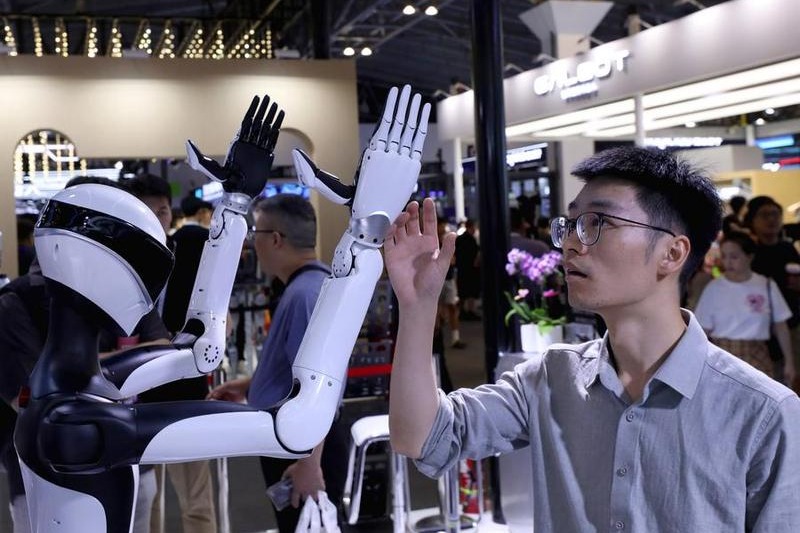
As we move toward the "Fifth Industrial Revolution", AI may develop the ability to think independently and become as creative as humans, and GenAI may become even more intelligent and capable of completing intellectual tasks like humans.
With the advancement of machine learning, AI systems may start developing original ideas that can be applied in complicated situations and contexts. AI has the potential to revolutionize education if designed and applied properly. The challenge for higher educational institutions is how to keep up with the rapid development of AI, particularly when it comes to devising suitable policies to impart education to the future generations.
The author is a professor at Athabasca University, Canada.