IMF chief: Domestic consumption 'reliable source of growth' for China









China has faced "a fork in the road" for quite some time: continue with its export-led growth policies or boost domestic consumption and shift the growth engine to the Chinese consumer.
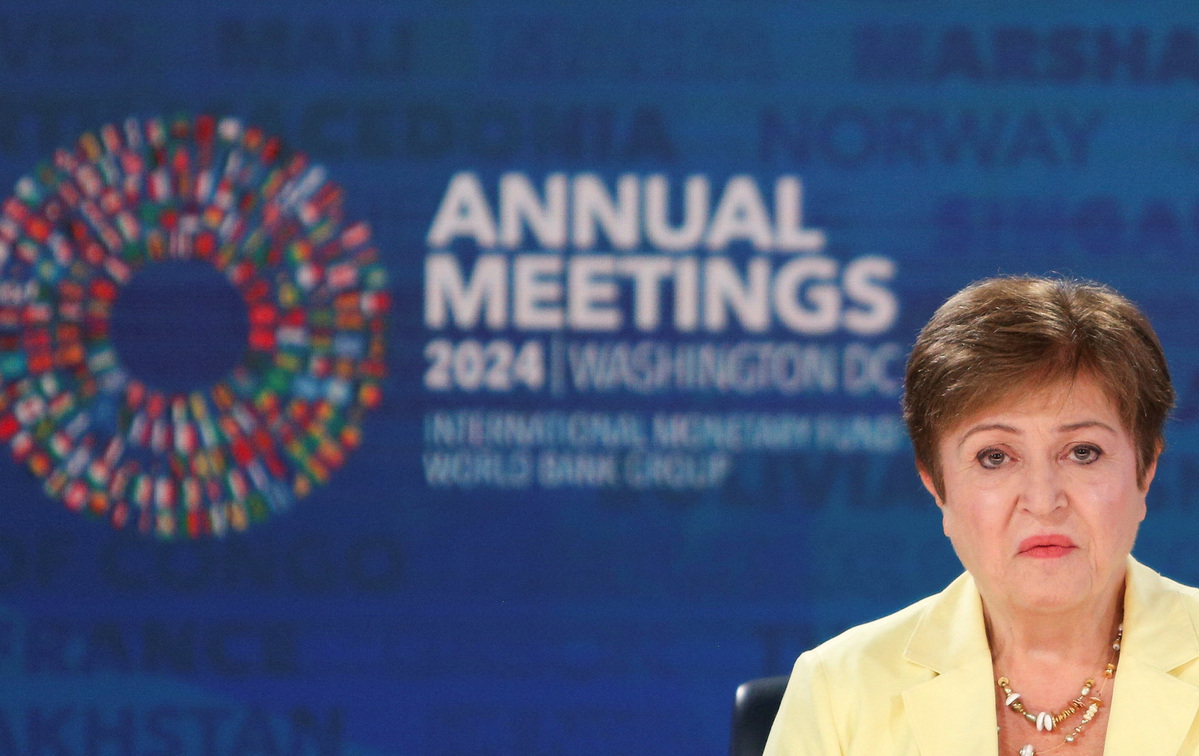
According to Kristalina Georgieva, managing director of the International Monetary Fund, the way ahead is to shift to domestic consumption-led growth.
The IMF projected China's GDP to grow by 4.8 percent in 2024 - down 0.2 percentage points from its July forecast - and then 4.5 percent in 2025, the same as its July forecast, according to the latest World Economic Outlook released on Tuesday. One of the major reasons for the decrease was weak consumer confidence, the report said.
"We are of the view that as the Chinese economy has grown so big, it is the latter, domestic consumption, that is the reliable source of growth. We also have been keen to see China recognize that in the short term, one big obstacle to consumer confidence is in the property sector, and a decisive action to resolve that would help lift up consumer confidence," Georgieva said while briefing the media on the IMF's Global Policy Agenda on Thursday.
Ramping up consumption to propel growth has recently been increasingly highlighted by many Chinese economists.
For example, Chen Wenling, chief economist at the Beijing-based China Center for International Economic Exchanges, told China Daily earlier that compared with other drivers of China's economic growth like investment and exports, consumer spending is well positioned to be the fastest-moving engine in the long run, and stronger steps should be taken to further stimulate consumption.
At the media briefing, Georgieva also said China's social security and pension reform would have the potential to boost domestic consumption. It "gives people confidence that they don't need to save excessively".
"They can rely on the system. That would mean that they spend more, taking the sectors of the economy that are somewhat less developed from a consumer standpoint, like healthcare, education, elderly care, and making services more of a driver for growth," she said.
She also said the IMF would "carefully assess" the stimulus measures that China implemented recently "to determine what exactly their likely impact is".
"There are measures that go in the right direction," Georgieva said.
This briefing is part of the 2024 annual meeting of the IMF and World Bank Group, which is being held from Monday to Saturday in Washington, bringing together finance ministers and central bankers from nearly 200 countries and regions.
Krishna Srinivasan, director of the IMF Asia Pacific department, spoke about the tension between the US and China regarding Asian economies on Thursday at the media briefing for the release of the report Asia Pacific Department Regional Economic Outlook October 2024.
Srinivasan said that many Asian economies, notably some in the Association of Southeast Asian Nations, "increased their market shares of both Chinese and US imports in both gross and value-added terms".
"Now we also find that these third-party countries' exports of targeted goods, of the goods which are targeted for tariffs by US and China, they've also increased," he said.
However, Srinivasan said only time could tell whether those changing trade patterns would be permanent or temporary. "But our analysis has shown that in the long run, everyone hurts from trade fragmentation. And that's because global demand comes down. When global demand comes down, everyone hurts," he said.
"And so, we all have to collectively fight against these forces of fragmentation," Srinivasan added.
Gita Gopinath, deputy managing director of the IMF, said in an interview one day earlier that the escalation of trade and tariff tensions between the US and China would have economic consequences around the world.
"Output is going to be much lower than what we are projecting for all countries in the world. There's going to be pressure on inflation, so that's not the direction in which we should be going," she said, pointing out that tariffs would be "costly for everybody."
IMF Chief Economist Pierre-Olivier Gourinchas wrote in his blog about the just-released World Economic Outlook that some industrial and trade policy measures "often lead to retaliation and fail to deliver sustained improvements in standards of living".