


'Tailored solutions' help fill Africa's grain bags
Chinese experts draw on experiences at home to boost continent's food crops










Hardier rice
Drought-resistant rice is another example of how Chinese agricultural knowledge is helping Africa increase production, protect wetlands, and combat climate change.
In late July, on the outskirts of Zanzibar, Tanzania, two small patches of rice began to turn yellow in the experimental fields, their plants bending under the weight of their heavy grains.
In the nearby comparison patch, the rice plants looked green and were more than 10 days away from reaching maturity.
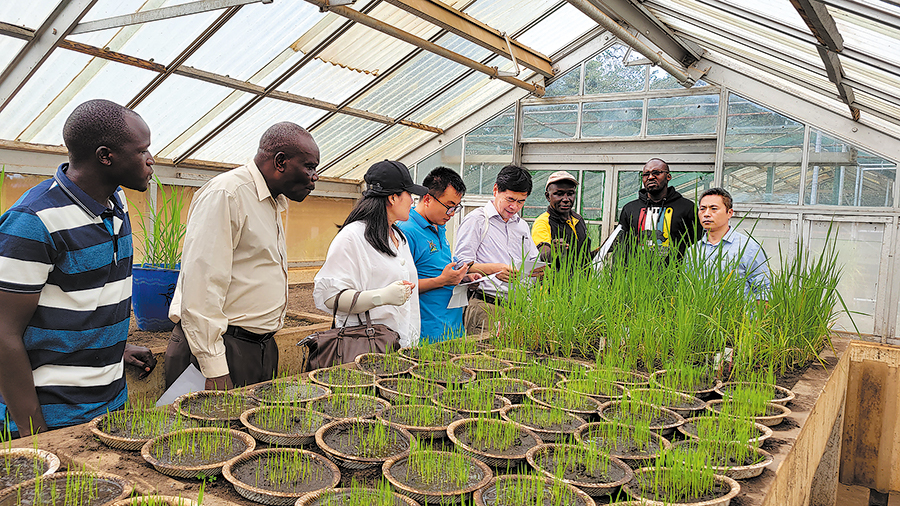
These fields belong to the Zanzibar Agricultural Research Institute, and the rice ripening early was WDR73, a drought-resistant variety developed by the Shanghai Agrobiological Gene Center.
While it hasn't been officially approved in Tanzania yet, its success in Uganda, where it has been endorsed for nationwide use, impressed Salum Faki Hamad, a rice scientist at ZARI.
Hamad reached out to Liu Zaochang, the Africa project manager at the Shanghai center, to initiate the collaboration.
African countries such as Kenya have joined the Convention on Wetlands, which means they cannot increase planting areas at the expense of wetlands, Liu explained.
"In this context, water-saving and drought-resistant rice has become a great solution in the region," Liu said.
Since the late 1990s, crop scientists, including Luo Lijun at the Shanghai center, have been building a pool of over 200,000 rice gene samples for breeding purposes.
After decades of hybridization research, they successfully developed the drought-resistant rice strain in 2004. With a 40 percent reduction in water usage, the per hectare yield can exceed 11 metric tons.
Since the variety doesn't need to be grown in flooded fields, it can also reduce emissions of methane, a potent greenhouse gas, and prevent mosquito breeding.
Scientific research achievements related to the WDR73 variety were recognized with the National Science and Technology Progress Award in 2020.
"Data has shown that the variety has curbed methane emissions by at least 70 percent," Liu said.
As the Belt and Road Initiative progresses, the center in Shanghai has been introducing the variety to partner countries over the past decade.
Liu said it has been grown in rice fields in northern Vietnam, Burundi and Kenya.
Agricultural research institutes in Iran and the United Arab Emirates have shown great interest in introducing the variety.





