


Beijing Central Axis listed as World Heritage Site









A centuries-old example of Chinese urban planning and architecture has received global recognition.
The 46th session of the World Heritage Committee in New Delhi, India, announced on Saturday that the Beijing Central Axis — "A Building Ensemble Exhibiting the Ideal Order of the Chinese Capital" — has been inscribed on the UNESCO World Heritage List, becoming China's 59th World Heritage Site.
The Central Axis in Beijing is an ensemble of palaces, public buildings and gardens that governs the overall layout of the old city area of the Chinese capital.
Stretching 7.8 kilometers north to south through the heart of Beijing, the newly inscribed World Heritage Site comprises 15 components. At the northern end of the axis are the Bell Tower and Drum Tower. It then runs south through Wanning Bridge, Jingshan Hill, the Forbidden City, the Upright Gate, the Tian'anmen Gate, the Outer Jinshui Bridges, the Tian'anmen Square Complex, the Zhengyangmen Gate, the Southern Section Road Archaeological Sites, before terminating at the Yongdingmen Gate at the southern end, the Imperial Ancestral Temple, the Altar of Land and Grain. The Temple of Heaven, and the Altar of the God of Agriculture are located on the east and west sides of the Axis.
The complex comprises imperial palaces and gardens, imperial sacrificial buildings, ancient city management facilities, national ceremonial and public buildings and remains of the original central axis roads.

See more by scanning the code.
"It is an important symbol that embodies prominent characteristics of Chinese civilization, highlighting Beijing's exceptional status among the famous ancient capitals of the world," Li Qun, director of the National Cultural Heritage Administration, said in an interview with China Global Television Network on Saturday in New Delhi.
"It has had a profound impact on the history of urban planning and construction worldwide and serves as a Chinese case for the preservation and sustainable protection of ancient capitals," Li added.
Construction of the Central Axis began in the 13th century and was completed in the 16th century. It has undergone constant refinement over the past centuries and continues to influence Beijing's urban development to this day.
The World Heritage Committee acknowledged that the Central Axis in Beijing meets the World Heritage List selectioncriteria No 3 and No 4: It bears unique or exceptional testimony to a cultural tradition or to a civilization that is living or has disappeared, and is an outstanding example of a type of building, architectural or technological ensemble or landscape that illustrates significant stage or stages in human history.
Ernesto Ottone, UNESCO's assistant director-general for culture, speaking at a celebratory event in New Delhi later on Saturday, said that Beijing's intricate urban planning draws inspiration from Confucian philosophy with a history spanning thousands of years and which flourishes even today. The preservation and design of urban heritage are not only about protecting the past but also about constructing a better future, he added.
According to the National Cultural Heritage Administration, the Central Axis in Beijing provides exceptional material testimony to the philosophy of "neutrality and harmony" prized in Chinese tradition. It is an outstanding example representing the mature stage of the urban central axis of Chinese capitals, and also the best-preserved capital central axis in China.
"(The Beijing Central Axis) is the product of some of the best urban planning in history," said Christa Reicher, a professor at RWTH Aachen University in Germany and a UNESCO chair for cultural heritage and urbanism, in an interview with Xinhua. "It is regarded as the 'spine of the city's culture' and a magnet for tourists from all over the world."
Lyu Zhou, director of the National Heritage Center at Tsinghua University, said that this paradigm of city planning can be traced back to Kaogongji (Book of Diverse Crafts), a section of the Confucian classic Rites of Zhou that was compiled more than 2,000 years ago. The milestone work outlines the rituals and order in the planning of a capital city.
The Forbidden City and the markets at the Bell Tower and Drum Tower area correspond to the book's account of "court in the front, market in the back". The tome speaks of "an ancestral temple on the left, an altar of land and grain on the right", which is reproduced in the Imperial Ancestral Temple and the Altar of Land and Grain, located symmetrically on the east and west sides of the Central Axis.
"It is a carrier of traditional Chinese concepts and beliefs, constructing a symbol for national order and witnessing the formation of the Chinese cultural tradition of inclusion and diversity," Lyu said.
Between 2020 and 2023, an action plan for comprehensive protection of the axis was put into practice. Various efforts including renovation of historical buildings, related archaeological research, improvement of the environment, and activities to encourage wide participation of the public in this process followed.
"Through this process, the historical pattern and historical charm of the Central Axis in Beijing are gradually being restored and vividly reproduced, with continuous improvement in the living environment and urban landscape along the axis," said Chu Jianhao, deputy director of the Beijing Municipal Office for Conservation and Management of Beijing Central Axis.
"The inscription marks a new starting point. China will adhere to the World Heritage Convention, and continue making efforts to protect and restore heritage buildings, mitigate the impact of natural disasters, encourage public participation, strategically guide tourism development, and improve the capabilities of property interpretation and presentation," Li from the National Cultural Heritage Administration vowed at the session in New Delhi on Saturday.
"China will continue to coordinate the management and protection of World Heritage Sites, strengthen exchange and cooperation with international organizations and other signatory countries … and contribute to promoting cultural exchange and mutual learning and building a community with a shared future for mankind," he added.
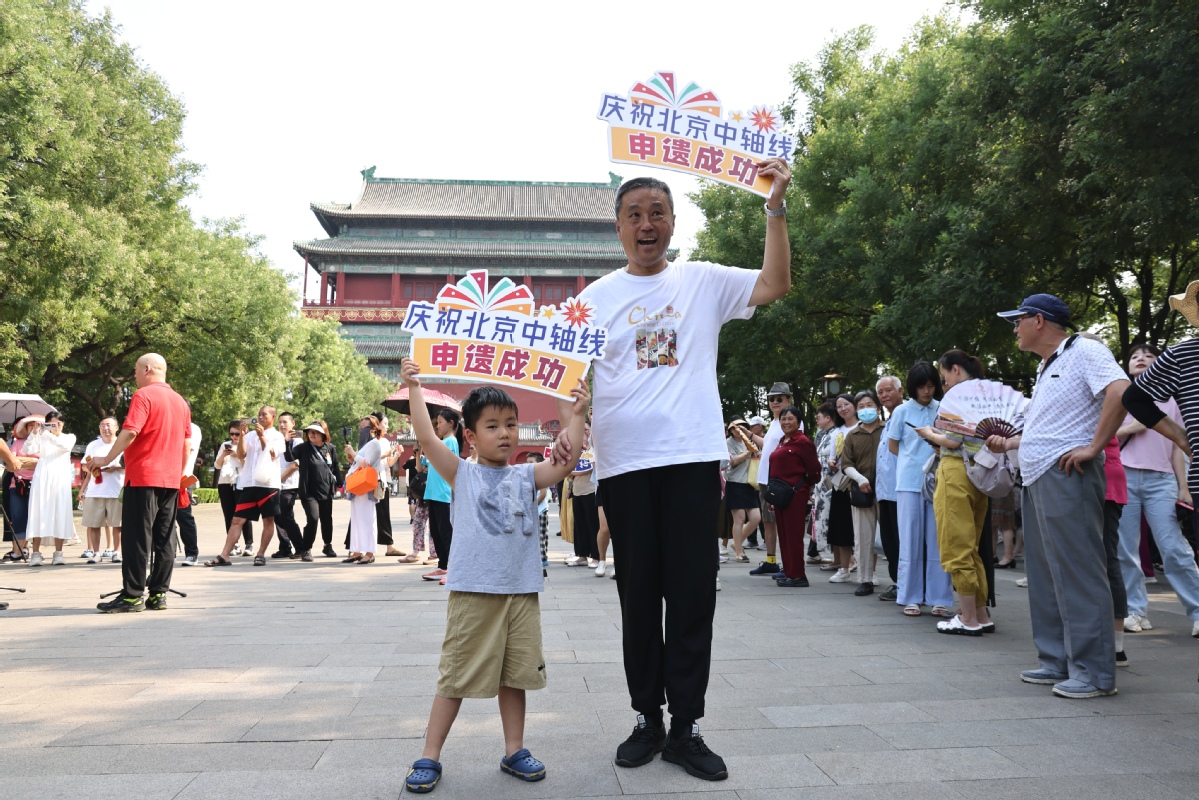
Various activities to celebrate the inscription of the Central Axis on the UNESCO World Heritage List were held across Beijing over the weekend.