


Framing a portrait of innovation










Suzhou exhibition focuses on art during Ming and Qing dynasties, Zhao Xu reports.
"A camera of the Ming (Dynasty of China)" is how Yang Danxia, an expert on ancient Chinese painting from the prestigious Palace Museum in Beijing, describes Zeng Jing, a leading portraitist active in the late 16th century to mid-17th century China.
Of the many works he presumably painted, only around 20 have lasted to date.
One of them, owned by the museum, depicts a man named Wu Yunzhao, a lyricist-poet and member of the literati among whom Zeng had commanded a large following.
Donning a monochromatic robe and a black headscarf befitting a scholar-recluse, Wu was placed amid forested mountains, where he was accompanied by his own read, which he held by hand, as well as two boy attendants rendered skillfully by Zeng.
It's worth noting that the scenery was done by Zeng's contemporary Hu Zongxin, one of the several landscapists Zeng had cooperated with in an effort to bring out the inner tableau of those he portrayed.
"Zeng brought something new into a long tradition of ancient Chinese portraiture, with huge success," Yang says.
That reason alone has guaranteed his position in art history, and his inclusion in an ongoing exhibition focusing on the art form during the country's Ming (1368-1644) and Qing (1644-1911) dynasties between the mid-14th and early 20th century.
"Why Ming and Qing? Because in between those centuries, Chinese portraiture, steeped in the thoughts and aesthetics of Confucianism, underwent big changes, of which Zeng was a key figure," says Yang Zewen, the exhibition's curator.
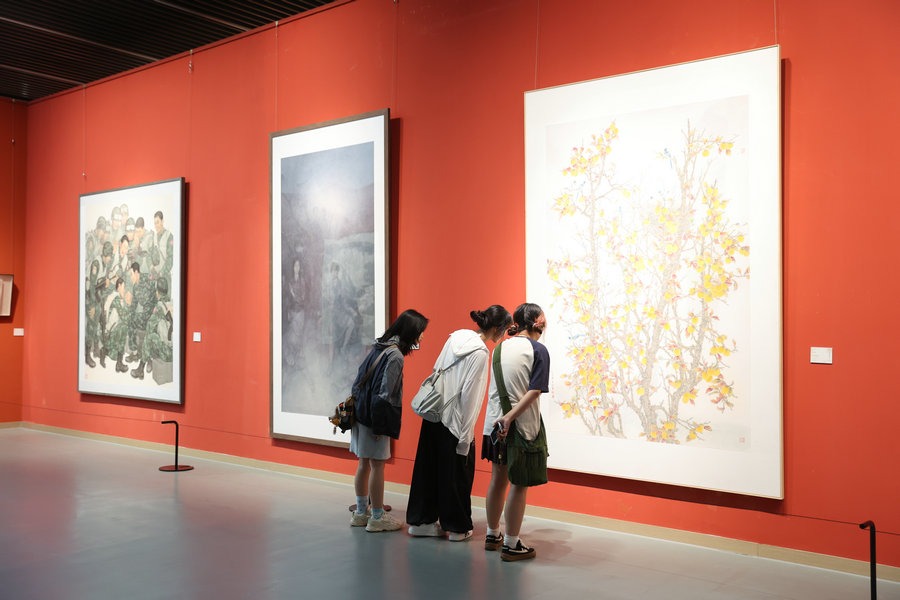
Featuring around 100 pieces of work ranging from ancestral and royal portraits to images of eminent officials and celebrated men of words, the exhibition is held by the Suzhou Museum in Suzhou city, Jiangsu province, whose modern-day capital Nanjing, around 200 kilometers from Suzhou, was where Zeng spent his most productive years.
In 1582, around 18 years after Zeng was born, Matteo Ricci, an Italian Jesuit priest, arrived in Macao, where he studied the Chinese language and customs.
It eventually took him 13 years to arrive in Nanjing, where he stayed for a couple more years before making his way further north to Beijing. There he was given an audience by Emperor Wanli of the Ming Dynasty in 1601.
Among the gifts he presented to the Chinese ruler were three oil portraits. The emperor was believed to have been astounded by how lifelike the images were. In the following two centuries, more Jesuit missionaries followed Ricci's footsteps, among whom were many painter-portraitists with an innate understanding of the power of art.
"Two artistic traditions intersected — one embraced by traditional Chinese portraitists; the other, by Western artists who had previously been trained, among other things, to carve a vivid image with light and shadow, " says Yang Zewen.
Light and shadow — prominent factors in Western painting including portraiture — had largely been ignored by ancient Chinese portraitists "for a deeper, philosophical reason", to quote Yang Danxia from the Palace Museum.
"For them, it was the perceived truth about an individual rather than physical likeness that mattered. So, instead of going after a heightened sense of existence and momentariness often conveyed by the employment of intense light and shadow, they went for something more constant, more indispensable of the man, as seen through their mind's eye," she says.
However, that doesn't mean that the Chinese portraitists who had contact with the missionaries and their art weren't tempted to reflect on their own way of painting. In fact, some of them did, including Zeng, who soon came up with what's known today as the mogu fa, or the technique of structuring with ink.