


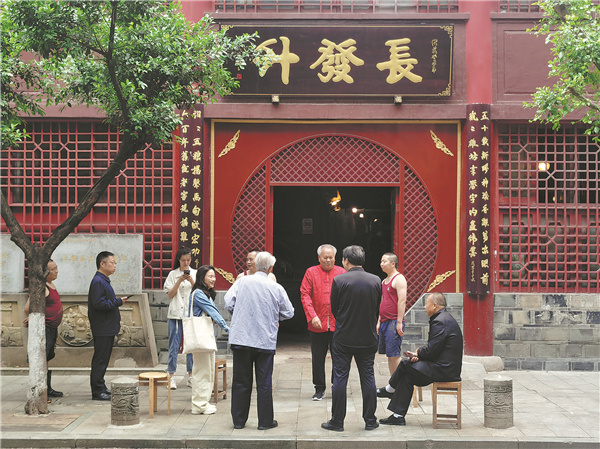
On the 24 window bars of the main hall of Zhang's Ancestral Temple built in 1839 and covering 4,000 square meters, there are 48 carved cranes around which are hollowed-out cloud patterns.
The crane figurines have 48 different postures, either spreading their wings, flying or looking for food.
In addition to ancient architecture, Lizhuang is best known as an academic refuge during the War of Resistance Against Japanese Aggression (1931-45).
After the Lugou Bridge Incident in Beijing on July 7, 1937, Japanese troops started an all-out invasion of China.
To take refuge, people from important Chinese institutions such as the Central Research Institute and preparatory office of the Central Museum in Nanjing, Jiangsu province, which was the seat of the Kuomintang government, and other institutions of higher learning like the National Tongji University — today's Tongji University in Shanghai — stayed in Lizhuang from 1940 to 1946.
After their campus in Shanghai was destroyed by Japanese warplanes, the teachers and students of the National Tongji University passed through nine Chinese provinces and Vietnam, traveling more than 11,000 km before settling down in Lizhuang, which was beyond the range of the Japanese military, in 1940, thanks to the help of Qian Zining, a graduate of the university who was the boss of a papermaking factory in Yibin.
Lizhuang, which covered an area of 1 sq km, had 3,000 inhabitants at the time. To accommodate 12,000 students and scholars, locals provided them with homes and temples as teaching buildings and residences, according to Fan Wangna, a town guide.
As the Japanese army never entered Sichuan, the National Tongji University continued enrolling students in Lizhuang and the institutions that relocated staff were able to continue working.
Adhering to the belief of saving the country with science and serving the country with academics at a time marked by a shortage of materials and the struggle against poverty, scholars never stopped learning or researching.
Forty-three people who worked or studied in Lizhuang in the 1940s later became academicians of the Chinese Academy of Sciences and the Chinese Academy of Engineering, says Li Chun, head of the Lizhuang Ancient Town Administrative Committee.
One of them is Wu Mengchao (1922-2021), who studied at the National Tongji University's medical college.
Known as "the father of hepatobiliary surgery" in China, Wu had saved or extended the lives of more than 14,000 patients before he passed away at the age of 99 in 2021.
In 2011, the International Astronomical Union named a minor planet No 17606, discovered by the Beijing Schmidt CCD Asteroid Program, after Wu, in recognition of his achievements.
Wu revisited Lizhuang three times. A photo of him sitting leisurely in a bamboo chair on Mat Street in Lizhuang in 2012 is kept in a showroom in the National Tongji University's medical college.
In 2016, Wu operated on a patient at the Tongji Lizhuang Hospital to mark its opening, the hospital's first operation, where Wu served as the lifelong honorary president of the hospital set up with assistance from Tongji University in Shanghai.
Bordering Lizhuang is Yibin's Nanxi district. Lizhuang was once under the administration of Nanxi, then a county, until 1983 when it became part of the city of Yibin, says Guo Zhanchun, head of the Nanxi district integrated media center.
What impresses many first-time visitors to Nanxi most is its 1,109-meter-long city wall built between 1457 and 1464 consisting of three city gates, three towers and wharves, the vast expanse of the Yangtze River and the green mountains.
There are more than 30 km of well-paved and well-shaded roads along the Yangtze River for visitors to view the magnificent scene along the banks.
After dinner, many residents flock to the roads to exercise or run, says Chen Yuan, executive director of the publicity department of the Nanxi district committee of the Communist Party of China.
On May 19, over 3,000 people from different areas of China participated in the first leg of the 5th National Harmonious Rural Health Run held in Nanxi.
The run was guided by the Ministry of Agriculture and Rural Affairs, supported by the General Administration of Sport of China and hosted by the China Farmer Physical Culture Association, the Sichuan Provincial Department of Agriculture and Rural Affairs and the Yibin government.
Organizers say one reason why Nanxi has been chosen as the site for the run is that it has a fabulous natural environment.
Wei Peijun, a middle-aged farmer from Puyang, Central China's Henan province, says that he enjoyed his run in Nanxi.
"The bucolic scenery of mountains and the river (Yangtze River) on the way is terrific," he says.








