Bridging the gap between now and then










"For all its reputation as the earliest existing city map known to the world, it also serves as a comforting assurance that what we are seeing today is not so different from what people would have witnessed right here 800 years ago."
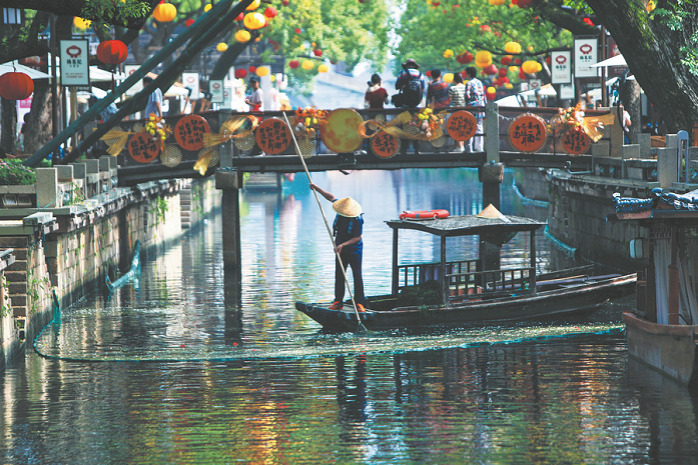
Of the 360 or so bridges the map famously contains, a dozen still straddle the 1.6 kilometer-long Pingjiang River, which is clearly depicted, although not specifically named on the map.
The river, and the Pingjiang Road that runs alongside it, form the core of the Pingjiang Historic District, a 116-hectare zone which is essentially — to use Ruan's words — "an authentic, boiled-down version of what Suzhou has been throughout history".
Among other things, the 78-year-old surveyor-turned-preservationist is referring to what he dubs as "the double-chessboard layout" of the Old Town, which first appeared during the Tang Dynasty around the ninth century.
"Despite the region's abundance of water, all the waterways you see inside the Old Town are artificial passages — canals built as straight as ruler to a chessboard effect, with the ones running north-south intersecting with those running east-west at every junction," he says. "Upon this densely woven water network, a road grid was overlaid, so that the road traffic and the water traffic always move hand in hand."
These days, those taking a boat along the Pingjiang River are still looking up to their pedestrian counterparts strolling alongside them on the stone-paved Pingjiang Road, the latter sandwiched between the waterway and a row of black-tiled, white-painted houses, most of which date back to the late 19th and early 20th centuries.
The best way to get an unobstructed view of the Pingjiang River is to stand on one of its dozen bridges, all of which are short given that the canal's width is no more than five meters. If poems are to be believed, in Tang-Dynasty Suzhou, red-painted wooden bridges contrasted beautifully with the green water running underneath. This was before they were replaced by their stone successors from the Song Dynasty, some of which have survived, at least in part.

One example is the Shou'an Bridge, which, on Pingjiang Tu, appears over the canal under a different name. Certain sections of the bridge are tinted by a slightly purplish hue.
According to Pei Hong, a local cultural official-cum-amateur historian, the color is typical of a native stone material that was widely used for construction during the Song Dynasty.
Between 1034 and 1035, Fan Zhongyan (989-1052), a Song poet and politician, served as the governor of Suzhou, his ancestral home, where his flood-control efforts won wide acclaim. At a time when the only way for a commoner to enter officialdom was through excelling in exams at various levels — the highest of which, dubbed dianshi, or palace exams, were held every two or three years in the capital — Fan launched initiatives to provide free education to poor school-age children.
Those who managed to battle their way to the very top were known as zhuangyuan, and of the 114 zhuangyuan of the Qing Dynasty (1644-1911), 26 were Suzhou natives. In 2014, a museum dedicated to their memory opened in Niujia Lane, one of the small alleyways extending westward from the Pingjiang Road, less than 100 meters from a two-story building where Ruan was born in 1946.
"It's only fitting that this museum is housed inside the onetime residence of a man named Pan Shi'en (1769-1854), who became zhuangyuan at only 25, before going on to serve three emperors as a top cabinet member," says Ruan.
"If the Pingjiang Road is the backbone of the historical district, then the many alleyways that run perpendicularly to it — there are eight to its east and nine to its west, including the Niujia Lane — are where many of the area's stories have been tucked away."
Some of the stories were about silk weavers, who lived in concentrated numbers in the area, "filling it with the rhythmic clacking of their looms", according to a popular saying of the Qing Dynasty.
During his visit to the historical district in July last year, President Xi Jinping talked about "the artisanal spirit of Suzhou" as underpinning the city's lasting prestige.