Experts: US tariffs won't hurt too much
Flay latest move, call it politically motivated with no link to business









The United States' additional tariffs on certain Chinese products are unlikely to have a severe impact on the industries concerned in China, said analysts, noting the US move is motivated not by economic factors but by political purpose, designed to demonstrate a tough stance against China.
On top of existing tariffs under the Section 301 of the US Trade Act of 1974, the US government decided on Tuesday to impose additional tariffs on its imports of Chinese products like electric vehicles, lithium-ion batteries, solar cells, critical minerals, semiconductors, steel, aluminum, port cranes and personal protective equipment.
Starting this year, the US government will increase tariffs on imported Chinese EVs from 25 percent to 100 percent.
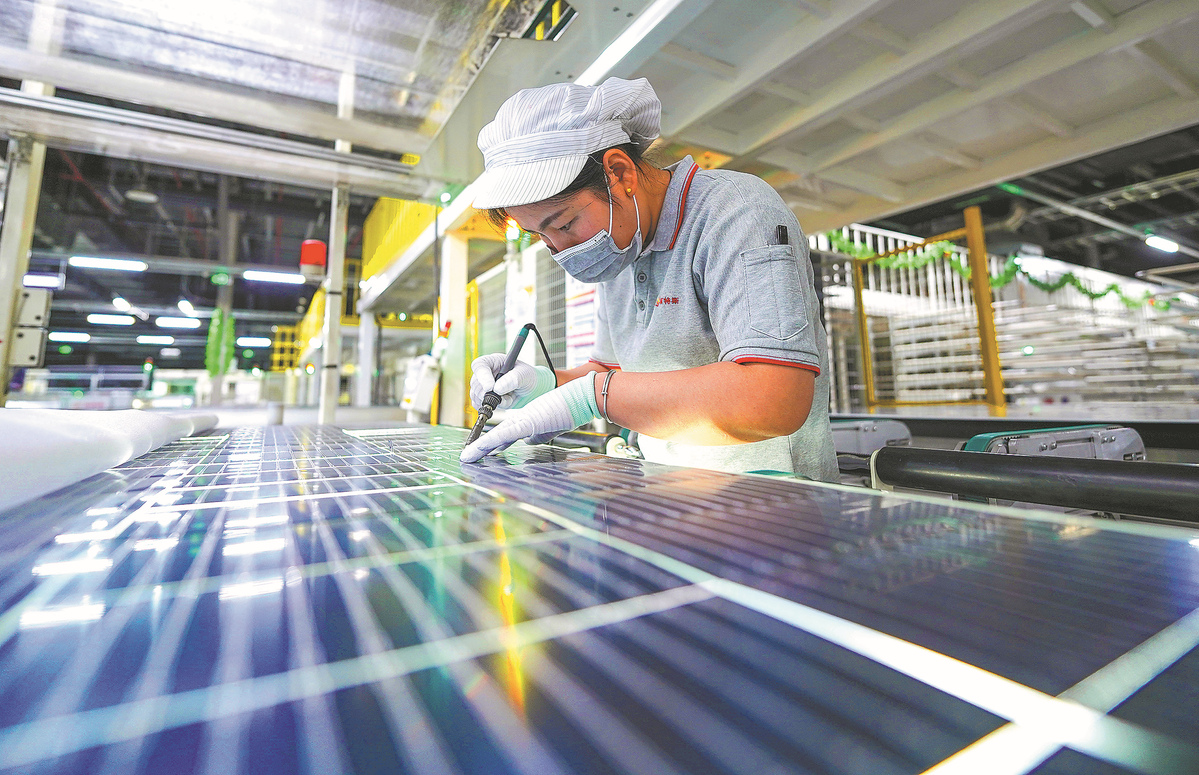
Additionally, the import tax on Chinese solar cells will rise from 25 percent to 50 percent. Tariffs on certain Chinese steel and aluminum imports will also see a significant hike from 7.5 percent to 25 percent.
After China's Ministry of Commerce vowed on Tuesday to take resolute measures to safeguard rights and interests of Chinese companies, market watchers said China has a number of options to respond to this move that might not necessarily target US vehicles but could affect other areas.
Currently, Chinese EVs have a small market share in the US, so the immediate effects of increasing tariffs would be relatively limited, said Dong Chao, head of the institute of circulation and consumption under the Beijing-based Chinese Academy of International Trade and Economic Cooperation.
However, the rationale behind the US approach is that without intervention, the market share of Chinese EVs in the US would inevitably rise. Taking action after becoming dependent on the Chinese supply chain would entail greater costs, said Sun Lei, a senior partner at Beijing Dacheng Law Offices.
The pressure on Chinese companies to invest and build factories in other parts of the world will increase, accelerating their decision-making processes, said Sun.
Because the automotive supply chain is extensive, relocating car assembly lines and production to other countries could affect the entire supply chain, including steel, aluminum, engine technology and lithium batteries, he said.
"Take lithium batteries for another example. Many global EV brands rely on China's supply chain, from Tesla and Toyota to BMW and Mercedes-Benz. With the new US tariffs, the costs for these automakers' EVs are likely to increase, ultimately affecting consumers," said Ding Rijia, a professor specializing in energy economy at the China University of Mining and Technology in Beijing.
Highlighting that China's steel, aluminum and automobiles currently constitute only a small portion of the US supply chain, Ding said that rather than suppressing niche markets, the latest measures by the US government are more about curbing anticipated import growth.
Sharing similar views, Lin Boqiang, head of the China Institute for Studies in Energy Policy at Xiamen University in Fujian province, said that the purpose of the US' additional tariffs on Chinese solar products is still to suppress the industry's development. China's photovoltaic industry has a significant advantage in technology, prices and after-sales service, thanks to years of large-scale development and technological iterations.
"They are worried that China's PV industry will quickly dominate the global market, leaving limited growth space for them," said Lin.
"However, the direct impact of this move on China's PV industry is limited, as exports to the US are not significant. It may have a certain impact on market expectations though."
According to data from the China Photovoltaic Industry Association, solar modules export market had become more diversified last year. However, in the first 10 months of 2023, the top 10 export markets did not include the US, whose market share was lower than that of Germany's 2.6 percent at No 10.
Liu Yiyang, deputy secretary-general of the CPIA, said the US sees about 40 gigawatts of new installations of solar power facilities each year on average, which is less than 10 percent of the global market share.
Moreover, against the backdrop of global energy transition to the green mode, Chinese solar products have a strong price advantage, and global demand is still strong. The country's solar product exports are developing toward a diversified direction, said Liu.
Contact the writers at zhongnan@chinadaily.com.cn