



China and Africa tied together by roots of agriculture









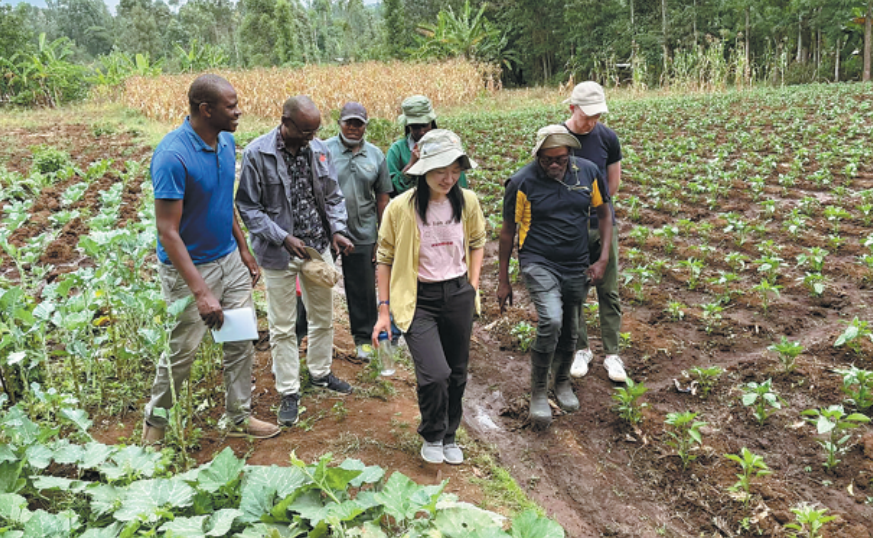
Li Yi and Kiprotich Wesly Cheruiyot share a common quest but are separated by the best part of 9,000 kilometers.
In fact, they don't even know one another. Yet they are the quintessential model of international people-to-people exchanges. The Chinese Li lives in Kenya and is now making social contributions to her adopted country; the Kenyan Kiprotich has lived in China for the past 10 years, getting an education that he hopes soon to turn into a good account in his homeland.
Another thing they have in common is a hands-on passion for agriculture, which would have been scarcely plausible just three years ago when Li appeared to be destined for a stellar career in the commercial world.
In 2021, as she sat in her office not far from downtown Nairobi, she had every reason to feel highly satisfied with her career. Li, 27, from Nantong in Jiangsu province, had spent four years studying at Pomona College in California and had gained a bachelor's degree in economics.
From there, she landed a job with the global consulting company McKinsey and worked in its Los Angeles office for a year before being transferred to Beijing in 2017 and then to Kenya in 2019.
Yet after more than a year in Nairobi, Li felt something was missing.
She had joined a project aimed at helping local small and medium-sized enterprises to survive the economic fallout of COVID-19. At first, she was thrilled to be working on something with a direct social impact, but soon she realized that it seemed to be impossible to transform great ideas on paper into help for those in need.
Real life was passing her by, she felt, so one day she decided to quit her job.
Rather than trying to persuade her to change her mind, the McKinsey partner to whom she announced her decision applauded it and suggested she find work with an agricultural company. In an instant, Li, a management consultant, was transformed into Li, a prospective agricultural worker.
Three years later the decision to head off into new pastures appears to have paid off handsomely, not only for her but also for Kenya.
She is now the chief executive of an agricultural company called Farm-Works which aims to improve the productivity and consistency of local agricultural production and raise the living standards of local farmers.
Kiprotich's interest in agriculture and his hands-on approach to it germinated a little earlier than was the case with Li when he was about 20.
In 2013, when he was a senior college student at Jomo Kenyatta University of Agriculture and Technology in Nairobi, he took part in a training program on ridge-furrow planting technology with plastic film mulching and recycling for local farmers in Kenyan fields under the leadership of a Chinese expert, Professor Xiong Youcai.
He was fascinated by the technology Xiong demonstrated, so after he graduated he applied for a place in a postgraduate program guided by Xiong at Lanzhou University in Gansu province, where he would take a closer look at the technology.
According to statistical data observation of years at multiple points, the ridge-furrow planting technology with plastic film mulching and recycling that Xiong's team developed can increase the average yield of staple crops (corn and wheat) by 70-80 percent and improve the average water use efficiency by 90-100 percent.
Introducing technology
In the past 13 years, Xiong and his team have shuttled back and forth between China and Kenya more than 30 times, introducing this technology to Kenyan farmers.
After studying agriculture in China for a decade Kiprotich's goal is to take this technology back to Kenya.
Kenya, with its vast agricultural potential, struggles with low agricultural productivity, Li says. Most of its agricultural production is conducted by smallholder farmers, making it challenging to achieve economies of scale and mechanization.
Smallholders' yields are only a fraction of what they could be, with productivity hovering at 10-20 percent of those of developed countries, and that presents a significant opportunity for improvement, Li says.
FarmWorks has three core activities: growing, buying and selling vegetables. "At the heart of our operations is a dual focus, namely managing production and sales," Li says. "We're keen to expand our sales network across Kenya. This approach aims to tackle the market access problem that smallholder farmers face, offering them a reliable outlet for their produce."
On the production side, the company owns three farms covering 66.67 hectares, where it has adopted the latest farming practices. The company obtains additional produce from growers elsewhere and turns a profit by distributing its own and others' vegetables to local supermarkets and farmers' markets and exporting high-end vegetables to Europe.
"We're now working with about 5,000 local smallholder farmers, many of whose incomes and yields have risen significantly as a result of working with us."
The income of FarmWorks' external partner growers has risen by as much as a third after just one season, or three to four months, of being involved with her company, Li says.
FarmWorks is helping to change the way smallholder farmers operate in Kenya, Li says, improving their agricultural productivity.
Like Li, Kiprotich is effusive about the benefits his project work offers Kenya. "In the minds of Kenyans, there are two major Chinese projects. One is the Mombasa-Nairobi Railway, the first modern railway constructed in Kenya since its independence, and the other is the ridge-furrow planting technology with plastic film mulching and recycling.
"I want to master this technology and take it back home and drive positive change for Kenya."
Xiong's team has set up eight technology demonstration sites across Kenya, where local agricultural technicians and farmers frequently come to visit. His team has trained more than 1,500 smallholder farmers and 220 agricultural technicians.
Kiprotich, who is doing his postdoctoral research at Lanzhou University, says he wants to further promote the technology in Kenya, which will not only help guarantee the food security of the country but also help empower farmers and improve their livelihood.










