


Exploring the lost land of Loulan










Sands of time
Since its rediscovery over 120 years ago, Loulan has fascinated explorers, archaeologists and historians both inside and outside of China, with excavations and studies shedding more light on the history of Xinjiang.
The latest major outcome is The Report on Archaeological Investigation and Excavation of Loulan, a book published in 2022 by late Chinese archaeologist Hou Can, which provides detailed new information on its location, scale, layout and history.
Given its important location along the Silk Road, Loulan used to be a bustling hub of economic and cultural exchange between the East and the West. Exotic adornments made of seashells and corals were found here, thousands of miles from the nearest seashore.
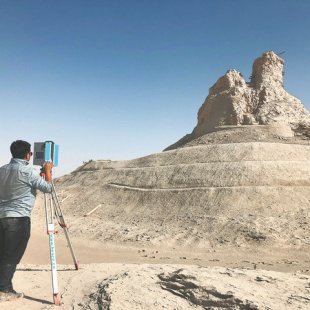
The position and size of the stupa indicate its importance in the city, says Pan Pan, an assistant professor at the School of Sociology and Anthropology at Sun Yatsen University.
"It proves that Buddhism was quite popular back then after it had entered ancient China's western regions."
However, in the eyes of many historical researchers, the most striking feature of this remote local kingdom is its strong bond with the central regions of China.
"From the inscribed wooden slips and paper documents found near the three-room house, we can determine that the city of Loulan used to be the seat of the office of the top official dispatched by the central government to govern the western regions," says Feng Jing, curator of the Loulan Museum.
Exquisite brocades uncovered here showcase the close cultural and emotional attachment between the central and western regions of ancient China. Many of them are embroidered with good wishes in traditional Chinese characters or auspicious creatures like dragons and tigers.
"The embroidered brocades reflect the broad mind of ancient China during the Han Dynasty," says Li Wenying, director of the Xinjiang Institute of Cultural Relics and Archaeology.
"They also convey the beautiful wish for national prosperity. Loulan witnessed and participated in Silk Road exchanges. It is a symbol of Chinese culture shared by all ethnic groups of the Chinese nation."
Cultural conservation
To preserve this outstanding cultural symbol, a broad array of endeavors has been made by authorities and communities at both national and local levels.
The latest major protection and restoration project for the Loulan Ruins was carried out in 2020, during which an expert team worked for about 170 days to repair the stupa and three-room house in defiance of scorching heat and suffocating sandstorms.
In order to better present the hard-to-access site to the public, the Loulan Museum, the only Loulan-related museum in the world, was built in Ruoqiang and officially opened in 2011.
Greeting visitors at the entrance to the ancient Loulan-style structure is a relief of the Beauty of Loulan, a 3,800-year-old mummy that was found in 1980.
There are 5,717 cultural relics in the museum's collection, including mummies, woodenware, bronze items, pottery, embroidery and documents, of which six are classified as first-class cultural relics, says Feng.
In a corner inside the museum, a variety of products with distinctive Loulan features are on sale, such as bookmarks, flash drives, pillows, cushions, water cups and handbags.
"The brocade fragments uncovered in Loulan are the source of our inspiration," says Sun Hu, owner of the booth. "Tourists like our products very much."
To the north of the museum lies a Loulan-themed cultural park, where a host of embossed walls, inscribed columns, sculptures and pavilions display various aspects of the rich Loulan culture. It has become a must-go destination for visitors to the county.
In addition, Feng says that with government support, the museum regularly organizes training courses, outreach programs, cultural symposiums and other activities to further encourage exchanges and studies and enable more people to know about the real history of this mysterious site.
"The Loulan Ruins offer an important window for the world to understand China," says Meng Xianshi, a professor of history at Renmin University of China and longtime Loulan researcher.
With studies gaining more attention and going deeper, the cultural and historical value of ancient Loulan will be further decoded and better understood, he adds.
Xinhua