


A deeper purpose
Questions remain about what the pits uncovered at Sanxingdui were for, and while theories abound, one suggests evidence of a major spiritual reform, Zhao Xu reports.










"But of course, other incidents — natural disasters for example — may have occurred that resulted in a serious loss of faith among the Shu people in their original beliefs."
With that being said, the relationship between Shu and Zhou had proved to be one of love-hate. Oracle bones dated to the Zhou Dynasty have been found that referred to "military campaigns against Shu".
What happened in reality was extremely complicated, but one thing is for sure: By the end of the Sanxingdui culture in the 11th century BC, the influence of the Zhou Dynasty was already felt on the Chengdu Plain. At the Jinsha site, archaeological remains of wheat, grown by the people of Zhou in northern China, have been found.
After Jinsha, which lasted between 1100 BC and 600 BC, the ancient kingdom of Shu largely ceased to exist as one single political entity, according to Hu. It was ruled instead by a number of competing forces, a situation mirrored by what was happening in the realm of Zhou, where various vassal states fought with one another for military supremacy and territorial expansion.
One of them was the state of Qin, which in 316 BC conquered Shu, 95 years before it united China for the first time in history, in 221 BC.
Then what about the elephant tusks?
"Back then, elephants were probably native to the land of Sanxingdui. And elephant tusks, not unlike gold, were much-treasured resources that had not only embellished the life of locals, but also occupied a place of prominence in their culture and spirituality. They might have also been traded between Sanxingdui and other cultures," says Cao Dazhi, associate professor from Peking University's School of Archaeology and Museology.
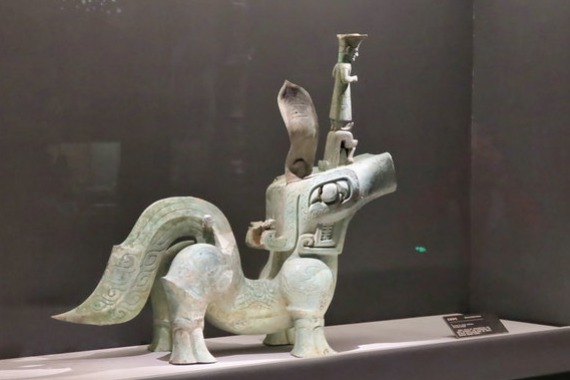
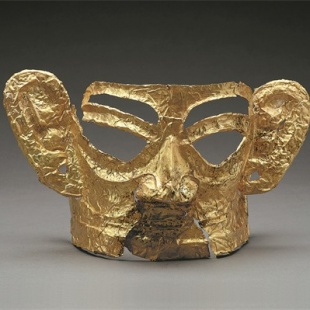
Hu has his own theory. "In a form of sorcery popular in ancient China, a thing believed to have dominant strength was placed right on the top of something else representing a force one intended to subdue. In my opinion, that's what the tusks were there for: to prevail against whatever power and spirit embodied by the ritual bronzes and jades, and to make sure that they lay there underground without stirring," he says. "Or, perhaps, until the world was ready to hear their stories."