


British musician takes Chinese music to heart









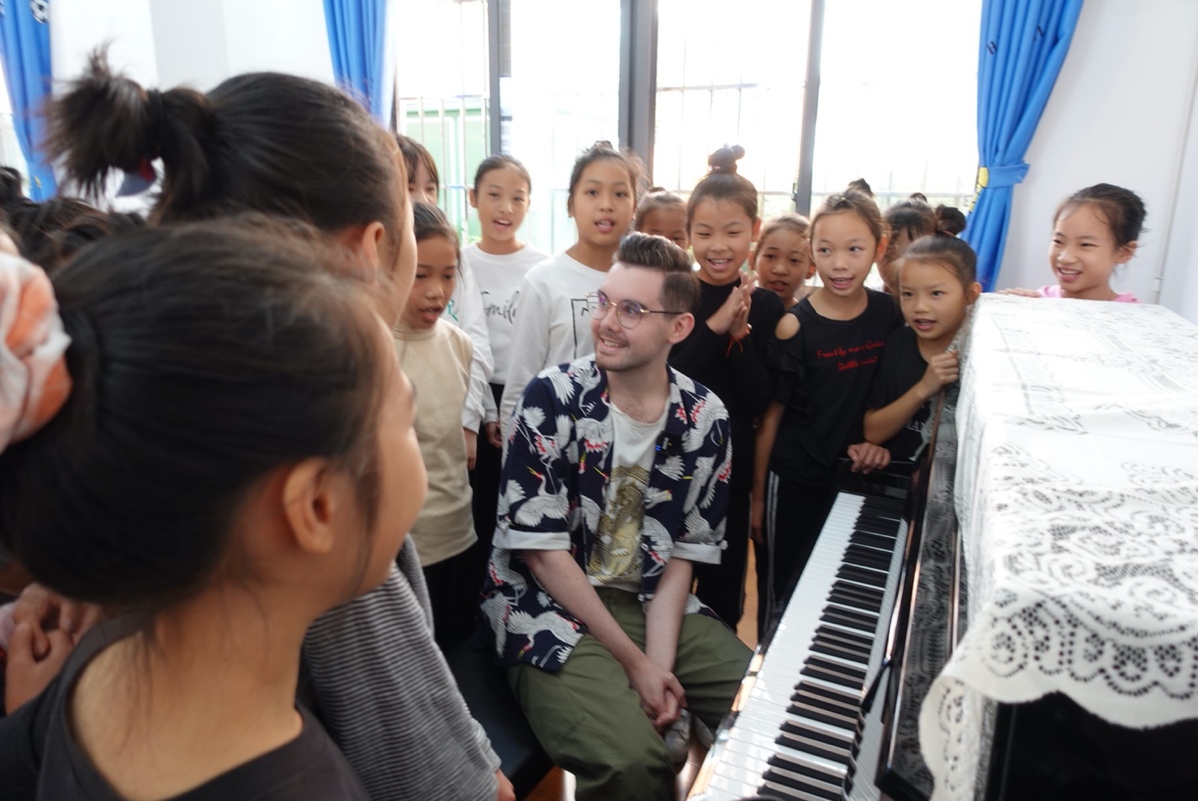
Shaun Gibson's access to Chinese music began in the karaoke bars of Liverpool, England.
When he was a student studying music at the University of Liverpool, his Chinese friends pulled him to such bars, where he became fascinated by the hit Chinese pop songs of the day.
But as a British songwriter who has been constantly exploring the combination of Chinese traditional instruments and Western pop rhythms, Gibson's interest in the ancient sounds that also come out of China was sparked during his first trip to China in 2014, when he heard a busker playing pipa (a four-stringed Chinese lute) in Chengdu, Southwest China's Sichuan province.
"I thought pipa would be more like a cultural relic, not really relevant in modern society," he says. "But when I saw that lady performing in the shopping center, just like a busker would play the guitar in the streets of Liverpool, I realized that pipa is also part of modern Chinese culture. And I could, maybe, have the opportunity to work with this amazing-sounding instrument and put it into my own music. All of that started my journey to where I am today."
Gibson is now a music influencer, with more than two million followers worldwide, and has been invited occasionally to compose Chinese-style songs.
Fusion music sounds like a cliche nowadays because it is frequently mentioned, but he says it is not easy to achieve a smooth mix between two distinct and different sounds.
And when asked how he chooses the appropriate traditional Chinese instruments for a piece, Gibson says: "It just happened very naturally for me."
For example, in a song named China Blue, which evokes imagery from Jingdezhen city in East China's Jiangxi province, Gibson integrates dizi (Chinese flute), pipa, and yangqin (a Chinese hammered dulcimer) into the main tune, to paint a picture of the misty place where water frequently trickles down the lanes from the mountains so often topped with an emerald haze.
As dizi, pipa, and yangqin can all have lyrical tones, Gibson says the instruments do a good job of capturing the essence of Chinese water towns.
"How I chose the instruments is purely based on what the song needs," he says. "If I am going to write a song about Jingdezhen, I won't use big drums or the sounds of Peking Opera because it is not appropriate. Different instruments are like an artist's palette. If you are trying to paint, you need certain kinds of colors to create the pictures that I'm imagining in my mind. So, it's my instinct as a musician (that dictates which instrument to use)."
And the development of that instinct came from years of accumulated experiences.
Although he has never formally studied Chinese traditional music, he has constantly gathered knowledge during his travels throughout the land.
"For example, when I was in Xichang (a city in Sichuan), I came across a busker, literally singing one of the most beautiful songs I've ever heard. Although I totally don't understand the local dialect, it just touched me, touched my soul.
"Now, I am curious. I am going to start doing research, find out who are the singers, and how I can create something new from that."
And, just as in the case of the pipa, he heard all those years ago, the busker and all the other timeless sounds of China have connected with his soul.
Gibson says it is his wish to bring that sort of emotional connection to people in the West, through his compositions, bridging gaps between civilizations in an ever-turbulent world.
"Music has the beauty of being an international language," he says. "It transcends borders. It's an expression of life in its purest form, encompassing stories of love, loss, excitement, discovery, and adventure. You can experience all of these things anywhere you live, anywhere you're from.
"If I am inspired by Chinese culture, then other people might also be inspired as well. I really hope that Western people can discover Chinese culture through my works. And I think this kind of exchange is the way by which we can move into the future more peacefully.
"We need to promote understanding between each other … There are a lot more similarities between people than there are differences, and our differences are also things to be celebrated, not things to be feared."