Plateau species protected
Tibetan antelopes are a unique species related to goats and sheep that are found exclusively on the Qinghai-Tibet Plateau.The efforts of conservationists have helped unravel some of the mysteries of the antelopes and shelter them from threats. Yan Dongjie reports.









Editor's Note: As protection of the planet's flora, fauna and resources becomes increasingly important, China Daily is publishing a series of stories to illustrate the country's commitment to safeguarding the natural world.
Wu Xiaomin is the first scientist in China to conduct scientific investigations into the summer birthing grounds of Tibetan antelopes. Over the past decade, he has traveled to the Qinghai-Tibet Plateau many times, gradually unraveling the mystery of Tibetan antelope migration.
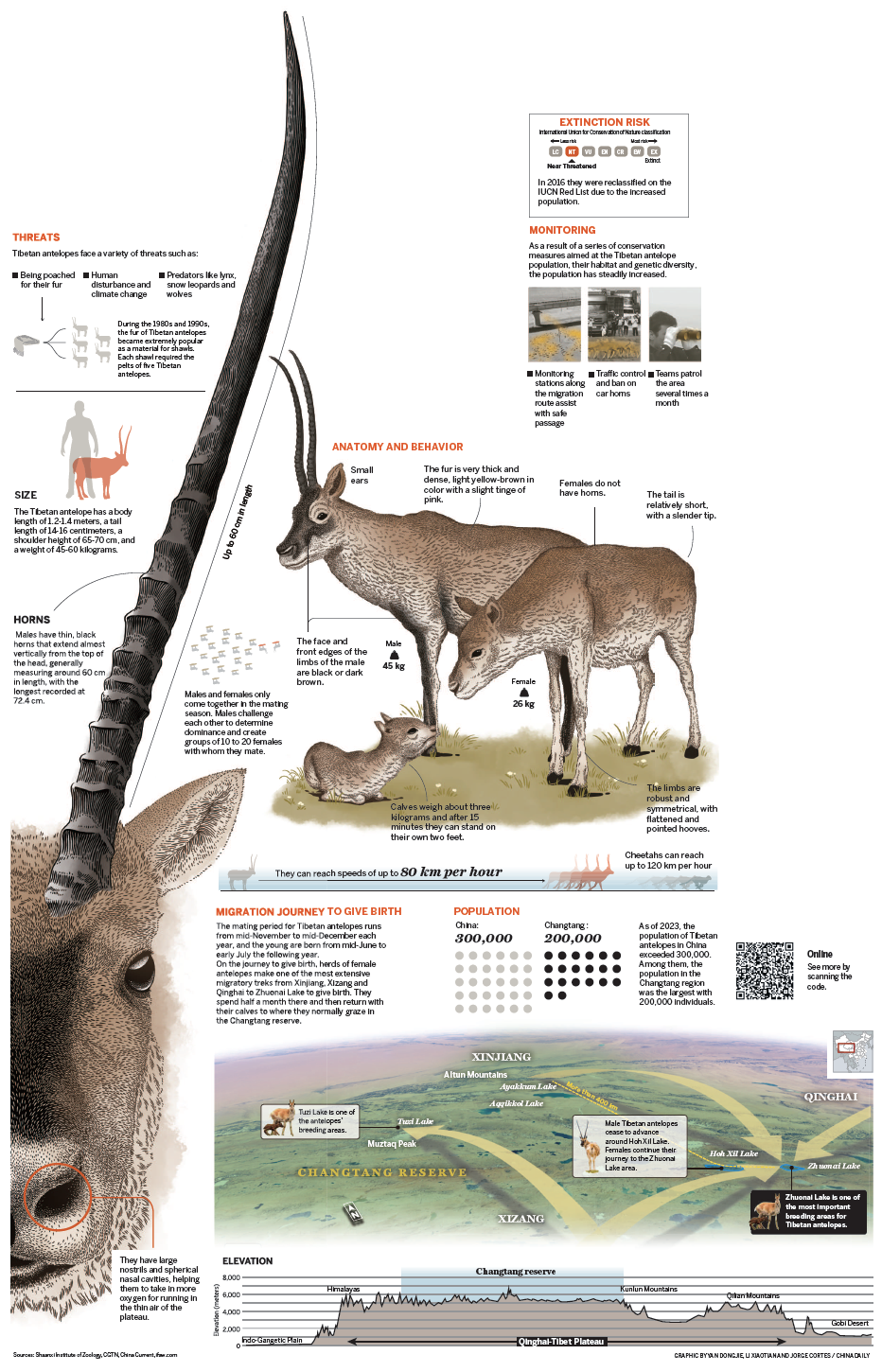
The Tibetan antelope is listed as a first-class protected wild animal in China and was classified as near threatened in the IUCN Red List of Endangered Species in 2016.
Excessive hunting, human activities and habitat changes have posed threats to the birthing and migration of Tibetan antelopes, which led to a rapid decline in their population. However, over the past few years, the situation has been changing.
Wu, now a senior expert at the Shaanxi Institute of Zoology of Shaanxi province, explained that as a result of a series of conservation measures implemented for Tibetan antelope habitats, their population has steadily increased. As of last year, the population of Tibetan antelopes in China exceeded 300,000, with the largest population found in the Changtang area, reaching 200,000.
On the Qinghai-Tibet Plateau, the area where Tibetan antelopes live spans 1,600 kilometers from east to west, and seasonal migration is an important reproductive characteristic. The migration of Tibetan antelopes is one of the world's most spectacular migrations among hoofed animals.
The environment in the uninhabited areas of the Qinghai-Tibet Plateau, which has an average altitude of 4,500 meters above sea level, is complex and hard to access for humans, making the migration patterns of Tibetan antelopes a long-standing mystery in zoological research.
In 2003, Wu's team conducted scientific investigations into the unique wildlife on the Qinghai-Tibet Plateau, especially monitoring the activity patterns of wildlife during the construction of the Qinghai-Xizang Railway. This is when Tibetan antelopes entered the field of vision of Wu's team.
Over the past 20 years, Wu and his team have gained a clearer understanding of the migration routes of Tibetan antelopes by using traditional tracking and monitoring methods, as well as the latest technological means, including satellite navigation and intelligent camera systems.
"These new technologies, combined with the infrared cameras we have been deploying for the past 10 years, have enabled us to build an integrated monitoring system covering the activity of wildlife," Wu said. In the future, this monitoring data can be directly uploaded to the cloud, allowing researchers to remotely share on-site data.
Observations indicate that female Tibetan antelopes exhibit seasonal reproductive migration behavior. The mating period for Tibetan antelopes occurs from mid-November to mid-December, and the young are born from mid-June to early July the following year. For example, in the Changtang region, female Tibetan antelopes gradually gather and migrate to the summer birthing areas in June each year. After giving birth, female Tibetan antelopes return in early July and then go back to their wintering habitats in August.
Tibetan antelopes in the Changtang region mostly gather at the foot of the Kunlun Mountains, and some even cross the Kunlun Mountains to give birth in the Altun Mountains in Xinjiang. Those in the eastern region migrate northward toward Hoh Xil, while those in the southern region migrate short distances to secluded river valleys to wait for birthing.
"Tibetan antelopes need to spend three-quarters of the year in their wintering areas, which are mostly grasslands or river and lake beaches that are close to water sources," Wu said.
"Tibetan antelope calves start migrating with their mothers from birth, and only about 30 percent of those that survive have the best genes, allowing this population to persist in the unique and harsh natural conditions of the Qinghai-Tibet Plateau. I have always believed that there is no end to the study of them," he said.






- Intl students showcasing global business acumen in Shanghai
- CPC expels former senior official of Guangxi
- Shanghai university unveils sustainable, efficient water treatment system
- Fire at auto business park in Jiangsu claims one life
- Magnitude 6.0 earthquake strikes Akqi county in Xinjiang
- Shenzhou XXI team to carry out first spacewalk