



Globalization of science interrupted









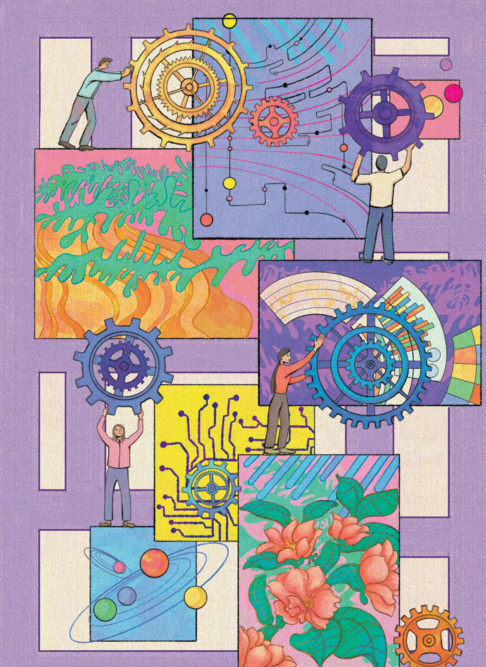
Humanity faces common challenges such as climate change, digital divide and poverty, which are in desperate need of global cooperation and solutions inspired by technological advancements
As a nation's capacity of technological innovation is increasingly getting linked with its national strength, wealth and security, technology has turned into a focal point of major country competition, and the politicization of technological issues has emerged as a prominent problem. Geopolitical competition is exerting an ever larger impact on technological innovation. As a consequence, the global technology landscape is becoming more and more divided.
On the one hand, some major countries view technological innovation as a core capacity crucial for national security. They have thus scaled up efforts to develop key high-tech industries including artificial intelligence, new energy vehicle batteries, semiconductors, microelectronics and quantum information by rolling out incentive policies to lure tech industries back home and encouraging investment in research and development while restricting exports of cutting-edge technologies.
In the frontier fields such as cyberspace and aerospace, several major countries have strengthened strategic planning, issued policy guidelines and enhanced infrastructure building. Take the case of the semiconductor industry as an example. The United States, the European Union, the United Kingdom and Japan have unveiled road maps to guide the development of this industry.
In February, the White House Office of Science and Technology Policy issued an updated list of critical and emerging technologies — covering areas such as AI, energy and semiconductors — that are potentially significant to the US' national security. The list will be used to inform the US and its allies and partners to advance technology cooperation and devise technology development strategies.
On the other hand, the global technology landscape risks getting divided — in some areas, division and fragmentation have already occurred. The US is attempting to link its technology policies with ideology in order to create an exclusive economic circle with its allies. The country's tech war against China has not de-escalated since 2023 though the narrative has changed from "decoupling" to "de-risking", a term coined by European Commission President Ursula von der Leyen in March 2023, which quickly gained traction in the US. In May, "de-risking" was included in the communique issued after the G7 Hiroshima Summit, signifying that it has become an official economic policy of the G7 member states toward China.
While European countries' primary goal is to enhance their capacity to withstand risks and economic pressure, the US is attempting to isolate and contain China economically and technologically by cutting China off from cutting-edge technologies in the name of "de-risking".This is far beyond the normal scope of competition between nations. In essence, it is intended to preserve the US' dominance in technology by dividing the global technology system and intensifying protectionism, which run against the interests of a majority of countries in the world. Since 2023, the US has not relented on imposing sanctions against Chinese internet and telecommunications companies, and, in the semiconductor industry it has joined hands with its allies to exert investment and export controls targeting China.
In January, the US, Japan and the Netherlands reached a deal on restricting exports of advanced chip-making machinery to China; in February, the US Department of Justice and the Department of Commerce launched the Disruptive Technology Strike Force to tighten the enforcement of export controls; in March, the US issued the "guardrails" provision in the CHIPs and Science Act, which prohibits the recipients of CHIPS incentives funding from investing in semiconductor manufacturing in China for 10 years; in August, US President Joe Biden signed the Outbound Investment Executive Order, which bans US enterprises and citizens from investing in cutting-edge technologies such as semiconductors in China.
Following the US' steps, Japan and the Netherlands have tightened curbs on China's access to advanced technologies in a bid to reshape the global technology and industrial chains landscape, exacerbating the division of the global technology landscape.
The governance and regulation of emerging technologies are also an arena of competition among major countries. The US and European countries have deepened cooperation in creating a unified front and a "small circle "to promote their standards and rules in the governance and regulation of the AI industry and take the lead in the area.
In the field of AI regulation, the EU has launched a debate over its ethics, and pushed for the legislation of governing the utilization of AI. The bloc has also expanded cooperation with other countries. After passing a draft act on AI regulation in June, EU officials held negotiations with Japan, the Republic of Korea, Singapore, India and the Philippines over the issue, seeking to promote the AI Act across the world. On Dec 8, EU lawmakers and member states reached a political agreement on the key provisions of the AI Act, making it the first-ever comprehensive legal framework on AI worldwide.
As technology increasingly becomes a key strategic foundation for a country's economic and military strength, and determines the well-being of its people in an unprecedented way, it is also getting more and more closely intertwined with national security. The COVID-19 pandemic and the Ukraine crisis have intensified the trend of politicizing technological issues.
Currently, humanity faces common challenges such as climate change, the digital divide and poverty, which are in desperate need of global cooperation and solutions inspired by technology advancements. To this end, certain countries should shun the mentality of zero-sum confrontation, and actively participate in global technology cooperation.
That being said, some countries should abandon their confrontational mindset of the global science and technology system, actively participate in and promote the globalization of science and technology, and improve their level of openness. On the one hand, China has been enhancing its capacity for scientific and technological innovation, and on the other hand, it has actively shared knowledge and technology through global development initiatives, injecting impetus into global scientific and technological exchanges.
Cai Cuihong is a professor at the Center for American Studies at Fudan University. Zhang Ruoyang is a doctoral student at the School of International Relations and Public Affairs at Fudan University. The authors contributed this article to China Watch, a think tank powered by China Daily. The views do not necessarily reflect those of China Daily.
Contact the editor at editor@chinawatch.cn.





