Exploring diversity in STEM









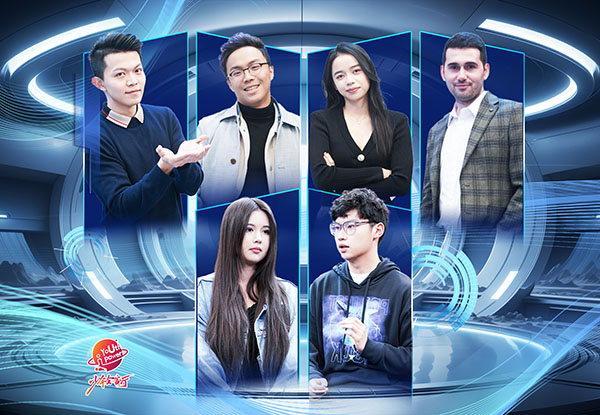
Youth Power episode features five STEM majors sharing insights on gender bias, debunking myths, and the intersection of science, technology, and art.
In the latest episode of China Daily's Youth Power, which aired on Feb 29, five students from different countries, majoring in science, technology, engineering, and mathematics, or STEM, came together to share their stories and delve into what their majors signify both to them and to the world.
The evolution of AI-generated content, revelations surrounding the reportedly newly found superconductor LK-99, and various recent technological advancements have drawn more attention than ever to STEM fields.
Among the participants was Nikita Li Van Heerden, a 21-year-old information management major from South Africa and the United States. She stumbled upon her passion for computer science during her senior year in high school. For her graduation project, she designed an online computer system for managing volunteering and donations, an endeavor that significantly influenced her decision to pursue this major.
Similarly, Li Zitong, 20, delved into the field of material science and engineering driven by his profound fascination with physics.
Addressing a common misconception that STEM students have no leisure time, Li admitted that while his passion for science demands a substantial investment of his time, he still manages to indulge in hobbies such as table tennis, soccer, video games, and swimming.
"But I think scientific research does deserve the time," he said. "No one is a born genius. You must experience trial and error before getting the result you want."
Echoing Li's sentiment, Ooi Hon Son, or Harold, a 30-year-old Malaysian studying mechanical engineering with a focus on bio-manufacturing and regenerative medicine, said: "Science is about chasing the unknown. Science is about the process of that chase, of finding out new things, and of creating new things."
Harold recounted his first project, a painful yet fulfilling endeavor to 3D-print a human heart, which took him and his teammates almost a whole year.
"We printed it, failed, printed it again, failed again, and the deadline was approaching in two or three weeks," he said. "One night, at exactly 3 am, I was desperately trying it, and then I saw it started beating. That was the 'eureka' moment."
Another prevailing myth suggests that there are more males than females in STEM majors. Mustafa Umut Ozbek, a 25-year-old student from Turkiye pursuing a master's degree in nuclear engineering and management, admitted that it's not a myth but a reality — one that needs to be overturned.
According to him, only 20 to 25 percent of his classmates are women. But he believes that their meticulous attention to detail is a quality that's crucial in fields like his. He also stressed the contributions of female STEM students globally, advocating for the encouragement of more women to pursue STEM education.
While agreeing with Mustafa's perspective, Harold brought up an underlying query that goes beyond gender disparity — the entry point for fostering interest in STEM — and said that it's important to address the issue at its root.
"Are we necessarily bringing in people because they are interested or because they have nowhere else to go and that's the only scholarship they got?" he said. "Policy questions don't address cultural questions."
He illustrated his point by suggesting that when children reach the age of 5, parents should pose questions like, "Would you like to learn how to build or design a car or a truck" rather than imposing gender stereotypes such as, "Don't play that; that's for boys. Don't become an engineer because you're not supposed to be one".
"We should be telling parents, your daughter can also be a great scientist, or can be a great engineer," he said.
Another enduring misconception is the belief that STEM majors inherently possess greater intelligence than those pursuing arts and humanities.
"Everyone has different kinds of interests and they develop their skills regarding these interests. Maybe some of us are better at math, and others are better at physics. It doesn't mean that he's smarter or she's smarter," said Mustafa.
The young guests also highlight the practical applications of their studies, particularly in fields like mathematics. For Mustafa, studying math has equipped him with problem-solving skills vital in both life and research contexts. Li also stressed the importance of math. "Material science and engineering is a highly comprehensive subject. You need knowledge from math, solid physics, quantum mechanics, and chemistry to solve one problem," he said. "Math is the foundation of all those subjects. Only after you study math, can you study other subjects."
As science and technology develop rapidly, discussions and debates emerge regarding their impact on equality.
Aime Lu Fan Chen, a 25-year-old student from Canada studying AIGC and digital art, believes that technologies like AI tools can enhance equality in education. "Basically, we can learn 80 percent of knowledge in this world through a conversation with AI, which brings more opportunities to people who are not able to pay the tuition to get proper education."
However, Nikita argued that technological progress may lead to an increase in inequality. She mentioned that in South Africa, most of its population lives in poverty and lacks access to technology or the privilege to go to school and use computers.
Another heated debate surrounding technological advancement is whether it will replace humanities and arts.
Li took the position that humanities and arts play an irreplaceable role in nurturing aesthetic sensibilities and enriching people's lives, including those pursuing STEM fields.
Nikita agreed. "AI can regenerate sounds and play music. But they are merely recreating something that was already created, something that was drawn or played by other musicians or artists. Our human mind is much more creative," she said.
Harold acknowledged the value of both realms. "Science improves the world, but art improves our soul," he said.