Lore of the rings










Within the vast area of what was to become China, the gradual adoption of the string-sawing technique followed — quite naturally — a similar north-to-south direction as the spread of jade culture.
About 1,200 kilometers to the southwest of Xiaonanshan lies another important Neolithic site known as Xinglongwa. The Xinglongwa culture, believed to have prospered between 6200 and 5400 BC, is noted for its pottery and jade creations. In fact, some scholars consider it to represent the beginning of nephrite jade's preeminence in East Asia, pointing to what they call a "regional standardization" that dictated both the selection and production of its jadeware. A yellow-green nephrite was favored above all else, and the use of the string saw became de rigueur.
"In Xinglongwa societies, nephrite jades were rare, exquisite and enduring objects, which are qualities within the modern definition of precious stones," goes a line from a co-authored chapter that forms part of The Oxford Handbook of Early China, published by the Oxford University Press.
And for exactly that reason, jades were associated with special members of the Xinglongwa settlements, which were "exceptionally large for their time period" to quote from the same chapter. "Those who were buried with jades often had other exceptional burial goods, such as animal sacrifices and human skull accessories," it goes.
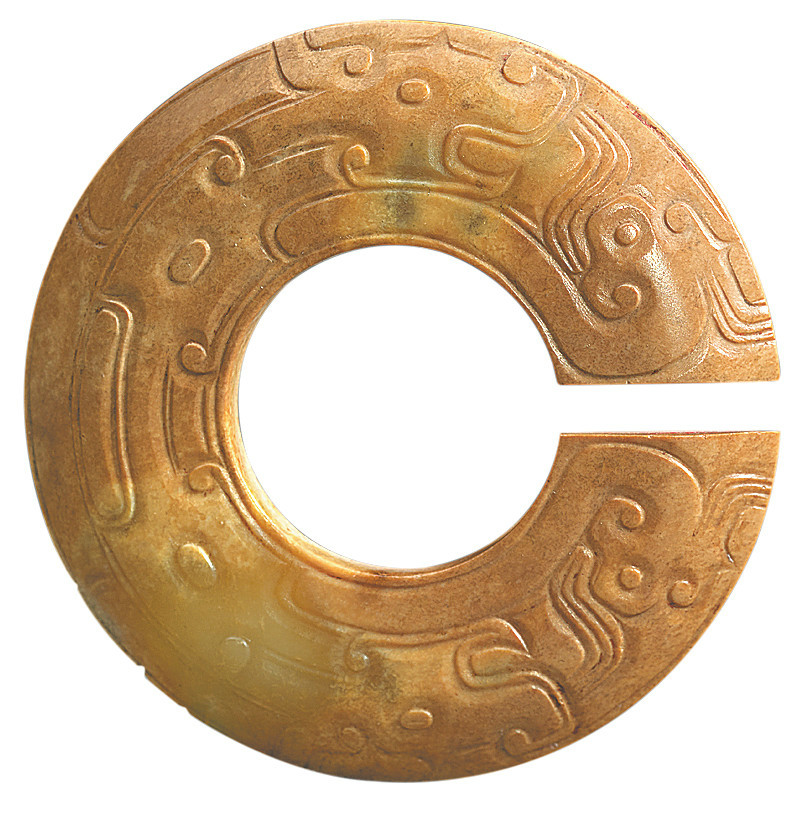
Almost exclusively found within the burials were slit rings, which, judging by their relative position to the human remains, were most likely to have been worn as earrings.
The influence of the culture was felt far and wide. From the fifth millennium BC, Xinglongwa nephrite slit rings, pendants and beads spread into the Amur River region, coastal Far East Russia and the Sea of Japan region. (It's worth noting that the world's earliest nephrite jade usage is believed to have taken place nearly 30,000 years ago, during the Upper Paleolithic period in Russia Siberia, although there's no evidence indicating that this tradition was somehow related to the jade culture of Xiaonanshan.)
Down south, imitations of the Xinglongwa jadeware, realized using other materials, including quartzite, talcum and seashells, were discovered in major Neolithic cultural groups in the Yangtze River Delta region, including Majiabang.
Lasting between 5000 and 3900 BC, the Majiabang culture is of special significance in the sense that it eventually gave rise to the Songze culture (3900-3300 BC), which culminated in the formation of the Liangzhu culture (3300-2300 BC).
"An early regional state" — that's what Liangzhu represented according to the UNESCO World Heritage Convention, which in 2019 put Liangzhu's archaeological ruins on its World Heritage List.