


Carrying a lute of responsibility
Uygur musician promotes the beauty of the region's traditional instruments and music, Chen Nan reports.










Uygur musician promotes the beauty of the region's traditional instruments and music, Chen Nan reports.
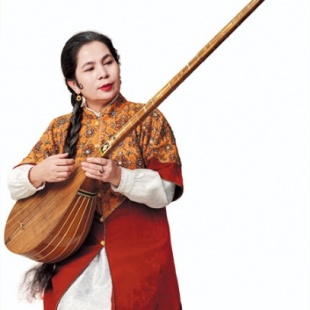
As a child, Sanubar Tursun was intrigued by the sounds of the dutar, a two-stringed lute that is characterized by its long neck and pear-shaped body, which her father loved playing at home.
"The instrument was hanging on the wall at my home and my father often played it for fun. My mother always sang along and we danced together," recalls Sanubar, who was born into a Uygur family in Ili Kazak autonomous prefecture, Xinjiang Uygur autonomous region.
Her father, a musician performing with a local art troupe, was good at playing different folk musical instruments, such as Xinjiang yangqin (hammered dulcimer) and dutar, as well as making instruments. He taught Sanubar and his other children to play dutar.
When her father died, Sanubar, who was 8 years old back then, composed her first song, to commemorate him, on the dutar.
Now, a musician herself, Sanubar has written over 100 songs and released about 10 albums. She travels around the world singing and playing dutar.
On Jan 13 and 14, the 52-year-old musician will give two concerts in Beijing and Shanghai, respectively, performing with her band featuring the traditional stringed musical instruments, dutar, satar and gijak, each with its own unique range.
One of the songs she will perform is White Horse, adapted from an old Xinjiang folk song and recounting a love story.
Another song, named Childhood, written by Sanubar, is about how her father discovered her musical talent and supported her learning to play dutar.
There are also songs she wrote that are adapted from poems by the musician's favorite poet, Rabindranath Tagore from India.
"I get inspired by poems. Poems are as rhythmic as music. So when I read a beautiful poem, I easily connect it with its sounds, which allows me to turn the poem into a song," says Sanubar. "Though I perform in the Uygur language, people can still understand me because the emotions delivered through the songs are shared."
Some songs are selected from the Xinjiang Uygur Muqam, a variety of practices widespread among the Uygur communities, which includes songs, dances, folk and classical music, and is characterized by a diversity of content, choreography, musical styles and instruments. It was inscribed on the Representative List of the Intangible Cultural Heritage of Humanity in 2008 (though it was originally proclaimed in 2005) by UNESCO.
She says that she grew up listening to many songs from Xinjiang Uygur Muqam as her mother loved singing while doing housework and cooking.
Sanubar will also improvise onstage with her band members, showcasing the beauty of their instruments.
According to Sanubar, the sound of dutar is low and deep, serving as a bass in the band. The sound of satar takes people back to ancient times and reminds them of their past, and is often used in playing music pieces from the Twelve Muqam — one of the four main regional styles of Xinjiang Uygur Muqam. Gijak, quite different from dutar and satar, is characterized by its crisp, light sound, serving as the tenor. The three instruments work together like chamber music, forming complementary sounds while keeping their own voices.
Sanubar learned to play dutar and Xinjiang yangqin at Xinjiang Arts University and, after graduation, she joined the Xinjiang Art Theater Muqam Art Troupe. From 2003 to 2005, she came to Beijing's Central Conservatory of Music to study music production. In 2010, at the age of 39, Sanubar quit her job with the Xinjiang art troupe and enrolled in the Shanghai Conservatory of Music, where she spent four years learning to compose and got her Bachelor's degree.
"I left my hometown to study music in Beijing and Shanghai because I wanted to write more songs, using different techniques," she says. "It has enabled me to work more effectively with my band members and better express myself through my own compositions."
During her study in Shanghai, she met Wu Man, an internationally celebrated pipa (a four-stringed Chinese lute) player, who invited her to record songs together and perform worldwide. Sanubar's stirring vocals and her instrumental performances were featured on Wu's 2012 album Borderlands, showcasing the rich and diverse musical heritage of Xinjiang to listeners outside the region.
In 2018, when sound artist Li Xingyu traveled around Xinjiang recording the album The Farthest Place From the Sea, Sanubar was also invited to record a song. She improvised a song about a mother and daughter, as well as playing dutar.
"In a yard, Sanubar and other folk musicians sang and danced with smiling faces. They were as happy as children," recalls Li. "She also read us the poems she wrote. Her voice was soft and warm."
Now, Sanubar teaches dutar at an art school in the regional capital Urumqi. During the summer, she returns to Ili Kazak autonomous prefecture, where she has a music studio.
"The local government supports my research into the folk music of Xinjiang. The music studio is a base where musicians gather to play their instruments and create music," says Sanubar. "I noticed that many young people in Xinjiang are learning traditional instruments and singing old songs, which makes me very happy."