



Rare tiger hunts down and kills rarer leopard









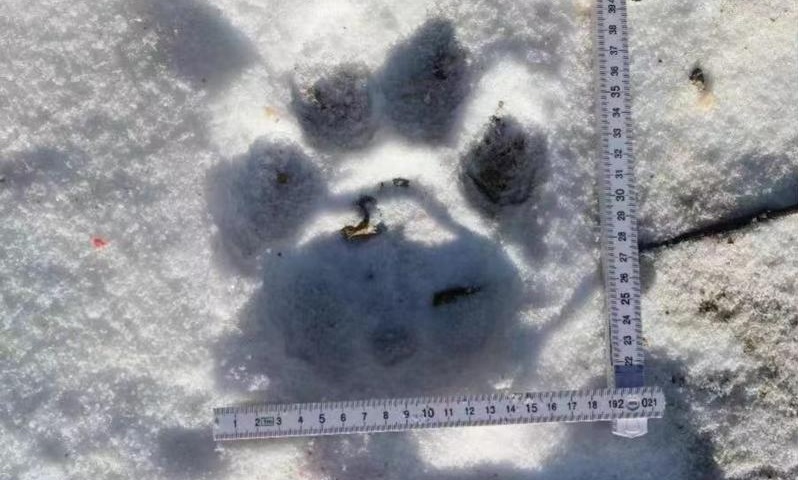
An investigation team has determined that an Amur leopard whose remains were recently found in the Hunchun area of the Northeast China Tiger and Leopard National Park was the victim of a Siberian tiger in a rare case of one big cat hunting another.
The Siberian tiger is the largest cat species in the world and a first-class protected animal in China.
The global population is estimated to be only around 600 individuals, and it is listed as an endangered species by the International Union for Conservation of Nature.
The Amur leopard is also a first-class protected animal in China and is listed as critically endangered by the IUCN, with a population of only about 30 at the beginning of this century.
The investigation team comprised staff members from the National Park Administration and the National Forestry and Grassland Administration's Northeast China Tiger and Leopard Monitoring and Research Center, and police from the city of Hunchun in Jilin province.
Since the establishment of the Northeast China Tiger and Leopard National Park pilot project on the border of Jilin and Heilongjiang provinces in 2017, conservation policies have restored the big cats' habitat, with tiger and leopard populations steadily increasing.
The area's initial recorded population of 27 tigers and 42 leopards has now risen to over 50 tigers and 60 leopards, said Feng Limin, deputy director of the research center.
"This is the first time an incident of a Siberian tiger preying on an Amur leopard has been found in China, which indicates that the population of the tigers and leopards has been rapidly increasing in recent years," he said.
He added that both the Siberian tiger and the Amur leopard are fierce carnivores, but their prey differs. The Siberian tiger mainly preys on large and medium-sized animals, while the Amur leopard mainly preys on small and medium-sized animals.
Adult male Siberian tigers can weigh over 200 kilograms, while male Amur leopards weigh only 50 to 80 kg, with the huge difference in weight and strength making the Amur leopard potential prey for the Siberian tiger.
"However, through a long process of natural evolution, the Amur leopard has learned survival skills within the territory of the Siberian tiger, enabling coexistence," Feng said. "For example, their activity times do not overlap, and their activity areas do not intersect. The Siberian tiger mainly operates at lower altitudes, while the Amur leopard mainly operates at higher altitudes."
The investigation team found that the remains of the Amur leopard, discovered last week in the snow, exhibited bite marks on the head, abdomen and hindquarters.
Yu Hongxun, deputy director of the national park's Hunchun branch, said that after arriving at the scene, the team followed drag marks and found the paw prints of another species of cat.
"There were obvious signs of a fight about 160 meters south, which should be the first scene of the hunt," Yu said. "The police confirmed that the leopard had been killed and eaten only a few hours earlier, and the body was not yet stiff."
Paw print measurements, analysis of fight marks and predation habits helped the team determine that the Amur leopard was killed by an adult male Siberian tiger. Pattern comparison confirmed that the Amur leopard was a member of the leopard group in the national park.
"This was an approximately 8-year-old male leopard in its prime," Feng said. "After reaching adulthood, it expanded to this area and established its own territory. It belongs to the first batch of 'native residents' in this area and is the third generation of the Amur leopard population returning to China. It has produced multiple litters of cubs."
He said the Amur leopard had been recorded over 800 times by the national park's monitoring system, with the most recent sighting being recorded in September.
"China has been conducting continuous monitoring and research on tigers and leopards throughout the park for more than 18 years," Feng said. "Our investigation team is also conducting on-site hair DNA screening and tiger track analysis to further confirm the identity of the tiger involved."
Chen Yang, deputy director of the Northeast Tiger and Leopard National Park Management Bureau, said: "This incident provides new evidence for further research on the diet and behavior of the tigers and leopards in our country, as well as for the protection and management in the national park.
"After a period of adjustment, the habitat for tigers and leopards will be further expanded, and the population of flagship species will continue to increase."





