



Chinese devotion to shared sustainable future









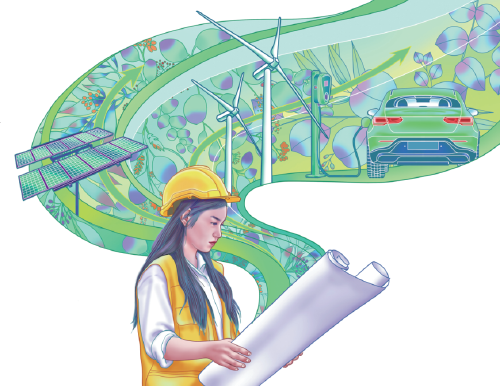
It cannot be emphasized enough that achieving sustainability is an essential but daunting task. Disasters such as forest fires, droughts, floods, sea level rise, biodiversity loss, deforestation, desertification and nuclear radiation among others are a few of the threats we have witnessed or heard of. However, it is too optimistic to think that such disasters befall or affect only the unlucky few.
We may wish that any disruptions caused by such circumstances are temporary, so that we can continue business as usual in our work and life, but there is growing consensus worldwide that we need to act urgently to transition to a sustainable path. This paradigm shift is reflected in China's development strategies, the European Green Deal and initiatives of other economies. Nevertheless, turning the aspirations into reality, a future that is prosperous, equitable and sustainable, requires tremendous effort and innovation from all of society.
Evan Schofer, a sociologist, has emphasized the importance of institutional environments that exhibit the characteristics of structure, penetration and persistence for global conventions or consensuses (for example, regulating greenhouse gases or CFC emissions) to take root at a country level. Structure refers to state organs, regulations and policies, and civil organizations such as professional communities that can uphold the culture and functions of world society. Penetration means the structures and culture mentioned above could directly influence actors at all levels of society, such as individuals, associations and firms. If this influence is persistent over time, it is highly likely to lead to desirable individual and firm behaviors, collective efforts and sustainability outcomes.
The Chinese central government has established a robust policy framework for green transformation. The Decision of the State Council on Implementing Scientific Outlook on Development and Strengthening Environmental Protection was introduced in 2005, elevating the importance of environmental protection. This was followed, two years later, by the publication of China's National Climate Change Program. Since then, environmental protection and climate change have been placed high on the central government's policy agenda.
The 11th Five-Year Plan (2006-10) set national targets to reduce pollution (binding) and energy intensity (non-binding).The 12th Five-Year Plan (2011-15) witnessed the transformation of these targets into binding obligations. During the 13th Five-Year Plan (2016-20), a dual control mechanism was implemented to oversee the total amount and intensity of energy consumption.
These progressive national targets have translated into actionable objectives for economic sectors such as power, iron and steel, cement, transportation, and so on. Furthermore, financial incentive mechanisms such as the national carbon market complement those compulsory measures in building the delicate formal structure of the national environmental governance system.
However, it is challenging for the central environmental authorities to penetrate the various actors in Chinese society. We all know it is difficult to align the interests of the government across different levels, enterprises occupying different nodes along global value chains, and individuals and households with various means and demographic features.
The central environmental protection inspection is unprecedented in Chinese history, as it explicitly imposes the high standards and green objectives of the central government at a local level, backed by enhanced information revelation by the public. Studies found the environmental inspection could reduce the area of land sold by local governments, particularly to industries that harm the environment. This proves that the Chinese government's environmental enforcement is effectively penetrating the local levels, influencing the core economic decisions that shape China's future.
Besides environmental inspection, the National Bureau of Statistics has been exploring alternative approaches to quantify development. By incorporating gross ecosystem product, or GEP — which is the total value of final ecosystem goods and services supplied to human well-being in a given region, like a county, a province, or a country annually — into a nature-social-economic accounting system, the country is paving the way for a scientific and systematic approach to assessing local environmental performance. With the help of the Gaofen, a series of state-of-the-art high-resolution Earth imaging satellites, the GEP could be successfully implemented, allowing for the measurement of both the stock and change of ecological and environmental assets. This innovative approach will play a key role in realizing the vision of ecological civilization across all jurisdictions in China.
The challenge of promoting sustainability is not limited to the government alone. Instead, it is equally cumbersome for the government to regulate non-State actors such as financial institutions, polluting enterprises, carbon emitters and the public to ensure a cleaner, greener and low carbon future. Walter van Hattum, head of Trade and Economic Section of the European Union Office to Hong Kong and Macao, rightly pointed out that in the global turn to sustainable finance, bankers and financial institutions have a critical role to play to mobilize the needed (private) capital toward green investments. Given their important role, he encouraged bankers to go beyond meeting regulatory requirements and to contribute to the greater good of society. The ultimate purpose of corporations is often to stay in business and make a profit. In that case, it becomes essential to educate an environmentally aware citizenry that could supplement the government's efforts at catching non-compliance and detecting greenwashing, which is the process of conveying a false impression or misleading information about how a company's products are environmentally sound.
The funding agencies play a pivotal role in stimulating public interest and finding solutions for realizing sustainability transitions. They have the resources to plant the seeds of socio-technological and institutional innovations, adopting transdisciplinary and cross-sector approaches. People who make funding decisions need to understand that eco-conservation, pollution prevention and control, climate mitigation, and climate adaptation are complementary, interconnected, and indispensable domains of the complex nature-society-economy system. To drive innovations for achieving sustainability transitions efficiently and effectively, it is necessary to build the capacity of funders to appreciate such complexity and develop a holistic view of the environmental-economic-social system.
Learning from past experiences is crucial for driving innovation and forming persistent collective actions. The Web of Science Core Collection, a leading global knowledge repository, hosts nearly 9,000 academic articles on co-producing collaborative efforts for achieving sustainable development worldwide. China is the only developing country, with over 50 articles published, that has joined the global collaboration network to create knowledge related to this critical topic. Currently, the Chinese scholars' collaborators are primarily based in the United States and the United Kingdom.
As a fast-industrializing nation, China possesses valuable lessons for developing countries pursuing green growth. Through South-South cooperation, China can amplify its positive sustainability impact globally. We expect the partnerships formed under the Belt and Road Initiative International Green Development Coalition and other initiatives to co-produce knowledge and experiences of sustainability transitions and to contribute to our shared sustainable future.
The author is an associate professor at the School of Energy and Environment and Department of Public and International Affairs, City University of Hong Kong, and a visiting associate professor at the School of Public Policy and Management, Tsinghua University. The views don't necessarily reflect those of China Daily.
If you have a specific expertise, or would like to share your thought about our stories, then send us your writings at opinion@chinadaily.com.cn, and comment@chinadaily.com.cn.





