


Classic works present a landscape of humans in harmony with nature










In his Complete Essays on Shanshui Paintings, 12th-century artist and theorist Han Zhuo wrote about how painters of classical Chinese landscapes could portray people's activities depending on the varying four seasons.
"When drawing spring, one can depict herding and plowing, excursions, fishing and boating; when drawing summer, he can depict sheltering under trees from heat, playing by the rivers and seeking refuge amid rainstorms; when drawing autumn, he highlights playing bamboo flutes, appreciating the full moon and climbing high up on mountains; when drawing winter, it can be hunting in the wild, and men in bamboo leaf hats standing alone in the snow."
Not only did Han elaborate on the technical aspects of painting, he also described how ancient Chinese associated their lives and interactions with nature in accordance with the change of seasons, and developed the wisdom of being on good terms with other creatures on the planet.
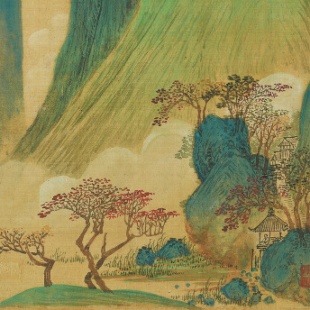
This philosophical take on the relations between people and nature has inspired the curators of the Art Museum of Central Academy of Fine Arts to mount Where to Seek the Trails, an exhibition of classic landscape paintings from its collection, which runs through to Friday.
The show invites the audience to engage in an interesting game of finding these small human figures amid ranges of mountain peaks, dense woods, streams and bridges, and then, "through the visions of those figures, viewers are directed to the nature the figures were looking at and surrounded by", says Zhang Zikang, director of CAFA Art Museum.
"It is a journey to trace the 'trails' of cultural traditions, and how ancient Chinese viewed a harmonious relationship with nature, which will add new dimensions to people's understanding of the environment," he adds.
Classical landscape painters normally took a half-realistic and half-imagined approach. They traveled far and wide to see diverse views of nature, expressed their feelings and impressions between layers of color, and meanwhile, added figures between the mountains and waters, imagining those being themselves in circumstances where they could live freely in the embrace of nature and neglect worldly affairs.
The paintings give a profile of the physical world and also, an ideal lifestyle, a spiritual haven prompted by a group of intellectuals in ancient times. They were portrayed sailing farther and farther away, or climbing mountains to have a clearer view of rainfall, or playing chess with good friends under trees and blossoms, or reading and playing the guqin (a seven-stringed Chinese zither) in a cottage tucked deep in the forest.
"It is rare for city dwellers today to maintain a close, intimate connection with nature," says Huang Xiaofeng, a CAFA professor specializing in the history of Chinese painting and one of the exhibition's academic advisers. "But even in the past, many people were also deprived of visiting the deep, enthralling sites of nature, and that was why landscape paintings were important to bring people a unique experience of woyou (staying at home and traveling in the mind)."
He says the small figures in the paintings activate the compositions, and they are key to directing the audience to the details and the atmosphere being created by the painters living centuries ago.
"Looking at how high the mountain rises, and how deep the water was, people just saw how small they looked in the paintings, when surrounded by the hills, the clouds, the rivers, and the zigzag roads leading into the depths of nature."
Huang says in the agricultural era, festive events held at different times were another important way for people to connect with nature. "Celebrations of the arrival of a new season often were carried out in nature, and these paintings have captured a certain moment of the day, the month, the year, and frozen the subtle changes of time and the particular mood people sensed, so that today, we can still share the same pleasures.
"When we gaze at these works from the past," he says, "we see their rich details and scenes, and in our minds, we think about the passing of time, and how our coexistence with the world has evolved."
linqi@chinadaily.com.cn