



Will Sino-US space competition stop at Mars?









While attending a conference in the United States recently, I overheard an American expert discussing the space competition between China and the US. After the event, I approached the expert to inquire about the possibility of space cooperation between the two countries. His answer is a matter of concern. He explained that as long as the US Congress doesn't withdraw the ban it announced in 2011, official space collaboration between China and the US is unlikely.
The escalating competition between China and the US in cislunar space risks spiraling out of control. And all signs suggest their space rivalry may extend to Mars in the next two to three decades, possibly leading to even more negative consequences.
To avoid such a future, the two sides should explore possibilities for cooperation. But for that, the US Congress needs to abandon its zero-sum thinking, paving the way for the early lifting of the ban on space cooperation and, thereby, raising hopes for Sino-US collaboration in space.
SpaceX's Starlink satellites, which comprise the majority of satellites in orbit, have made space exploration more affordable and efficient for a number of countries. But without proper management, the growing number of satellites in low Earth orbit could trigger the Kessler Syndrome.
The Kessler Syndrome, the brainchild of National Aeronautical and Space Administration scientist Donald J. Kessler in 1978, is a phenomenon in which, after the amount of junk (including defunct satellites) in orbit around Earth reach a certain threshold, collisions between objects become inevitable. These collisions will produce more debris, leading to a cascading effect and more collisions, and overwhelming the Earth's orbit with space debris, causing immense problems for satellites, astronauts and space mission planners, even preventing further satellite launches.
This interruption in space exploration would have a devastating impact on industries reliant on satellites for weather, navigation, communication, rendering them unsustainable.
The massive number of Starlink satellites (both operational and defunct) has raised concerns due to multiple instances of potential collision with spacecraft, including near misses with Chinese satellites. On Dec 3, 2021, the Chinese delegation to the United Nations and other international organizations in Vienna sent a note to the UN Secretary-General, saying that on July 1 and Oct 21, 2021, China's space station had to perform emergency maneuvers to avoid close encounters with Starlink satellites 1095 and 2305, respectively, to prevent accidents. While space exploration companies have attributed these incidents to technical malfunctioning, this explanation is less than convincing.
Even if we were to accept the claim of technical malfunctioning, the sheer number (more than 40,000) of planned Starlink satellites, even with a 1 percent failure rate, would generate a substantial amount of debris in low Earth orbit, leading to more incidents like the 2021"near misses". If this is left unchecked, the Kessler Syndrome will become reality with dangerous consequences.
To prevent this scenario, China and the US should engage in space cooperation. However, such efforts still face resistance from the US Congress. Even when the Barack Obama administration tried to establish space cooperation with China, the Congress dashed any such hopes by passing the "Wolf Amendment," in 2011.
The amendment, proposed by Republican Congressman Frank Wolf and included in the 2011 Appropriations Act, prohibits NASA and the White House Office of Science and Technology Policy from engaging in joint research with China. It also bars all NASA facilities from hosting "official Chinese visitors". As a result, measures were taken to restrict Sino-US space collaboration, preventing Chinese scientists from participating in international space conferences held in the US, and severely limiting communication and exchanges on space exploration between the two sides.
In fact, the US has declared that outer space is not a "global commons" and established a Space Force. These actions contradict the spirit of the 1967 Outer Space Treaty, which advocates the peaceful use of outer space. US Defense Secretary Lloyd Austin recently acknowledged that space has become a theater for major power competition, with China being the US' "greatest space threat". The US Congress further reinforced this competitive stance in space against China by increasing appropriations for NASA in the CHIPS and Science Act.
But collisions in low Earth orbit are just one aspect of the Sino-US space competition. Other issues include concerns over equipping traditional satellites with nuclear materials, direct-ascent anti-satellite weapon tests, and space debris from spacecraft re-entries. Each of these problems is highly complex, and without China and the US reaching a consensus on these issues, they could potentially trigger a new crisis in bilateral relations.
With China's space station already in operation, the next phase of China's manned space program is likely to be aimed at exploring the moon, conducting research on and about the moon, and eventually landing astronauts on Mars, following a new "three-step" plan.
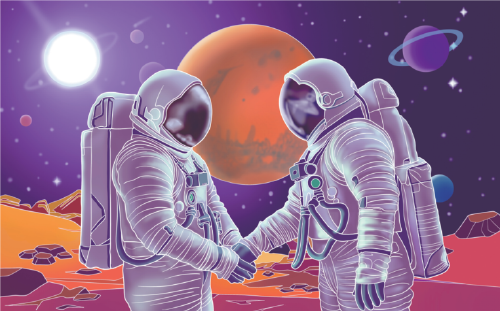
Despite setbacks in SpaceX's Starship launches, SpaceX CEO Elon Musk remains determined to land astronauts on Mars before 2050. Therefore, the likelihood of Chinese and US astronauts meeting on Mars is a possibility. If both countries can reach an agreement before this happens, and engage in peaceful cooperation to develop and use (if possible) Martian resources for the benefit of all humanity, it would be a rare piece of good news for the peoples in the two countries as well as those in the rest of the world.
The US Congress should abandon its Cold War mentality and zero-sum games, lift all sanctions, and refrain from committing further mistakes by putting its self-interest above common good. Although neither the US expert nor this author is overly optimistic about Sino-US space cooperation, the facts remain that there are only eight planets in the solar system, and Earth is the only place we can call home. Hence, it would be best if the competition between China and the US stops at Mars.
The author is an assistant research fellow at the Department for American Studies, China Institute of International Studies. The views don't necessarily reflect those of China Daily.
If you have a specific expertise, or would like to share your thought about our stories, then send us your writings at opinion@chinadaily.com.cn or comment@chinadaily.com.cn.





