


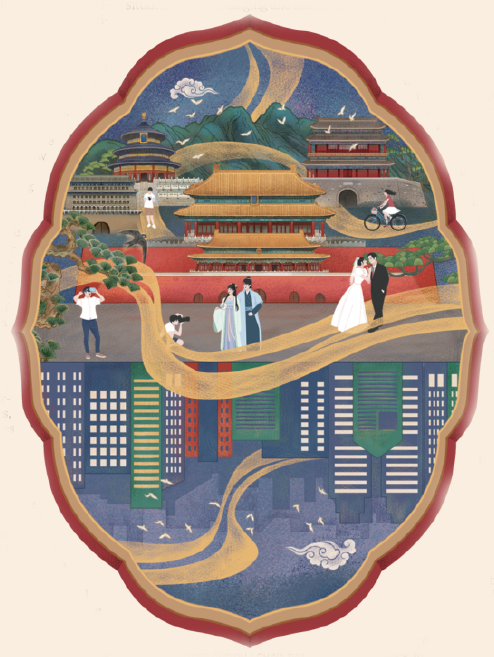
"The red walls and green tiles set each other off beautifully. It's so Beijing," said a 33-year-old Beijing resident surnamed Lin.
Lin, together with her 14-year-old cousin surnamed Wang, was enjoying a city walk along the Beijing Central Axis, where most of the major old-city buildings of Beijing, like the Forbidden City and the Bell and Drum towers, sit.
This summer, hashtags related to the trend of "city walking" have been more popular on numerous Chinese social media platforms. Traveling by foot, city walkers seek out interactions with locals, taste authentic snacks and gain a deeper appreciation for the history and culture of the capital city.
For Wang, it was an exciting experience as a tourist. "The ancient buildings that I have visited are very grand, and I want to learn more about the historical stories and figures behind these legacies," she said.
And now, she may find some clues in the popular reality show Glory Is Back! Beijing.
Premiered on streaming media platforms at home and abroad, including iQIYI and YouTube, in July, the reality show features captivating historic tales happening along the Beijing Central Axis spanning over 700 years. In each of the hour-long episodes, a group of celebrities and renowned scholars make inspiring journeys on the 7.8-kilometer-long axis to explore its origins, cultural roots and glories, attracting audiences mainly from Generation Z, observed Tong Tong, who works for iQIYI Gimbal Studio.
The show aims to bring the Beijing Central Axis closer to young audiences, said producer He Jibing. "I have noticed that many young people love taking a city walk along the Central Axis, and we hope to vividly present the historical and cultural charm of the axis from the perspective of young people."
For instance, in the first episode, the young explorers and scholars boarded a train and "traveled" through time and space to unveil the origin of the Beijing Central Axis, dating back to the Yuan Dynasty (1271-1368). Involving role-playing activities, the show entertainingly recreated the scenes of architect Liu Bingzhong designing the axis. Liu was deeply influenced by the traditional Chinese architectural philosophy of "sitting at the center of the world".
"Our ancestors clearly explained the idea of the Central Axis in the classic Rites of Zhou: Records of Construction (one of China's oldest technological books dating back over 2,200 years), including its functions, characteristics and landscapes," said Shan Jixiang, former director of the Palace Museum and one of the show's guests.
Based on ancient wisdom, the Central Axis not only links the different parts of Beijing, including royal palaces and marketplaces for common people, but also encapsulates key aspects of Chinese culture, such as the harmonious relationship between humankind and nature as well as the virtue of adhering to law and order. Once you understand the principle of "respecting the middle" embedded in the concept of the Central Axis, as Shan says in the show, you touch on the very root of Chinese people.
However, the Beijing Central Axis is not set in stone. After hundreds of years of vicissitudes, it is still changing and has formed a special connection with generations of Chinese people. "Especially when you take a stroll around the Bell and Drum towers, there's a palpable sense of energy in the hustle and bustle of daily life," said Lyu Zhou, a professor from Tsinghua University.
At a square between the Bell Tower and the Drum Tower, you can see local residents relaxing, cycling and playing games and even commemorating life events.
"We met each other and fell in love in Beijing," said a young couple who were taking wedding photos under the Bell and Drum towers. "This was one of our favorite meeting spots when we went on dates. You could say that the towers have witnessed the blossoming of our love."
In Lyu's eyes, everyone has their own understanding of the Beijing Central Axis, and Chinese civilization is inherited and carried forward in this way. As a guest of the show, Lyu was impressed by how the Central Axis was understood and empowered, especially by today's young people.
Su Yijun, a Gen Z virtual architect, shared in the show his own way of taking in the sights of the Central Axis — building a digital model in the popular video game Minecraft. Take his game version of the Forbidden City as an example, it covers a square grid of about 100 million blocks. Every facade of every building is a reflection of its real-life counterpart, and every last detail in the home of 24 emperors that ruled over a span of about 500 years is included.
Su is not alone. It is worth mentioning that this digital model was built by a team of 120 young people led by Su. All of them worked on it voluntarily, and this shared interest in Chinese historical architecture has even transcended geographic borders and cultures.
"All of my friends like the Forbidden City, and this is my first visit to the Zhengyang Gate. It's very helpful that there are bilingual signs that I can read to learn about the history," said a Moroccan visitor who was hanging out with her friend from Botswana at the Zhengyang Gate in central Beijing.
Throughout history, a number of foreign visitors from other parts of the world have left their footprints on the Beijing Central Axis.
The Venetian merchant and adventurer Marco Polo (1254-1324), for example, wrote about what he saw along the Central Axis in The Travels of Marco Polo back in the Yuan Dynasty: "Up and down the city there are beautiful palaces, and many great and fine hostelries, and fine houses in great numbers." And Swedish scholar Osvald Siren (1879-1966) took precious photos of walls and gates in Beijing back in the late 19th and early 20th centuries. These Western records have offered people around the world a glimpse of this remarkable slice of history.
Shan, Lyu and He all agree that it is Chinese young people that are playing an increasingly active role in sharing cultural knowledge of the Beijing Central Axis with the world in their own unique ways, such as by city walking, filming vlogs and even using cutting-edge technologies like game design.
"As a generation with growing cultural confidence, Chinese young people of today can look to the rest of the world as their equals," noted He. "Now they are tending to look inward, trying to figure out what makes China China and sharing the answer with the rest of the world."








