



Villagers help expand langur monkey habitat









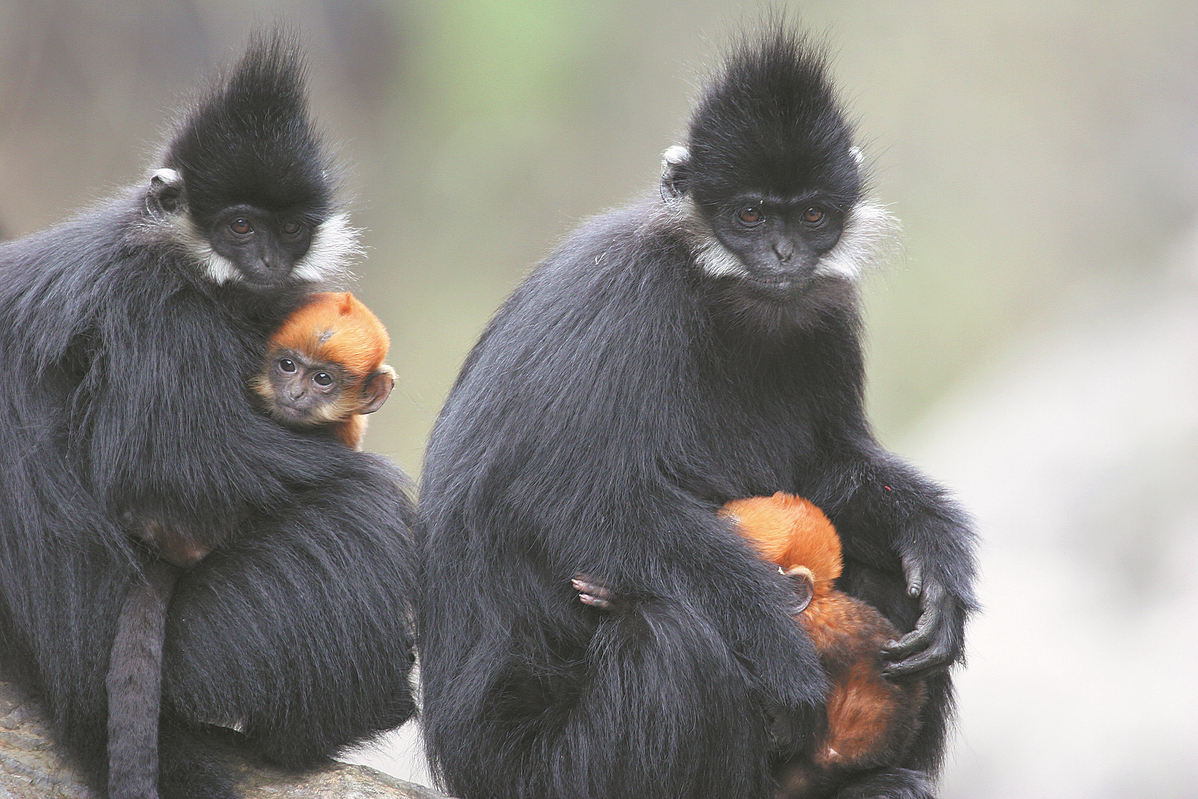
Like the fabled monkeys who live on the Huaguo Mountain in the ancient Chinese classic Journey to the West, Francois' langur monkeys live happily in Guizhou province, thanks to species migration and poverty alleviation relocation projects.
This was not always the case. Many local residents remember how the monkeys posed a threat to farmland in the 1980s, when crop cultivation was expanded to produce more food. The expansion resulted in a shrinking habitat and food shortages for the primates.
Li Yongfa, a former resident of Xuehua village, located in the core area of the Mayanghe National Nature Reserve, said the monkeys often stole corn for food. In response, the villagers used traps and bonfires to scare them off.
In 1987, the Mayanghe National Nature Reserve was established, and the monkeys were spotted in the area a short time later.
The reserve administration quickly carried out work to raise awareness of animal protection and educate local villagers, who were compensated for crop losses. Gradually, the relationship between the villagers and the monkeys improved.
"Nowadays, local people's awareness of environmental protection is rising and they are willing to vacate the land for the monkeys, which also gives the residents an improved and larger space for development," Li said.
In 2018, the administration and the local government started ecological migration and poverty alleviation relocation projects. About 4,600 people who lived within the reserve moved to the Dengta industrial park in Tongren city's Bijiang district, plus neighboring communities in other factories and newly built communities in nearby villages.
Wu Ankang, director of the administration, said that after the residents left, trees were planted to provide fruits such as peaches, plums and pears for the monkeys to eat.
"We have improved our efforts to publicize, observe and study the monkeys, and also established a five-tier forest and river chief system. Now, 51 rangers are responsible for the protection of forest resources and the prevention of fires and hunting. A special team has been set up to measure population changes among the monkeys and other animals in the region," he said. According to reports in Tongren Daily, the measures have resulted in the number of Francois' langur monkeys rising from 395 in 1987 to 763 at present.
Wu is planning an experimental zone: primary and middle school students will learn about the environment via science education and research tours, and by watching the monkeys from 1 or 2 meters away.
Meanwhile, villagers' lives have also improved. In the past, the main industry in Shangba village was flue-cured tobacco.
However, a coal shortage caused by poor transportation resources and relatively backward technology meant that villagers had to cut down trees to use as fuel to bake tobacco leaves, which caused serious damage to forest vegetation.
"Now we can get rich without cutting down trees," said Mao Xichun, who migrated from Shangba to Xianjin village.
In 2003, the nature reserve's status was upgraded to that of a national-level facility, and the villagers abandoned the tobacco industry.
In response, the reserve administration reclaimed the forest at the price of 4,850 yuan ($670) per 0.66 hectares (equivalent to 1 mu, a traditional measurement) and Mao's family received 480,000 yuan for their 7.2 hectares of contracted forest.
The administration also offered villagers annual environmental compensation at 16 yuan per 0.66 hectares. By 2020, Shangba's residents had received 15 million yuan in compensation. "The environmental protection compensation mechanism will be further improved to aid economic development and environmental protection," Wu said.
Shangba's villagers have also benefited from other industries. In 2021, their total revenue from growing green tea reached around 200,000 yuan. They have also planted more than 120 hectares of herbs used in traditional Chinese medicine, while about 100 households keep bees for honey production.
"Move ourselves, and we have a brighter future; make room for the monkeys, and they have a larger habitat," Li said.


- Report blames management for deadly Yunnan tunnel flood
- Companies flock to Shanghai home appliances expo
- Three people perish in Guangdong house fire
- Experts: too early to tell if super El Nino will hit this year
- China recovers $4.95b in medical insurance funds in 2025
- China launches remote sensing satellite





