



Dollar decline driven by US weaponization









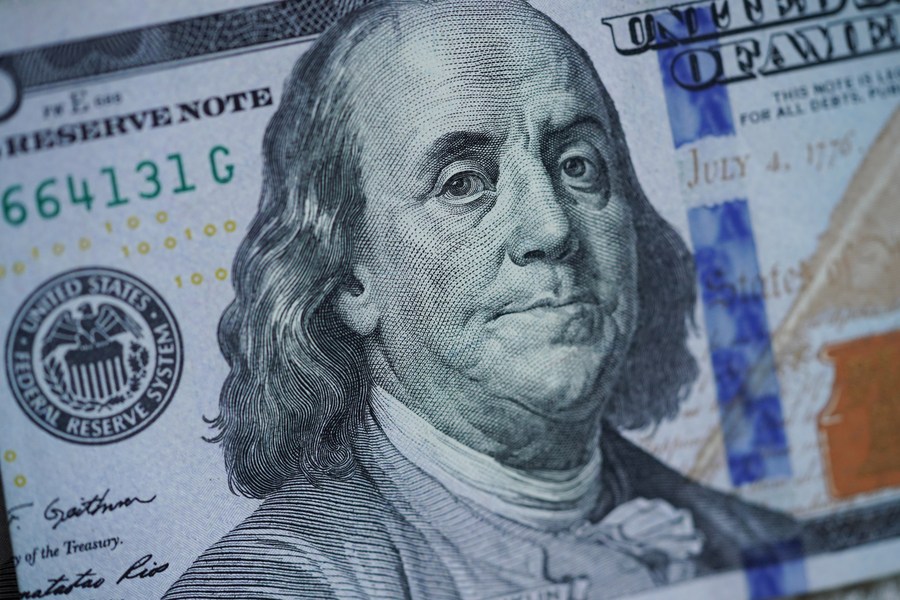
Experts: Countries diversify currencies due to Washington's irresponsible acts
Many insiders believe that de-dollarization has emerged as a financial trend in the past one or two years, manifesting itself as a concerted effort by an increasing number of countries to diminish the prominence of the US dollar in international trade, and the desire by a clear majority of central banks around the world that gold should become a more prominent reserve asset in place of the dollar.
One of the driving forces of this trend, they say, is the US' weaponization of the currency.
Sourabh Gupta, senior fellow at the Institute for China-America Studies in Washington, said the centrality of the dollar's role in the global financial system has been gradually shrinking in the past 10 to 15 years.
"But this year that debate has been given added impetus by the sanctions imposed by the United States against Russia," Gupta said. "Many major countries and emerging markets are questioning the outsized role of the dollar in the international financial system."
A newly released report by the Quincy Institute for Responsible Statecraft, a US think tank focusing on foreign policy, described de-dollarization as "an unstoppable trend".
"A major driver is Washington's weaponization of its currency via sanctions, covering 29 percent of the global economy," it said.
In another commentary published last month in the online magazine Responsible Statecraft, Frank Giustra, co-chair of the nonprofit Crisis Group headquartered in Brussels, said the idea that the dollar could lose its dominance had been unthinkable in most of the developed world until the US and its allies froze Russia's currency reserves and shut it out from the SWIFT system, after the Russia-Ukraine conflict broke out in February last year.
"Financial systems are built on trust, and if they are weaponized they lose the trust necessary to retain their dominance," he wrote.
Even US Treasury Secretary Janet Yellen acknowledged that the sanctions could cause or exacerbate the de-dollarization trend. In an April interview, she said "there is a risk when we use financial sanctions that are linked to the role of the dollar that over time it could undermine the hegemony of the dollar".
The dollar remains a powerful currency in international markets in terms of usage or reserve, Gupta said, and it will stay like that for a long period.
"So, the idea is not to eliminate or significantly reduce the role of the dollar, because that is a very long-term process. But the process of shrinking the salience, the footprint of the dollar, is an ongoing one, and it has been supercharged this year, or in the last two years, by US' weaponization of its currency."
The US has been weaponizing the dollar since the mid-2000s by using it "as a tool of leverage to punish opponents", targeting small countries at first and now confronting a state as huge as Russia, a move that "has given a real fright and anxiety to a lot of countries in terms of what the US could potentially do", Gupta said.
Countries took fright as to what could happen because the US could use such leverage against them, and coerce them into changing their foreign policies, not just their financial or economic policies, he said.
"They are worried because almost every country maintains a fairly significant amount of its hard currency reserves in dollars at the Federal Reserve Bank ... and if these dollars are suddenly not obtainable, their assets are frozen. It has significant implications in terms of financial, monetary and economic management.
"The countries are trying to diversify out of the dollar because the US has not been a responsible stakeholder in managing the dollar to the benefit of all as a public good. And this is why there is fright, anxiety and a need to diversify out of the dollar."
Compared with two strategic waves of de-dollarization in history — the anti-Bretton Woods movement in the 1960s led by France and the birth of the euro in 1999, which sought to reduce the influence of the dollar in Europe — this round is more by initiative from a political perspective, with the primary driver being defense against US blackmail, Gupta said.
Other factors such as hyperinflation and debt ceiling negotiations also impact currency diversification and de-dollarization, because they provide added fright to foreigners that the value of their dollars in the Fed might "depreciate and crater", he said.
"If the US is seen as irresponsibly managing its economy, it will necessarily impact the value of its currency," he said. "There will be that effect of trying to move away from holding assets in dollars."
Underlying factors
In a recent interview on the podcast The Jay Martin Show, Lyn Alden, a macroeconomist, investment strategist and the founder of Lyn Alden Investment Strategy in New Jersey, named two big underlying factors kicking the de-dollarization trend into high gear. One is that "other countries have lost trust in US government bonds"; another is the fear that the US government may seize their reserves at any point.
"Other countries know that the status of their dollar reserves is at the mercy of a few politicians in Washington," she said.
Gupta said countries are now realizing there are complications with placing so much faith in the dollar.
"And that's why, in this regard, the renminbi's rise is very welcome."
There is no need to exaggerate the RMB's role or how quickly it can become the world's central currency, he added.
"I think it still has at least one or two more decades to go", and it will require China to open up its financial markets and liberalize its capital account, he said.
Describing "an ideal international financial system", Gupta said: "So, perhaps an ideal balance would be about two or three competitive and stable currencies in the international system, and we may be getting to that point, maybe in one decade, or probably two decades, where we might have the US dollar still having a very significant role, but with the RMB also playing a much more important role, as the euro, hopefully, also keeps growing in terms of its role as an international currency."
Digital currency has "enormous importance" in the global currency system and de-dollarization process, he said, adding digital currencies will essentially create an alternative architecture that is no longer in the existing US-centered financial clearing, plumbing and correspondent bank network which underpins the dollar's strength.
"And that is the area which is gaining great importance, especially with US' weaponization of the dollar, because the way that the Treasury Department enacts sanctions is via that plumbing network, over which it has jurisdiction."
yifanxu@chinadailyusa.com










