Washington can't rupture peace in Asia-Pacific









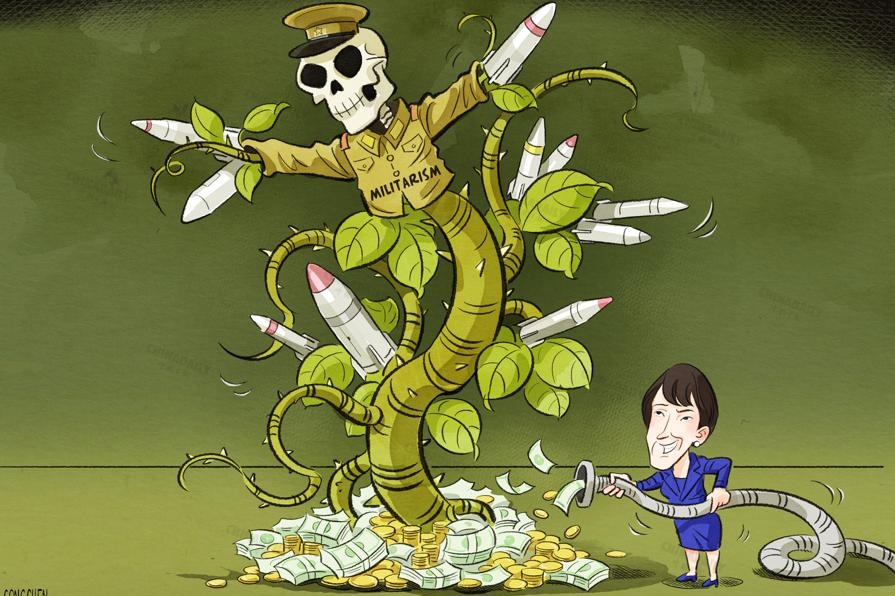
The United States’ efforts to promote so-called democracy across the world by creating divisions among countries are heightening tensions in the Asia-Pacific region. And its ambiguous stance on the Taiwan question — despite saying it acknowledges the “one-China policy”, it continues to sell weapons to the Chinese island — is a ploy to maintain its hegemony.
As a matter of fact, Michael McCaul, Republican chairman of the House Foreign Affairs Committee, recently said the US will provide weapons for Taiwan, and will ensure their delivery. He also said Congress is working to expedite the latest sales.
This is not only an attempt to further raise the already high tensions in the region but also a direct interference in China’s internal affairs.
Tensions between China and the US have escalated due to the increasing frequency and intensity of US’ illegal military activities in the South China Sea, which are a threat to China’s national security and contrary to the spirit of the UN Charter, which is aimed at maintaining global peace and improving state-to-state relations.
The US has also been conducting reconnaissance operations and military exercises off the coast of China in recent years in violation of international law and the basic norms of international relations.
Despite the Russia-Ukraine conflict, the US has continued to hold military drills in the South China Sea in an attempt to not only to warn Russia but also provoke China, significantly increasing the risk of a conflict. The US has also been flexing its military muscles by ordering its naval ships to sail through the Taiwan Strait in the name of “freedom of navigation”. Indeed, the US military’s presence and operations in the South China Sea and the Taiwan Strait are significant factors affecting the situation in the Asia-Pacific.
The US’ foreign policy has become increasingly problematic over time, with recent unscripted remarks by US President Joe Biden complicating the matters further. Biden, as a matter of fact, has come to be known as a president who says one thing and does another. Perhaps his biggest political faux pas was not stopping Nancy Pelosi, then House of Representatives speaker, from visiting Taiwan in August 2022, which further deteriorated Sino-US relations.
But despite Washington’s continued illegal efforts to spread propaganda against China and rally other countries to join the anti-China camp, many countries have refused to take sides in the disputes between Washington and Beijing. Instead, many of these countries are deepening their economic relations with China while taking measures to diversify their business operations and build new supply chains. This is evidenced by China overtaking the US to become the European Union’s largest trading partner in 2020.
Since many Asian and European leaders seek to strengthen their countries’ economic relations with China, Washington’s strategy to decouple from China and isolate it in the global economy is not bearing fruit. In particular, many countries in the Global South, including African countries, refuse to become a pawn in the US’ geopolitical game. While Saudi Arabia, China’s largest trading partner in the Middle East, relies heavily on collaboration with Chinese tech companies such as Alibaba and Huawei to realize its Vision 2030 development plan, Indonesia, a country the US has tried to use to curb China’s growing influence in the Asia-Pacific region, has chosen Huawei to help address its cybersecurity problems.
Washington’s geopolitical strategy, since it is self-centered and divisive, has been rejected by many countries. It is not aligned with the interests of other countries that are expanding their economic relations with China while diversifying their business operations. And therefore it has lost its credibility as a sound economy and influential superpower.
It’s time the US learned to accept the reality of China’s peaceful rise and its growing image as a promoter of peace and development. The US could also learn from the June 2-4 Shangri-La Dialogue, where the defense ministers of Asia-Pacific countries discussed how to maintain peace in order to create a favorable atmosphere for common development for mutual benefit.
The author is executive director, Pakistan Research Center for a Community with Shared Future, Islamabad.
The views don’t necessarily reflect those of China Daily.