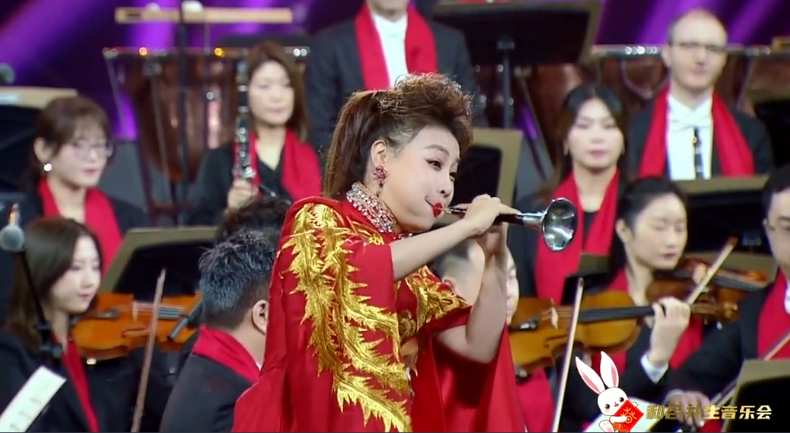
As a child, Liu Wenwen detested the suona, a "loud, high-pitched" traditional Chinese musical instrument, an ancestral heritage of her family that was to become her career.
Her peers at primary school laughed at her, saying her whole family was engaged only in "weddings and funerals." Indeed, these are the two major occasions where the horn-like wind instrument is played in China's rural areas, including Liu's home city Jining, in east China's Shandong Province.
Liu felt ashamed. In the 1990s, China's reform and opening-up drive was in full swing, and people admired things that were modern and international. "Suona, in comparison, was considered an art of the hillbilly."
Despite her reluctance, she followed her parents into the trade at three years old, "just for fun." What would you expect otherwise from a child whose parents both play the suona, and who falls asleep and wakes up to the loud music day in day out?
Her father's family has performed suona for seven generations, while the tradition on her mother's side of the family traces back to the early Qing Dynasty (1644-1911).
The music is ingrained in Liu's DNA, but it takes time and hard work to become a virtuoso musician. The instrument is so loud that it annoyed the neighbors when she practiced at home. "So my parents would wake me up at 4 a.m. every day and take me to practice outside in a park."
Besides suona, Liu has also learned traditional Chinese vocal music and dancing, skills that have improved her oral muscles and sense of rhythm and equipped her as a professional musician.
She found suona music beautiful for the first time in 2008, when she entered Shanghai Conservatory of Music to learn the instrument more systematically from Prof. Liu Ying, a top player.
"The music played by Prof. Liu is just amazing, and different from what I heard before," she said.
While she followed her parents to play the suona as a child, she only fell in love with the instrument at university. The first suona player to study for a doctor's degree, Liu is also teaching at her alma mater in Shanghai.
She loves exchanging ideas about suona playing techniques with her students. "It's wonderful to see the younger generation carrying on the cultural heritage."
Liu said she is delighted to see suona music regaining popularity among the young people, sometimes even combined with jazz, opera and other art forms. This is a reverse from its decline in the 1990s.
On China's social media platforms, her name is often followed by a video of her live performance at a concert in Sydney, Australia, alongside award-winning composer Tan Dun in 2017. For her debut on the international stage, she was playing "Hundreds of Birds Paying Homage to Phoenix," a masterpiece that often represents excellence in suona performance.
A year earlier, a film with the same name caused widespread concern over traditional suona music that was on the verge of extinction, with senior musicians struggling to make ends meet and forced to take up other trades, while young apprentices stopped learning the instrument altogether.
Liu, however, promoted the "hillbilly" music to an international audience, thanks to Tan and his team, who recomposed the traditional music and arranged the piece into an orchestra.
"At first I was timid and scared, but Tan said something that strengthened me," she said.
The composer said to her, "You will be part of an impressive scene, with your Western-style dress and traditional Chinese instrument, and with folk music accompanied by an orchestra."
The audience was truly impressed. The Westerners were amazed by the loud, unfamiliar instrument and its exotic, colorful music that imitated the chirping of hundreds of birds, whereas the Chinese were stirred by nostalgia.
"It was a seamless dialogue between a hillbilly Chinese instrument and a Western orchestra, loved by the musicians and audience alike," she said. "I felt my hard work had paid off. I trained for over 20 years, probably just to win cheers and applause for traditional Chinese music on the international stage."