



Shipyard No 1 in car-carrying vessels









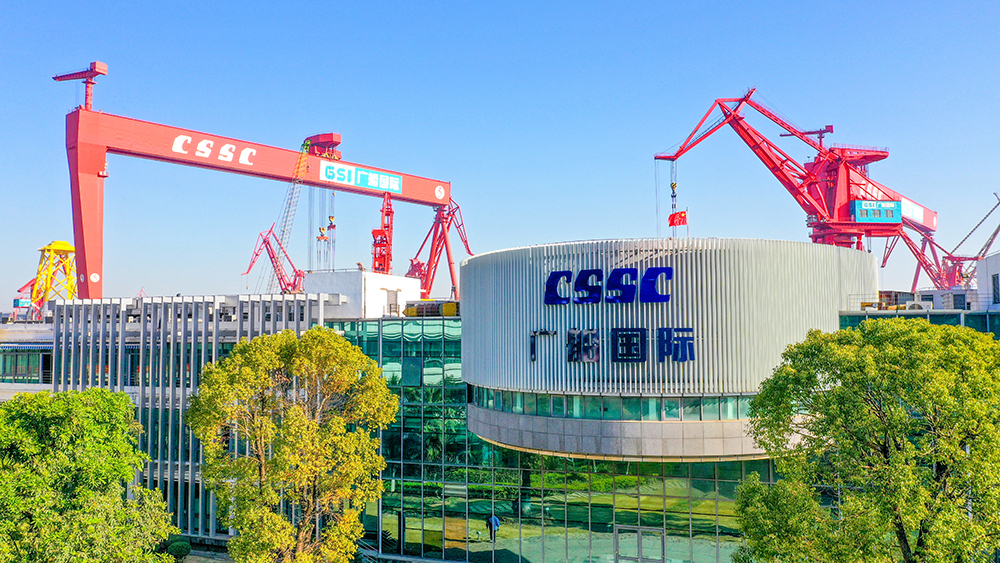
Guangzhou Shipyard International Co Ltd has recently become the shipbuilder with the largest construction orders for dual-fuel pure car truck carriers, or PCTCs, in the world, officials said.
The accomplishment by the company, a unit of State-owned China State Shipbuilding Corp, demonstrates its strengths and good judgment, industry experts said. The dual-fuel PCTCs can be powered using either liquified natural gas or fuel oil.
The company has contracts to build 25 PCTCs in hand after Zhou Xuhui, deputy president of GSI, signed a contract to build another three 8,600-vehicle dual-fuel PCTCs for a well-known Asian maritime transportation company. This elevated the Guangzhou shipbuilder to a world leader in PCTC construction.
Of the 25 orders to build PCTCs, 11 are being built for offshore companies.
GSI previously had signed contracts to build three PCTCs of the same ship type for South Korea's H-Line Shipping Co Ltd.
GSI, listed on the Shanghai Stock Exchange, had also contracted earlier this year with BYD Group, one of the country's major new energy carmakers, to build two 7,000-vehicle dual-fuel PCTCs.
China's car exports have been on the rise in recent years with the rapid development of its automobile industry and the improvement in the quality of its products. That has led to growing demand in the vehicle trading and transportation business, according to Zhou of GSI.
Construction of PCTCs is expected to boost China's automobile industry, help domestic carmakers increase their presence in the world market and assist GSI in realizing its development goals, he said.
China's automobile export volume increased significantly year-on-year to 682,000 vehicles during the first two months of the year, according to the General Administration of Customs.
"GSI quickly identified the hot spots in the shipbuilding industry and began building more PCTCs two years ago to improve the company's comprehensive competitiveness and management goals," Zhou told China Daily.
In April 2021, GSI signed a contract with Norway's SFL Corp to build two 7,000-vehicle dual-fuel PCTCs as part of the contract. The first 7,000-vehicle dual-fuel PCTC built by GSI for the Norwegian company was launched on March 7.
GSI is also a leading company in the construction of luxury vessels that allow passengers to take their cars with them on lower decks.
Zhou said it has become the global leader in PCTC construction in about two years, demonstrating the shipbuilding strength and technologies of GSI and China as a whole.
There are many technical difficulties in the construction of PCTCs, which are niche special transportation ships. But GSI has fully mastered core technologies, he added.
The company has good prospects for the development of PCTC construction in the coming years, Zhou said.
The global inventory of PCTCs is about 700, a quantity that has not been able to meet growing demand.
Chinese shipbuilding enterprises had few records of construction and delivery of this type of ship in previous years, he said.
"And of the current PCTCs in operation, many are out of date and are burdened with high fuel consumption. They need to be replaced or technologically renovated," Zhou said.
Freight rates for PCTCs have been on the rise in the global market, according to United Kingdom-based Clarksons Research. The going freight rate of a PCTC was $10,000 per day in the mid-2020s. But by 2022, the one-year charter rate for a 6,500-vehicle PCTC had soared to a record high of $55,000 per day, up 450 percent.
The 8,600-vehicle, dual-fuel PCTC series constructed by GSI is considered an expanded and upgraded version 2.0 of the 7,000-vehicle ship type.
The ship with the larger capacity has a total length of 200 meters and a maximum inside width of 38 meters. With a design draft of 9.2 meters, it is designed to reach a speed of 19 knots, equivalent to 35.19 kilometers an hour. A ship's draft is the vertical distance between the water line and the bottom of the hull.
The 8,600-vehicle ship has 14 layers of vehicle decking. While maintaining the primary dimensions of the 7,000-vehicle PCTC, the other ship's loading capacity is increased by 1,600 vehicles, helping maximize the vehicle transportation needs of the ship's owners.


















