



Building resilience









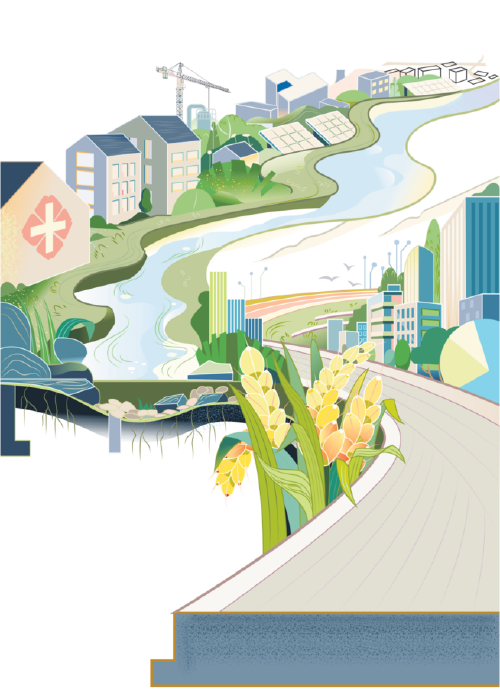
UNDP seeks to address infrastructure, environment and socio-economic aspects by focusing on small, transitioning and medium-sized cities
In today's world, which is dominated by risks that are increasingly manifesting in complex and intersecting crises, resilience is needed more than ever. The COVID-19 pandemic, Ukraine crisis, climate change and the extensive food insecurity in many parts of the world are all reminders that we need to act swiftly to stop the continued reversal of the human development progress of the past years.
Resilience, however, can mean different things to different people. At the United Nations, we have identified four key elements of resilience building that have helped us achieve a common understanding. These are: a shared understanding of the multiple dimensions of risk, as well as the wider socioeconomic context; the involvement of multiple stakeholders across sectors and from the local to global scale; a systemic approach to understand the knock-on and cascading effects of crises; and strengthening absorptive, adaptive, anticipative, preventive and transformative capacities of individuals, households, communities, cities, institutions, systems and societies.
Resilience building is, therefore, a unifying approach that cuts across different risk management practices with the aim of overcoming the humanitarian, development, human rights, and peace and security divide in support of sustainable development.
While resilience building must of course be pursued at all levels, I will focus my short deliberations on the local level and the issue of urban resilience. Why focus on cities? Humanity has become an urbanized society with more than half of the global population living in cities. By 2050, Asia and Africa will drive the largest rapid urbanization numbers.
Hundreds of entirely new cities are sprouting around the world, at an even faster pace and at a bigger scale than in the past. According to an estimate in Forbes in 2017, over 40 countries, including China, Malaysia, Nigeria, Morocco, India, Saudi Arabia, Ecuador, Oman, Kazakhstan and Kenya, made massive investments in developing new cities from scratch. Indonesia alone is investing in building 27 new cities.
Based on a McKinsey survey with over 2,600 cities, new and old cities alike are at risk of concurrent stresses, be it resource stresses (energy, water, and food), environmental and climate change stresses (biodiversity degradation, earthquakes, floods, droughts, and cyclones), and/or social stresses (demographic shifts, migration, rising poverty and inequalities, weak governance and unemployment).These stresses are a fertile ground for the type of polycrisis that we are observing today, and they require poly-solutions.
Cities, governments and communities are key actors in any crisis response, recovery and prevention. This is not different in the case of the climate emergency, or in cushioning against the impact of the cost-of-living crises on the well-being of people.
As I mentioned earlier, the characteristics of our urbanized world are leading to a rapid accumulation of risks and vulnerabilities. This underscores the need for an integrated approach toward resilience building. According to data provided by Resilient Cities Catalyst, an independent research institute, in the 136 biggest coastal cities, 20 percent of their population and $4.7 trillion in assets are exposed to coastal floods. Around 90 percent of urban expansion in developing countries is near hazard-prone areas and built through informal and unplanned settlements. Small- and medium-sized cities, with less capacity to deal with complex challenges and risks, are likely to have a higher number of low-income and low-skilled residents compared to larger metropolitan areas. This calls for making cities resilient, safe and inclusive places to ensure no one is left behind.
Progress to achieve the United Nations Sustainable Development Goals will remain elusive unless resilience considerations are integrated into policy, planning and implementation as well as the socioeconomic development process. With about two thirds of the infrastructure and socioeconomic assets between now and next decades yet to be built, investments in risk-informed urban planning, development and implementation are a must for reducing the mounting economic losses, social inequities as well as for preventing the creation of new risks.
This requires investing not only in building the resilience of physical assets and infrastructure, but also fostering the environmental and socioeconomic aspects. United Nations Development Programme's Urban Risk Management and Resilience Strategy seeks to address all three dimensions of resilience with a focus on the small, transitioning and medium-sized cities. We urgently need transformational shifts of building resilience for sustainable development, peace and security, human rights, and the well-being for all.
This is a multilayered effort premised on building the foundations for next-generation policy instruments in cities. These include: setting a direction for well-planned, risk-informed and climate resilient urban development; adaptive and inclusive governance arrangements; resilient production systems, and resilient public-service infrastructures; new economic models and articulation of multiple development pathways for cities; reinforcement and nurturing of the social infrastructure; deploying financial solutions and partnerships to provide long term investment toward sustainable urban transformation.
The author is assistant secretary-general of the United Nations and the director of the Bureau for Policy and Programme Support at the United Nations Development Programme. The author contributed this article to China Watch, a think tank powered by China Daily. The views do not necessarily reflect those of China Daily.
Contact the editor at editor@chinawatch.cn.





