


Nation embraces fresh approach










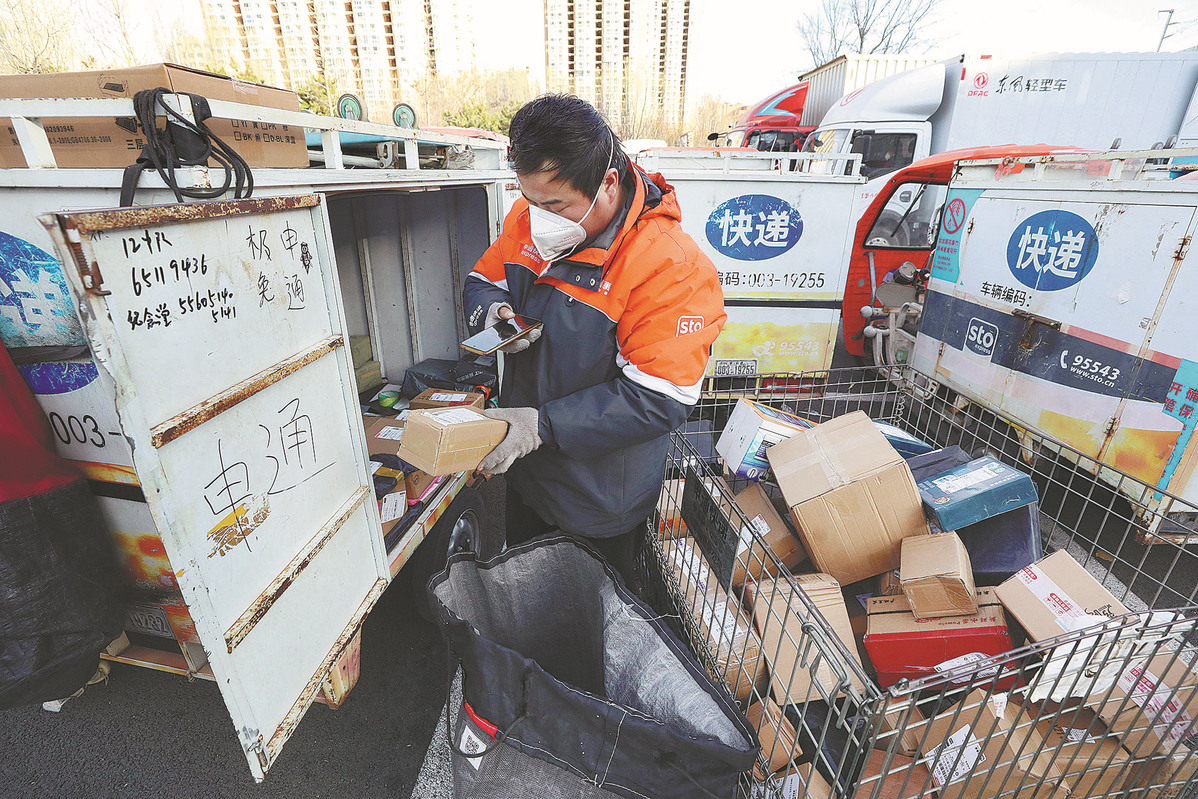
Parcel pileup
Delivery drivers have been crisscrossing Beijing's alleys late into the night on electric rickshaws as they race to clear a backlog of parcels in the wake of the "Double 12" e-shopping festival.
The event — which can last for weeks from about Dec 12 — is among the country's most testing moments for the logistics industry as goods worth hundreds of billions of yuan funnel through courier companies to the doorsteps of binge-buying households.
However, recent outbreaks have made this past Double 12 peak season even more trying for couriers.
Early in November, health authorities lifted a restriction on buying fever, cold and anti-inflammatory drugs as part of a broader effort to encourage COVID-19 patients to wait out discomfort at home and avoid busy hospitals.
As a result, online orders for such medications soared, as well as those for antigen test kits, N95 masks and other epidemic-themed products.
On top of that, large numbers of courier workers fell ill and asked for sick leave.
Yao Hongxu, deputy general manager of the Beijing division of SF Express, said that Omicron knocked out half of his 18,000-strong team at the worst time. The number only bounced back recently as many workers recovered and returned to their posts.
To replenish the workforce, parcel companies in Beijing raced to "borrow" delivery workers from regions less affected by the virus. Some shifted employees from non-delivery work to the front line and upgraded cloth masks to N95 to prevent further illness among workers. Drivers were also encouraged to contact clients to see if parcels could be delivered at night.
"I deliver more than 100 parcels a day," said Xu Zhenglong, who was "borrowed" from Anhui province to help ease the parcel pileup in the capital. The father of two had been staying at a budget hotel with other borrowed colleagues.
After days of hard work, the parcel mountain had been reduced to a flat plain, he said.
Chen Shiju, general manager of Xinkaiyuan, a cold-chain logistics company in Zhengzhou, Henan province, had a team of 43 workers, but less than 10 were still working.
Half of those left, including himself, had tested positive for COVID-19 but chose to stay.
"The infections have created a temporary shortage of workers, which has exerted huge pressure on our company," Chen said. "Hopefully, things will be sorted out when the workers who fell sick earliest recover and return to work."
No more control tasks
For the last three years, Bian Siqian has been accustomed to being assigned "epidemic prevention tasks" in addition to her duties as a pediatrician at Xi'an Fourth Hospital in Shaanxi province, such as collecting samples at COVID-19 testing booths.
In November, Bian's employer sent her and 53 colleagues — all doctors and nurses — to staff a makeshift isolation facility in an eastern suburb amid an uptick in local cases.
More than 7,000 people had been quarantined there since it opened. "At first, there were too many patients and too few staff members, so lunch seldom arrived on time," Bian said.
Then, after centralized isolation was made voluntary early last month, the number of residents started to fall and finally stabilized at 1,000.
"Those who remain are reluctant to leave because food, drugs and tests are all readily available here," the doctor said.
When positive cases were scarce, authorities had mixed samples of up to 10 people to speed up mass testing and reduce costs. However, the spike in infections meant a greater number of mixed samples returned positive, so single-sample tests were needed to pinpoint the patient. That caused delays in uploading test results.
As a result, Xi'an and many other cities nationwide dropped the test requirement for visiting hospitals — the few remaining places sticking to stringent test demands.
Bian hasn't yet been infected, but she said that half the medical workers she knows have, and those with mild symptoms had remained at work to help deal with a surge of patients at hospitals.
The silver lining? Many of the pandemic control tasks tossed at her will soon be history, though it may take some time.
"In the past year, I have spent little time as a pediatrician because of epidemic control tasks. I have plans for exams in my field of study if more time is available in the near future," she said.
Wang Mengni, a midwife in Xi'an, said there used to be eight doctors in her department, but now only four are left.
"Some doctors are so sick that they had to ask for sick leave, and that means those still at their posts have to work longer hours," Wang said.





