



Economic outlook injects confidence









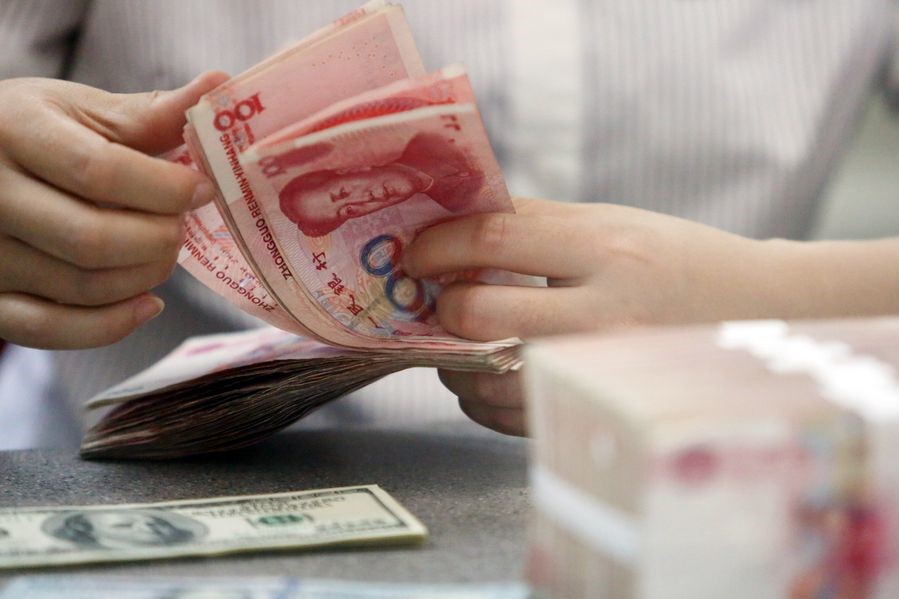
The renminbi's value used to feature heavily in debates about global imbalances. While outsiders considered it to be undervalued and urged appreciation, the People's Bank of China insisted on maintaining the currency's de facto peg to the US dollar. In recent years, however, China's concerns that its currency would grow too strong have been replaced by fears of a sharp depreciation.
Though China has sustained its current-account surplus, capital outflows have been putting the exchange rate under frequent downward pressure since 2015. The sources of the pressure can be divided into three broad categories, based on the drivers of the outflows: deteriorating domestic economic conditions, noneconomic factors, and arbitrage.
In 2015, while equity prices crashed and led to months of market turbulence, and GDP growth was losing its momentum, the PBOC introduced a new rule for setting the renminbi central parity rate against the US dollar to make the renminbi exchange rate more flexible. Though the move itself was correct, it triggered a sudden rise in expectations of renminbi depreciation. With that, capital began flowing out of China — and continued to do so through the end of 2016. To shore up the renminbi, the PBOC burned through some $1 trillion in foreign-exchange reserves during this period.
In 2018, non-economic factors — specifically, rising tensions with the United States — became the main driver of capital outflows. From March 2018 to May 2022, the renminbi exchange rate fluctuated significantly, reflecting the shifting intensity of Sino-American tensions. For much of this period, the renminbi exchange rate hovered below the psychologically important threshold of 7 to a dollar.
The recent build-up of renminbi-depreciation pressure began in May 2022, with the renminbi depreciating against the dollar at an unprecedented rate, again breaking the 7 to a dollar threshold in September. This time, the main factor has been arbitrage activities, with investors seeking to take advantage of the widening interest-rate differential between China and the US. Anecdotal evidence suggests that capital flight may have also played an important role.
In the past, whenever the renminbi's dollar exchange rate neared the 7 to a dollar threshold, some economists would warn that a collapse could follow if the threshold was allowed to be breached. This time, despite concerns, the PBOC has held firm in rejecting sustained intervention — and of course the crash has not come.
The PBOC's response to the latest renminbi depreciation — a policy of "benign neglect" — is particularly laudable. Policymakers did lower the foreign-exchange-reserve requirement ratio for banks, and they persuaded commercial banks to support the renminbi in various subtle ways. But they did not intervene in the foreign-exchange market in any significant way.
Some might argue otherwise, citing reports that the PBOC sold some $100 billion in US Treasuries in the first half of 2022. But, if the reports are true, it was not a currency-market intervention; it was part of the PBOC's long-term plan to diversify China's foreign-exchange reserves, or, as some Chinese economists may argue, it could be partly a result of the revaluation effect of US government bonds.
In any case, external pressure on the renminbi is waning. This is partly because of developments in the US: inflation has fallen for four consecutive months, and, perhaps more important, central bankers seem to have realized that their aggressive monetary tightening — 75-basis-point rate hikes at four consecutive policy-setting meetings — is untenable.
Because today's inflation is the result of both demand- and supply-side shocks, interest-rate hikes alone cannot contain it. What they can do is suppress growth, causing the US economy — already at risk of recession — to suffer stagflation. In light of this, the Fed now seems to be softening its hawkish stance on inflation. In fact, at its last policy-setting meeting of 2022, the Fed raised interest rates by only 50 basis points. As market expectations for US interest-rate hikes wane, so does downward pressure on the renminbi.
But the renminbi's value is not decided by US central bankers. The currency retains a fundamental strength, rooted in market confidence in the Chinese economy. This time, renminbi depreciation has triggered no panic in China's financial market, which reflects the maturity of Chinese investors and the market itself.
If Chinese growth can rebound strongly in 2023, net capital outflows will decrease or even reverse, providing further support to the renminbi. The Chinese government's decision to optimize its COVID response policy makes this scenario more likely, not least because that policy constituted the most powerful constraint on the effective implementation of expansionary fiscal and monetary policy. The likely result will be a growth rate that is higher than previous market forecasts.
But, while household consumption will rebound in the foreseeable future, supply chains may take longer than expected to repair. As a result, inflation may rise sometime in 2023. At the same time, the PBOC may need to lower interest rates to give the economy a boost. The failure to strike the right balance between anti-inflation and pro-growth policies — and any misstep in implementing expansionary fiscal and monetary policy — will negatively affect the renminbi exchange rate.
Whatever happens, the PBOC would do well to stick with benign neglect, allowing the exchange rate to act as an automatic stabilizer, while treating capital controls as the last resort. In other words, China's government should focus on economic growth and let the market take care of the renminbi.
The author, former president of the China Society of World Economics and director of the Institute of World Economics and Politics at the Chinese Academy of Social Sciences, served on the Monetary Policy Committee of the People's Bank of China from 2004 to 2006.
Project Syndicate
The views don't necessarily represent those of China Daily.
If you have a specific expertise, or would like to share your thought about our stories, then send us your writings at opinion@chinadaily.com.cn, and comment@chinadaily.com.cn





