Anti-pandemic measures need strong follow-up









The Chinese government has changed its anti-pandemic policy focus from strict prevention and control of COVID-19 infections to prevention of severe (or serious) cases in order to strike a balance between anti-pandemic measures and socioeconomic development.
The decision is informed by scientific studies of the mutations of the novel coronavirus: as the vaccination rate and number of infections continue to increase around the world, the dominant mutant strains of the virus, that is, the subtypes of Omicron, are becoming super contagious with a shorter generation interval — although most cases are asymptomatic and mild. As such, strictly controlling the overall infection rate is not only costly but also ineffective and unnecessary.
The priority now therefore should be to vaccinate key groups of people (especially the elderly), guaranteeing proper medical treatment to patients, and changing the main infection detection methodology.
Earlier, nucleic acid testing was widely used for clinical diagnosis (single tube) and large-scale group screening (10 people mixed in one tube). The large-scale centralized nucleic acid sampling method adopted by local governments this year not only greatly increased the workload of the sampling staff, but also required strict sample processing, safe transportation, and contamination-free laboratories, and costly PCR (polymerase chain reaction) testing equipment and technical operations. That imposed a huge financial burden on many local governments, which was unsustainable.
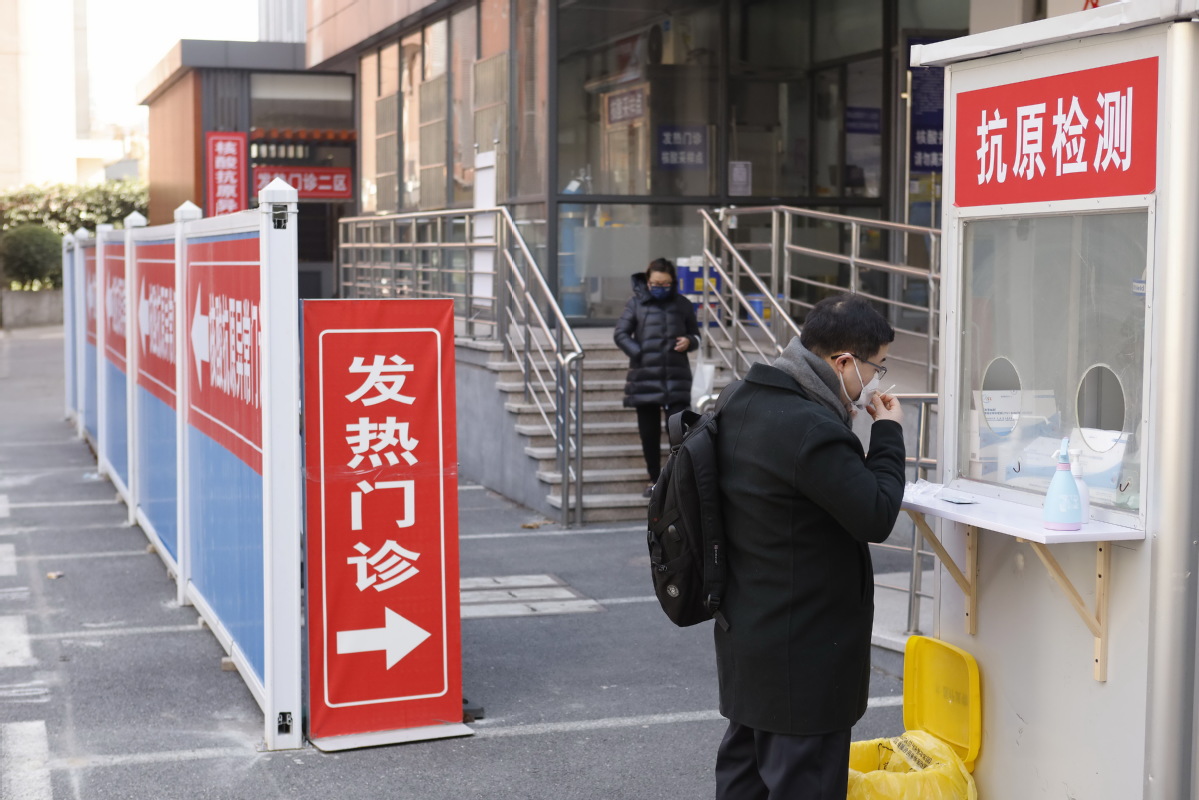
Now since the national COVID-19 prevention and control priorities and subsequent measures have been changed, free nucleic acid testing for all residents will not be conducted across administrative regions. Except for key groups and key places, a nucleic acid test will be conducted only on people who ask for, or require, it. For those who might be infected because of the on-set of fever and other symptoms, they can self-administer antigen detection tests at home. And if the result is positive but symptoms are mild, they will require only to treat the symptoms and rest at home, instead of getting admitted to a hospital or checking into a quarantine center.
Although an antigen detection test is not as sensitive as a nucleic acid test, generally an antigen test result could become positive in two-five days after a person has a fever. In fact, antigen detection is most effective when symptoms are present.
Since antigen tests are convenient and cheap, most countries are distributing antigen detection kits for free among the people so they can distinguish between COVID-19 and other upper respiratory infections.
Besides, if a person tests positive, the family can contact a doctor to prescribe medicines, which would not only be convenient for the patient but also can prevent the run-off of medical resources and cross-infection in the hospital.
As the cough caused by COVID-19 can last for several weeks, sometimes the test result could return positive even after a week of infection or last several weeks without any symptoms. Therefore, in general, a re-test is not recommended; as long as symptoms are not evident, people can wear a mask and rejoin work two-three days later.
On Dec 8, the National Health and Medical Commission said China should be equipped with sufficient antigen detection kits for 15-20 percent of the total population, among which grassroots clinics should complete stockpiling before Tuesday (Dec 20). This means China needs to stock about 210 million antigen detection kits.
But can China stock those many antigen detection kits in short time? In March, when the State Food and Drug Administration first approved antigen detection products for self-inspection, there were only five types of such kits. By Dec 12, at least 42 different types of rapid antigen detection kits had been approved for sale in China, which shows China can have a huge stockpile of antigen detection kits.
Although it is difficult to find antigen detection re-agents in many places including Beijing today, if the kit-makers raise their production to full capacity (one company usually produces 5-10 million kits a day), it could soon lead to oversupply, which in turn would lead to price cuts. And the rapid price cuts could prompt the manufacturers to compromise product quality. Hence, the authorities need to tighten supervision of testing companies and punish the violators according to law.
But despite the quality of antigen detection re-agents being guaranteed, if the authorities allocate medical resources based only on the results of antigen detection tests, it cannot prevent unnecessary run-out of medical resources.
Focusing on the key task of preventing severe illness, antigen detection tests should be conducted only when obvious symptoms are evident. While differential diagnosis can be used to distinguish between seasonal influenza and COVID-19 infection, fair and efficient allocation of medical resources could be made according to need factors such as the age and underlying diseases of the infected.
It's worth mentioning here that the optimized epidemic prevention and control strategy is still aimed at reducing and prolonging the peak infection rate as much as possible, so as to prevent severe cases and medical resource run-offs.
It is necessary to strengthen the facilities and capacity building of clinics and isolation wards in hospitals at all levels, while people should be encouraged to always wear a mask in public places, frequently wash their hands and noses, avoid crowded places and celebrate Spring Festival where they are if possible.
It is more important than ever to promote and popularize knowledge about medical treatment of COVID-19 patients, especially those with common symptoms. The new measures which prescribe home isolation and observation of patients with mild symptoms are no doubt more humane. Yet their effectiveness will also depend on people's health literacy and self-management.
Liu Yuanli is a professor at the Chinese Academy of Medical Sciences and Peking Union Medical College; and Ma Jing is a professor at the Institute for Hospital Management of Tsinghua University. The views don't necessarily represent those of China Daily.
If you have a specific expertise, or would like to share your thought about our stories, then send us your writings at opinion@chinadaily.com.cn, and comment@chinadaily.com.cn.