Modernization model gains traction with intl partners









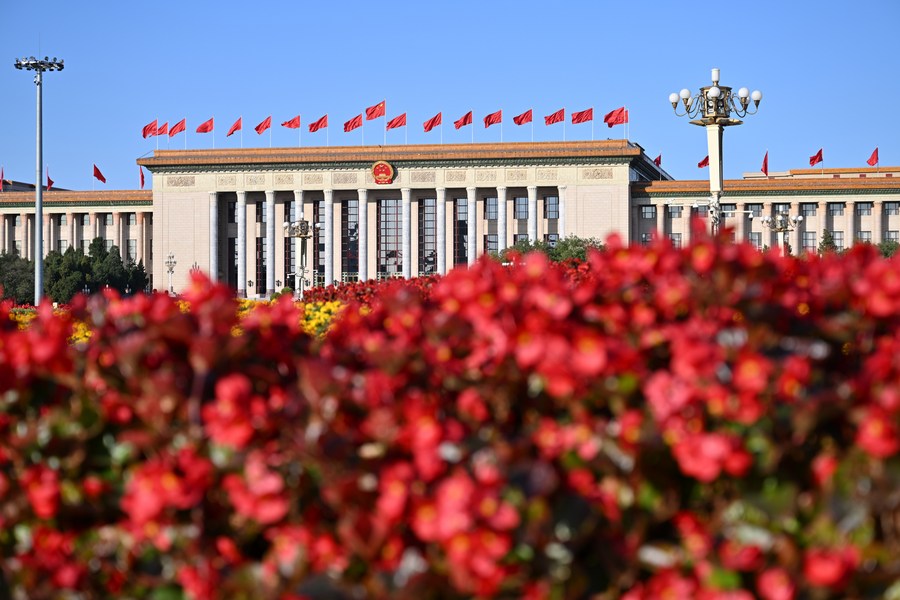
China's increased diplomatic exchanges following the recent 20th National Congress of the Communist Party of China are drawing global attention, with President Xi Jinping meeting with state leaders at home and overseas, Premier Li Keqiang attending several regional summits, and Vice-Premier Han Zheng visiting Singapore, all within a short span of time.
It is expected that these inbound and outbound diplomatic activities will continue in the near future. Since Hong Kong is an open economy, the city's development potential will grow as China's diplomatic arena expands.
The nation's stepped-up diplomatic activities are part of the process of back to normal from COVID-19's impacts. More important, they signal efforts at further opening-up to the world against the backdrop of a capricious global landscape, and the Chinese path to modernization model has gained traction with countries near and afar.
The state leaders who recently visited China or met with Chinese leaders overseas come from countries across Asia, Africa and Europe, and they all share a common goal of seeking collaboration with the world's second-largest economy, which is also the only major economy that provides certainty and opportunities for growth.
China's 40 years of reform and opening-up have created the two miracles of rapid economic growth and social stability. The key to achieving these successes is the country's consistent focus on "minding our own business" amid the vicissitudes of global developments and in the face of challenges.
The past decade was particularly challenging to China. In the face of the trade war waged by the United States, and the incessant provocations from the West over the so-called Xinjiang, Taiwan, Hong Kong and South China Sea questions, China remained focused on "minding its own business" or domestic socioeconomic development, while carefully defusing those external risks.
China has adopted an anti-COVID-19 strategy that fits the country's actual conditions and has effectively minimized deaths and infections over the past three years. Although the country's economic growth has slowed, it is still the fastest among the major economies in the world.
Thanks to effective control of the pandemic, the country's industry and supply chains remain resilient and stable amid challenges.
The 20th Party Congress put forward the concept of the "Chinese path to modernization" in mapping out the country's long-term socioeconomic development. The Chinese path to modernization emphasizes, among other goals, "harmonious coexistence", an ideal cherished in Chinese culture, which demands that China not damage the natural environment or harm the interests of other countries in its course of modernization. With its distinct institutional advantages, there is little doubt China will realize its goals.
China's stable and sustainable development serves as an exemplar for many countries in advancing their development goals with faith. That largely explains why these nations are eager to collaborate with China.
President Xi has repeatedly emphasized "partnership" in his meetings with foreign leaders. This indicates that China is willing to work with all countries to build a community with a shared future for mankind, in sharp contrast to Washington's "America First" and bloc confrontation politics.
The idea of "building a community with a shared future for mankind "is so inclusive that it transcends differences in ideologies, social systems and cultures. China is not only advocating this idea but also working on it. For instance, the Belt and Road Initiative championed by Xi is a mega infrastructural project that welcomes the participation of every nation in the world, including the US. China has also proposed the concept of institutional innovation, which is to reform its own systems to create favorable conditions for participating in international circulation. China's ideas and practices are in line with globalization, and thus are readily accepted and endorsed by the international community.
When President Xi met with German Chancellor Olaf Scholz earlier this month, he proposed four areas of collaboration for the international community: to support all efforts to facilitate the peaceful settlement of the Ukraine crisis; oppose the use or the threat to use nuclear weapons; work together to keep global industrial and supply chains stable; and make joint efforts to tide over civilians in areas affected by the crisis through the winter. His proposals can be summarized as promoting peace, opposing nuclearism, stabilizing market chains and having relief handouts for civilians.
The US, driven by a Cold War mentality, is busy searching for evidence to support its wild claim of "China assisting Russia in the aggression against Ukraine", but to no avail. China, as a responsible major power, instead of taking sides in the Russia-Ukraine conflict, chooses to advocate peace and the well-being of the global community. When the conflict broke out between the two countries, China swiftly sent humanitarian aid to Ukraine, and as Europe is embroiled in an energy crisis, China is willing to provide aid to civilians who are expecting the coldest winter ever. These actions embody the idea of "building a community with a shared future for mankind".
China's diplomatic interactions after the 20th Party Congress have conveyed the messages of inclusiveness, win-win and pragmatism — all of which are qualities crucial to world peace and development.
The country's stepped-up diplomatic interactions are a great boon to the city of Hong Kong, whose small and export-oriented economy can hardly withstand international shock waves and will need a peaceful and friendly political environment to thrive. The city will also benefit from China's strong diplomatic ties with the rest of the world; as a superconnector between the country and the West, it can also play a part in the country's drive to build a community with a shared future for mankind.
The author is a Hong Kong member of the National Committee of the Chinese People's Political Consultative Conference and chairman of the Hong Kong New Era Development Thinktank.