


The exhibition that changed a life










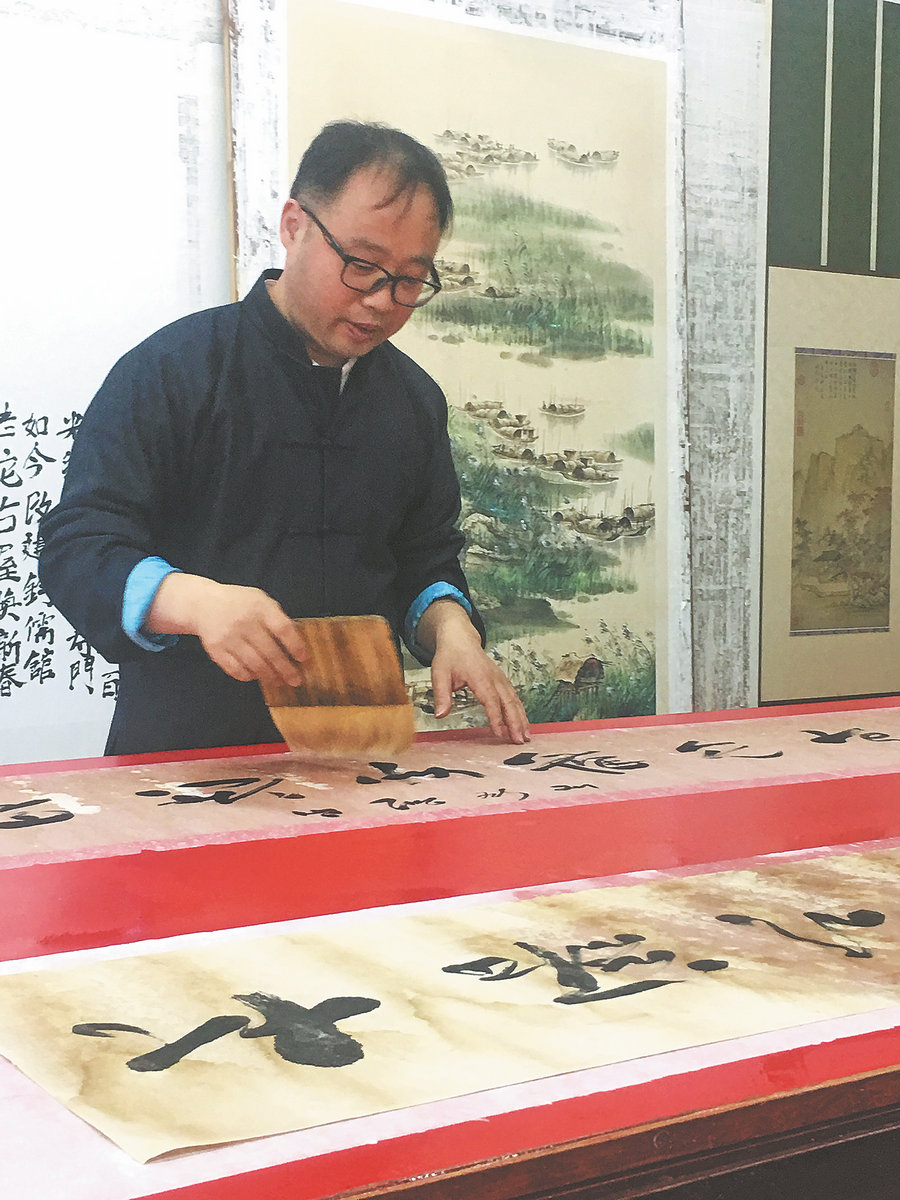
"One's understanding of the painting determines the result of the restoration," Fei says. "You must have good judgement, so you can produce the most suitable result for the work."
In fact, the preparatory work for a framing is more important and more time-consuming than the physical work in completing the assignment, he says.
"Each painting has its own features and poses different challenges for us. I was taught to think things over very carefully, form a plan and then start the work. Once we dip the artwork in water, often the first step in a restoration, we must continue without stopping, or the artwork might be irreversibly harmed."
For example, when he restored a picture of a family tree of Zhu Xi, a Chinese philosopher and Confucian scholar who lived during the Song Dynasty (960-1279), in 2016, he spent more than six months developing the plan, but the work took less than two months.
He talks fondly of one task he completed five years ago, restoring a letter written by Wen Zhengming, a painter and calligrapher of the Ming Dynasty (1368-1644). After patching several hundred holes in the letter, he found a slip of paper with the description of the letter on the back, thought to be a memo written by a Qing Dynasty collector who once owned it.
He carefully removed the slip of paper and mounted it with the letter, so as to "maximize the information".
"There are often marks on some paintings and calligraphy works, such as serial numbers, and we try to keep them when mounting," he says.
To restore ancient paintings, Fei says, he often has to find the proper paper substitute to fix the broken parts. However, ancient paper is a cultural relic that cannot be used in restoring ancient paintings, so that has inspired him to constantly experiment to try and replicate ancient paper. If he is successful, he will use it in his restoration.
"Before the Ming Dynasty, the paper that the literati used was quite different from today," he says. "They used various types of paper that had very different characteristics. Such paper was made with bamboo, hemp and mulberry, and involved very complex techniques."
Many of those techniques have been lost to history, with only a few records buried deep in volumes of historical literature. Fei has searched for them, seeking reliable instructions.
In 2018, when he tried to replicate the paper upon which some Song Dynasty classics were written, he became familiar with the raw materials and dyes after reading several books, but he needed to continue reading to find out how to apply this knowledge.
"Although different ancient books record how to make the paper, if you don't compare them to seek the key procedures in the techniques, you can't replicate the paper to a satisfactory degree."





