Dictionary buzzwords illustrate decade of transformation









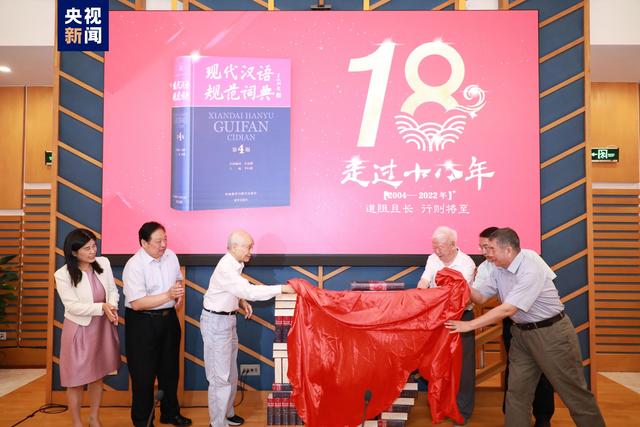
Chinese language scholar Li Yuming was thrilled to see the new word entries that document the progress China has made in the past decade, while flipping through the latest edition of a popular Chinese dictionary released recently.
The Standard Dictionary of Contemporary Chinese, launched in 2004, is now in its fourth edition.
The latest edition incorporates about 1,000 new phrases reflecting changes in China's socioeconomic landscape compared with its last revision eight years ago. Among these are phrases like "new normal "and "overtaking on the bend".
"The around 1,000 buzzwords were compiled from various aspects of society, recording the progress of the times," said Li Xingjian, chief editor of the dictionary. He added that the new edition contains more than 12,000 characters and about 72,000 phrases, presenting a comprehensive picture of contemporary Chinese vocabulary.
Evolution of society
Li Yuming, chair of the China Association of Lexicography, said that the timely revision of the dictionary has documented the evolution of society and satisfies people's need for reference.
Phrases such as "original aspiration", "anti-corruption", "top-level design", "free trade zone", "the Guangdong-Hong Kong-Macao Greater Bay Area", "ecological civilization", "pooling the strength and will", "worst-case scenario thinking", and "last-kilometer", have earned a place in the dictionary.
"The latest version of the dictionary reflects two major trends: the pursuit of green and low-carbon goals in economic and social life, and the significant impact of the internet on our daily life," said Zhang Yiwu, a professor of Chinese language and literature at Peking University.
Terms like "low-carbon economy "and "Weibo", a Chinese microblogging service, were added to the dictionary's second edition in 2010 when the two trendy concepts gained widespread popularity.
In 2014, the phrase "online shopping" was included in the dictionary after the phenomenal development of the e-commerce sector made it familiar to every household.
In this edition, new entries include "peak carbon emissions", "carbon neutrality", "cloud computing", and "mobile payments".
The national carbon market has seen a cumulative turnover of 194 million metric tons of carbon emission quotas worth nearly 8.5 billion yuan (about $1.2 billion) since it became operational in July 2021.
In 2021, China's cloud computing market size surpassed 300 billion yuan. Moreover, the annual transaction scale of mobile payments in China, which was only tens of billions of yuan in 2011, hit 527 trillion yuan in 2021.
The abundance of new words reflects the zeitgeist of society, said Wang Fang, president of the Foreign Language Teaching and Research Press, the publisher of the dictionary. "The emergence of new phrases is a result of the tremendous transformations and outstanding accomplishments in the past decade," Wang added.
New meanings, old words
New terms were coined, and old words also acquired new meanings. This phenomenon is another reminder of how much society has progressed. Among them is the phrase "overtaking on the bend".
The phrase refers to racers with superb skills and courage who surpass their opponents while rounding a bend. In the updated dictionary, it has gained a new figurative connotation of turning difficulties and risks into opportunities, rising to challenges and outperforming others.
From new energy vehicles to online consumption, 5G, high-speed railways, the sharing economy and artificial intelligence, booming emerging industries prove that "overtaking on the bend" is a reality in China.
One of the most salient criteria for the inclusion of new words in the dictionary is their wide use by the general public, said Zhang Shiping, who was in charge of revising the dictionary. "The inclusion of new words has reflected the development of society, which, in turn, has further enriched the language."
New phrases stemming from traditional Chinese classics have also been added to the dictionary, as the preservation of traditional culture now has greater weight.
Readers can acquire knowledge of Chinese culture and improve their own cultural accomplishments by looking up these words in the dictionary, Wang said.
The definitions of some words have been revised in the dictionary under the Civil Code to keep up with the country's progress in the practice of the rule of law. The Civil Code took effect on Jan 1, 2021.
"Dictionaries are the collective memory of the nation," said Li Yuming, adding that as society evolves, new entries must be added to ensure this memory stays fresh.
Xinhua



- China, Algeria expand space cooperation with new satellite launch
- Cross-Strait Chinese New Year bazaar unites cultures in Fuzhou
- Emergency Management Minister Wang Xiangxi under investigation
- Overseas-Chinese group tours Xinjiang as special guests
- China launches satellite for Algeria
- Capital accelerates humanoid robot mass production