



Integrated development drives Tibet to new high









While Tibet was preparing for its peaceful liberation, Chairman Mao Zedong gave instructions to develop the region on a priority basis.
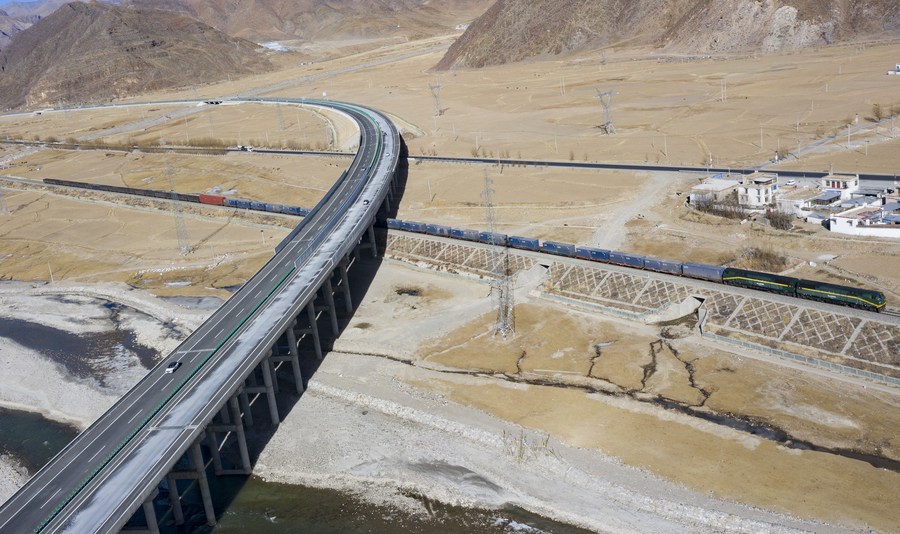
The most important communication links — the Qinghai-Tibet Highway and the Sichuan-Tibet Highway — were extended on the plateau in the 1950s and 1960s, greatly improving connectivity between the Tibet autonomous region and the inland provinces and regions. Since then, the connectivity between Tibet and the rest of the country has improved by leaps and bounds.
Tibet introduced democratic reforms in 1959 to promote equality and unity among all ethnic groups, and liberate and boost the productive forces. In 1960, Tibet began levying agricultural and animal husbandry tax and customs duty, which reflected the State’s sovereignty over Tibet.
After the launch of reform and opening-up in the late 1970s, the central government made Tibet the first region to be exempted from tax on agriculture and animal husbandry, reducing the burden on farmers and herdsmen, in order to narrow the development gap between the region and the rest of the country.
The central government has continued to provide assistance for Tibet’s development, as financial transfers from the central government, and funds from more developed provinces and cities form the bulk of investment in Tibet. And through the Central Symposium on Tibet Work since 1980, the central government has made major strategic decisions on Tibet’s development and mobilized the entire country to support the region. Today, Tibet is fully integrated with the inland regions, both politically and economically.
The central government has adopted important policies for Tibet’s development which cover people’s livelihoods, infrastructure, agriculture and animal husbandry. For instance, to facilitate the Tibetan economy’s continuous growth, it has sanctioned huge amounts of aid. In the new era, new aid models have emerged, with the channels and methods of providing aid for Tibet becoming more diversified and efficient. From 1994 to 2020, nearly 10,000 personnel from various fields helped complete 6,330 projects in Tibet with the support of more developed provinces and regions, as well as central organs and central enterprises.
In fact, Tibet has reached a development stage where it can explore its comparative advantages and achieve breakthroughs in key industries and fields. In 1986, Tibet officially joined an economic organization comprising seven southwestern and southern provinces and regions, developing economic partnerships with them and developed provinces such as Jiangsu and Guangdong.
The central government’s policy is to ensure Tibet pursues sustainable development, not least because it is essential to protect the ecological environment of the Qinghai-Tibet Plateau for the development of the entire Chinese nation. Accordingly, Tibet attaches great importance to the ecology and follows the green development path.
At the same time, by deepening industrial cooperation with the rest of the country, Tibet is transforming its rich natural resources into an economic advantage. For instance, the region is rich in water resources, so it is generating hydroelectric energy and supplying it to some other provinces, especially in summer. That means Tibet is helping the national goal to peak its carbon emissions before 2030 and achieve carbon neutrality before 2060.
The financial transfers and aid from the central government can help Tibet keep energy-intensive and highly polluting industries at bay while attracting sustainable projects and thus upgrade its industrial structure and achieve high-quality development. For example, tourism is a pillar industry of Tibet, which has helped increase people-to-people exchanges and integrate different ethnic groups.
In the past decade, China has faced many challenges, including the eradication of abject poverty in Tibet, in realizing national rejuvenation. But with the support of the central leadership and other provincial governments, Tibet lifted all its 74 poor counties and districts out of poverty by the end of 2019, thus eliminating absolute poverty which had plagued people of all ethnic groups for thousands of years.
Members of all ethnic groups have shared the fruits of China’s economic development. As a result, the overall strength of the Chinese nation has increased. Yet while deciding on the metrics to evaluate high-quality development, the central government takes account of the regional differences and uses differentiated assessment indicators. And by focusing on the green and inclusive development of Tibet, the central government has highlighted the key role of Tibet in national development.
Tibet is expected to take advantage of the Sichuan-Tibet Railway to further integrate into the southwest economic zone, and play a greater role in the country’s dual-circulation development paradigm, by supplying green agricultural and animal husbandry products, as well as traditional Tibetan medicines, and boosting the tourism industry.
By gaining more strength, boosting its economy, and upgrading its industrial structure, Tibet is set to play a bigger role in many fields such as national development and security, and protection of the ecological environment, and energy reserves.
The author is a researcher at the China Tibetology Research Center.
The views don't necessarily represent those of China Daily.





