



Time for Australia, China to rebalance









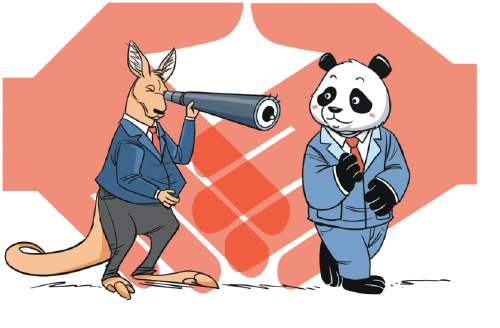
Australia has a new Labor government with a different character, an inclusive tone and new policy agenda. Australia will now rebuild its neglected regional diplomacy and take a more multidimensional approach to regional peace and cooperation.
The previous government's "Trumpist" hyper-politicization of national security has been comprehensively rejected by the Australian people. The change of government therefore provides a rare opportunity to rebalance the Australia-China relationship, should China wish to do so.
Anthony Albanese, the new prime minister, is a leader of substance, who has demonstrated over a lifetime of public service his unique ability to work with rivals to deliver practical outcomes, underscored by a ruthless focus on national interests. He will dispense with the unpopular, divisive tactics deployed for much of the last decade by a series of weak rotating leaders.
Other governments will have little trouble in taking the measure of the man and figuring out what he stands for. The same goes for Albanese's talented foreign minister, Penny Wong, who represents the face of modern Australia, its values and its capacity to play a constructive role in the world.
Albanese says he wants to "do politics better". He believes it is a show of strength to work with people, rather than to seek division and conflict. He is a purposeful leader, who will seek to build rather than to tear down. We can expect no more reckless talk of "war" and the fear-mongering that was the signature of the previous government.
Naturally, some things also stay the same. Both sides of politics in Australia are committed to a continuing US balancing presence in the Pacific. This is unremarkable. What is surprising is the lack of confidence exhibited by some in Australian politics, who feel the need to purchase US approval by unquestioningly following that country into failed wars, from Vietnam to Iraq.
Labor has never supported over-extended US military adventurism and has been proven right. Yet Labor remains committed to the US alliance, as a sovereign and steadfast partner, to deter any future threats. In this respect, Australia will act more like other US allies and less like a "deputy sheriff".
Albanese sees the world through Australian eyes. Just like his idol, John Curtin (Australia's Labor prime minister during World War II), Albanese can be relied upon in any circumstance to put Australia's interests first, no matter how that is received in distant capitals. This is a mark of strength that neighboring countries will respect.
Further, Labor will invest in other pillars of regional security and not rely on distant friends alone. Labor is deeply committed to closer relations with the broader region, stretching from the Pacific islands to Asia and beyond.
At the same time, Labor has an abiding ambition to contribute to and strengthen the international rules-based system embodied in the United Nations and its agencies. We can expect the new government to re-engage in the important work of strengthening regional and global cooperation in partnership with its neighbors, using measured and proportionate language likely to further those goals.
Now that Australia is likely to cease its recent politicization of national security, it will be easier for countries in the region to comprehend Australia's role in the world and the actions it takes in its own interests.
Australia-China relations have deteriorated in recent years with actions from both sides contributing to the situation. Both can now reset. China should lift its economic sanctions, as Australia ceases the provocative language of the previous government. If China's economic measures were in response to hyperbolic claims by the Scott Morrison government that set Australia apart from its peers, the rationale for those measures has now been removed.
Australia and China have a free trade agreement and are both members of the Regional Comprehensive Economic Partnership agreement. They have mutually complementary economies, and both can prosper from further economic cooperation, even as supply chains diversify and transform in the post-COVID-19 era.
There are other important areas of potential common ground. Of primary importance is the challenge of climate change that threatens China and Australia alike. The new Australian government is, finally, committed to real action to fight climate change. Such action will require cooperation, as Australia and China are highly interdependent when it comes to global supply chains that will need to make a green transition.
Australia and China also have deep and abiding people-to-people links and it is in the interests of both countries as we emerge from the pandemic to see a return to normal business travel, tourism, international education and scientific exchange. Australia has a large population of Chinese Australians and others who know relationship building takes patience and understanding, and must not be demonized or distrusted, as occurred in recent times. There will be misunderstandings from time to time, because of our dramatically different political systems, but ordinary people of both countries should not have to bear the brunt of political disagreements.
The new Australian government will likely be much more effective in building partnerships with its neighbors in Asia and the Pacific, as it will focus on practical cooperation and multidimensional, proportionate approaches rather than rhetoric.
If so, Australia will regain its former position of a state "punching above its weight" in the region. It will be a country that China will wish to work with, to demonstrate its own commitment to peace and sustainable development.
The fact that this year marks the 50th anniversary of the establishment of Australia-China diplomatic relations, made possible by a Labor government all those years ago, is an opportunity for mature reassessment, to demonstrate to the world that even societies with different political systems can work together in the common interest.
The views don't necessarily reflect those of China Daily.
The author, a former Australian and multilateral diplomat, is vice-chair of the UN ESCAP Sustainable Business Network, an international consultant.
If you have a specific expertise, or would like to share your thought about our stories, then send us your writings at opinion@chinadaily.com.cn, and comment@chinadaily.com.cn.





