



Creation of filigree is fiddly, but a joy









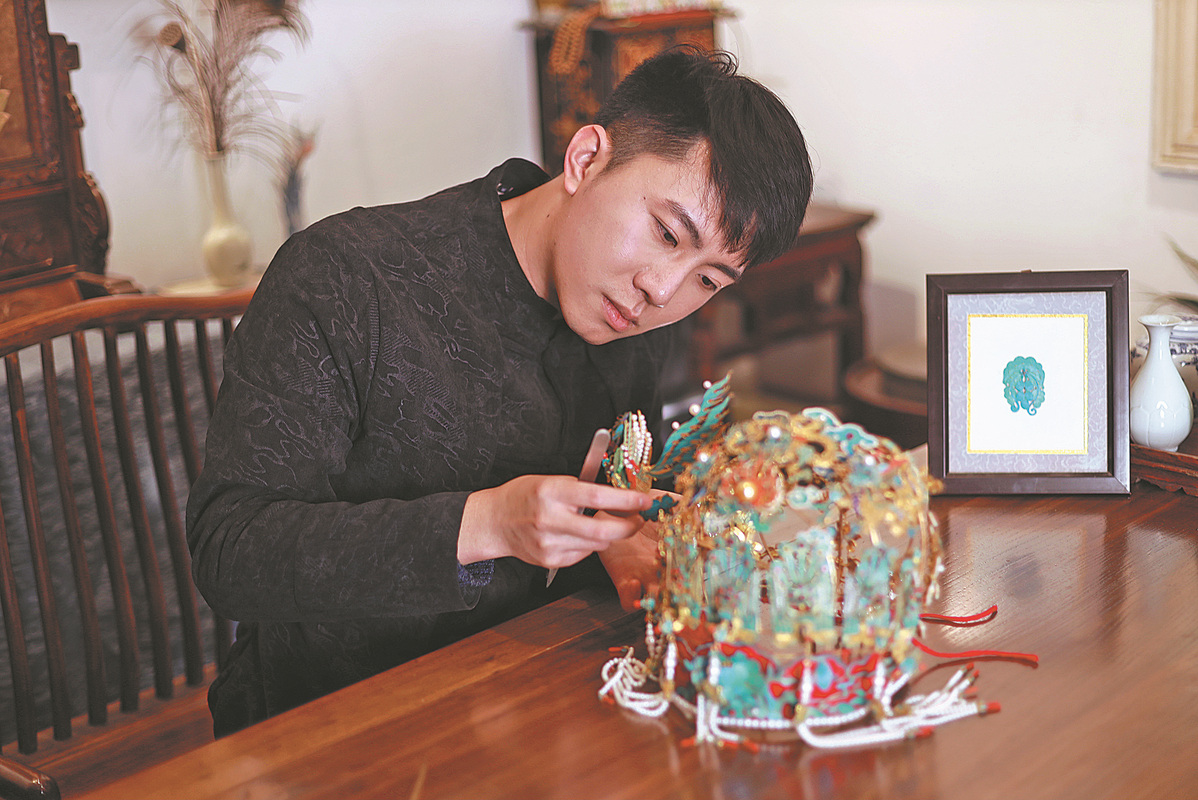
Former porcelain painter turned filigree designer breathing new life into ancient tradition
A young man in Southwest China's Chongqing who set out to update traditional filigree inlay art seven years ago has given the exquisite 1,000-year-old craft a modern twist, helped it regain its former glory and popularized it, especially among the young.
Gu Guoqiang's brand Shugong has annual sales at home and abroad of more than 1,000 pieces worth over 1 million yuan ($156,900), and the filigree designer's creations have been exhibited in museums and jewelry exhibitions in Shanghai, Beijing and Hong Kong.
An intricate form of metalwork often used to make jewelry, filigree weaves twisted threads of gold, silver and copper into structures onto which jade and precious gems can be mounted. The delicate art takes various forms.
Once mainly an embellishment for imperial ornaments like crowns and hats, filigree has since developed into a precious modern form of folk art.
Born in Chongqing's Yubei district in 1994, Gu showed keen interest in painting as a child. He studied sketching and traditional Chinese painting in middle school.
In 2010, he enrolled in the School of Ceramic Art at the Jingdezhen Ceramic University in Jiangxi province. Jingdezhen is the birthplace of Chinese porcelain. The university is the only one that specializes in ceramics in China.
He majored in ceramic design, which entails creating elaborate paintings on ceramics and requires a tremendous amount of study and practice to master.
After graduating four years later, Gu worked as an auction appraiser before getting the chance to study ceramic restoration under a master who repairs cultural relics in Beijing's Palace Museum. During his month with the master, he was introduced to filigree inlay art by chance.
"There are fewer practitioners of filigree inlay, and most are elderly," Gu said. With a desire to keep the craft alive, he returned to Chongqing in 2015 to study the intangible cultural heritage art form under Li Changyi, a master who has been making filigree inlay work for more than 50 years.
In 2008, the tradition was listed as a national intangible cultural heritage, and in 2014, the Chongqing style of filigree was listed as a cultural heritage of the city. Li is its only practitioner.
"The training was very, very difficult and tedious, at first," said Gu, adding that he often became frustrated trying to weld 0.8-millimeter silver thread on a silver plate. "It is incredibly intricate. A little too much melting can ruin an entire piece."
"But if others could learn, why shouldn't I?" Gu told himself whenever he felt like giving up, and remembered his dream and practiced even harder.
His eyes often felt dry after a day's work, but little by little, he learned to draw the metal into threads thinner than a hair and create vivid pieces of art.
Gu said that he tended to make copies at his teacher's studio, mostly large display pieces for orders from Beijing, but what he wanted to do was make new filigree inlay pieces better suited to modern tastes.
In 2017, he opened a tiny studio-the Shugong Classical Jewelry Studio-in Chongqing's Jiangbei district and started to work for himself.
"It was a tough start," he said, adding that although he had invested all his money in the studio, the traditional craft is extremely time-consuming to make and cannot be underpriced.
As a result, it proved difficult to sell and left him with a huge financial burden.
After struggling for a year, his stylish, highly aesthetic pieces-mostly jeweled brooches, earrings, hairpins, rings and pendants-gradually gained recognition and began to be recommended by customers.
Business suddenly bloomed in 2018 along with the rise of the China Chic trend.
Guochao, as it is known in Chinese, is known for fancy designs using different elements from traditional culture. It became widely known in 2018 after the sportswear brand Li-Ning took the fashion world by storm with its Oriental-style designs during New York Fashion Week.
This led to a growing number of Chinese brands joining the trend and creating the China Chic wave.



- PLA Daily: China resolute in winning anti-graft war
- China unveils regulations on Party organization elections within armed forces
- Pick your own cherished flowers in downtown Shanghai
- Liangjiang New Area of Chongqing inaugurated
- 17 rescued Filipino crew members transferred
- Team of Chinese, US scientists identifies key tumor cell state driving cancer growth, drug resistance














