


Tibetan relics show solid bonds between plateau and plains









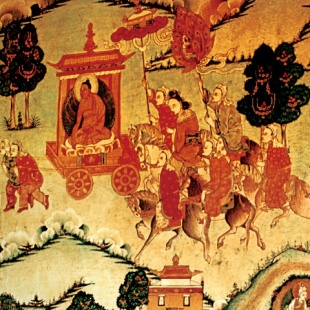
The Potala Palace, a landmark in southwest China's Tibet Autonomous Region, features a mural that illustrates a historic marriage between the Han and Tibetan ethnic groups.
The mural depicts ancient Tibetan officials standing in a row, holding their hands in front of their chests, to welcome Wencheng, a princess of the Tang Dynasty (618-907). The princess traveled to Tibet to marry Tibetan King Songtsen Gampo in the 7th century.
Similar to the mural, many other relics in Tibet have helped further uncover cultural communication and integration between the plateau region and the rest of China.
EVIDENCE ON THE WALL
Murals depicting the marriage between Princess Wencheng and Songtsen Gampo were also found in the Samye Monastery, a famed Tibetan Buddhist temple in Shannan City, Tibet.
"Princess Wencheng brought new varieties of crops to Tibet, and also helped improve local livestock breeds," said Basang, a monk from the monastery. "She made outstanding contributions to the ethnic unity between Han and Tibetan people."
Built in the 8th century on the northern bank of the Yarlung Zangbo River, the Samye Monastery was listed as a key cultural heritage site under national-level protection in 1996. The temple itself is also a manifestation of cultural integration.
The first floor of the main hall, built with rocks, features a Tibetan architectural style. The second floor, on the other hand, uses bricks and wood in a Han style, said Basang, 64, adding that the murals and statues on each floor are also consistent with their respective styles.
The Shalu Monastery, built in 1087 in the city of Xigaze, is another example of a mix of different architectural styles.
The first floor combines traditional Tibetan architecture with cultural traits popular in the Yuan Dynasty (1271-1368). Notable design choices from this period include the hip-and-gable roof, also known as the xieshan roof, blue glazed tiles, and patterns of the flying maid, lion, tiger and flowers on the roof ridge.
Losa Gyatso with the monastery's management committee said Drakpa Gyaltsen, head of the Shalu area during the Yuan Dynasty, presented himself with Emperor Renzong and was granted a gold imperial decree, a jade seal, as well as offerings including gold and silver.
"With the offerings from the emperor and many Han craftsmen invited here to build the monastery, the project has become a symbol for communication, exchanges, integration and unity of different ethnic groups," said Losa Gyatso.
In the Yuan Dynasty, the central government exercised jurisdiction and governance over Tibet.
UNDERGROUND FINDINGS
The earliest archaeological site identified at the heart of the Qinghai-Tibet Plateau so far is the Nwya Devu site, located 4,600 meters above sea level, in northern Tibet.
More than 4,000 stone artifacts, including blades, flakes, chunks and tools, have been recovered at the paleolithic site since 2016.
Scientific analysis showed that the site dated back some 40,000 to 30,000 years, said Dr. Zhang Xiaoling from the Institute of Vertebrate Paleontology and Paleoanthropology, Chinese Academy of Sciences, adding that it is also the highest paleolithic site in altitude ever found in the world so far.
Archaeological findings throughout Tibet's history have also provided abundant evidence to the cultural integration between the region and other areas.
For example, the wooden figurines unearthed from the Sangmda Lungga tomb site in Zanda County in Tibet's Ngari Prefecture are similar in shape to those found in the tombs in the neighboring Xinjiang Uygur Autonomous Region.
He Wei, an associate researcher with the regional cultural relics protection research institute, said the relics site spanning 366 BC to AD 668 witnessed political and economic development, integrating multiple cultures from the surrounding areas, such as those in Xinjiang and the plain areas in central China.
The cultural connection between Tibet and the Yellow River basin was proven at the Karub ruins in the city of Qamdo with the discovery of the millet, a crop customarily planted in northern China. The finding proved the communication between the plateau and northern China some 5,000 years ago.
Shaka Wangdu, a researcher with the regional cultural relics protection research institute, said since ancient times Tibet has been a region where cross-cultural concepts and traditions have met and jointly formed the colorful culture of the plateau.