



Home appliance makers jump into NEV market









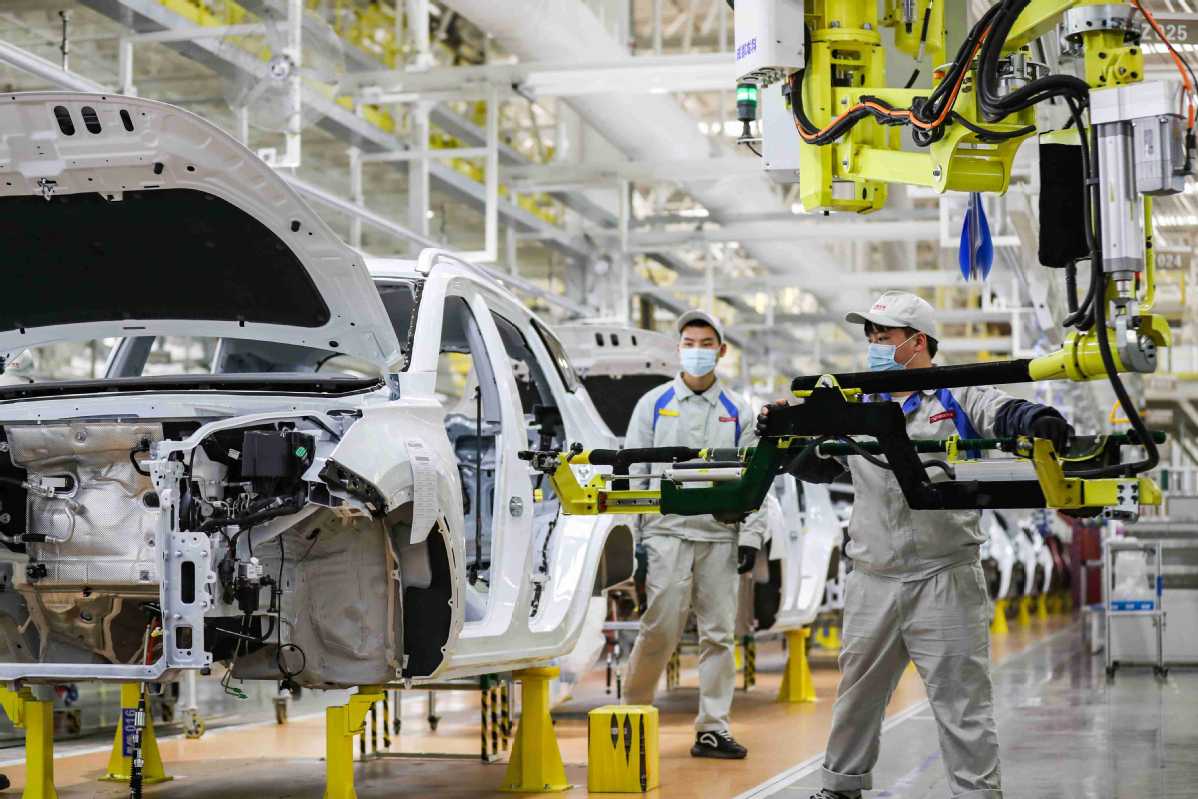
Hisense Home Appliances Group announced in May it had purchased Japanese auto air-conditioner supplier Sanden Holdings Co Ltd for about 1.3 billion yuan.
The home appliances giant, based in Qingdao, Shandong province, said it will use Sanden as the core company to expand into the automotive air-conditioning industry in a bid to achieve its expansion in different industries and enhance the profitability of Sanden.
In August, Gree paid 1.83 billion yuan for a 30.47-percent stake in Zhuhai Yinlong New Energy Co Ltd, which makes electric buses, electric vehicle charging devices and other energy storage systems, after a failed takeover attempt in 2016.
Together with the 17.46-percent stake already held by Gree Chairwoman Dong Mingzhu, Gree controls 47.93 percent of Yinlong's voting rights. The deal would help extend Gree's product portfolio into energy storage and the new energy sector.
Gree's revenue dropped 15 percent and its net profit plummeted 10 percent year-on-year in 2020 as a result of the negative effects of the COVID-19 pandemic.
According to the latest development plan for the NEV industry from 2021 to 2035, approved by the State Council, the country's Cabinet, the proportion of NEVs in the sales of all new vehicles is expected to rise to 20 percent by 2025, and vehicles used in public transportation will be completely electrified by 2035, according to the plan.
Global market research firm International Data Corp has predicted that China's NEV market would grow at a compound annual growth rate of 36.1 percent between 2020 and 2025.
The country's home appliance industry is shrinking in the face of challenges posed by the pandemic and the decline of consumer purchasing power, so traditional manufacturers of home appliances need to seek new business growth points, said Zhang Xiang, a researcher at the Automobile Industry Innovation Research Center, which is part of the North China University of Technology in Beijing.
There are some similarities between vehicle manufacturing and home appliance manufacturing, which gives those companies a measure of competitive advantages in tapping into the automotive sector, he said.
Home appliance companies have expertise in producing air conditioners, touch screens and speakers, and have developed voice recognition technology, which could be used in NEV vehicle-mounted systems, Zhang said.
Instead of choosing to develop cars on its own, Chinese television maker Skyworth Group transferred the ownership of 11 trademarks applicable to vehicles to Skywell New Energy Automobile Group, an NEV manufacturer, for 28 million yuan last year. After the transfer, Tianmei Auto, a subsidiary of Skywell, was officially renamed Skyworth Auto.
Huang Hongsheng, founder of Skyworth and chairman of Skywell, said they plan to launch at least four types of pure electric vehicles between 2020 and 2025, forecasting that a total of 250,000 Skyworth vehicles will be sold in 2025.
Skywell has been producing electric buses for more than 10 years, with seven production centers across the nation. The company has spent 10 billion yuan in auto research and development in the past decade, and will invest another 30 billion yuan in the coming years, Huang said.
The company established a joint venture with Skyworth in 2019 to develop electric vehicle software that can provide artificial intelligence-powered voice interaction capabilities and access internet-of-things devices.
Still, investments by home appliance companies in this new area come with potential risks as competition in the NEV industry heats up, said Zhang of the innovation research center, given that technologies applied to automobile manufacturing can be more complicated than those used in home appliances. In addition, the retail and marketing model of NEVs is totally different.
Luo Lei, deputy secretary-general of the China Automobile Dealers Association, said automobile manufacturing is a very complicated and systematic field, including auto parts manufacturing, assembly and tests, warehousing, logistics and after-sales services.
Traditional carmakers have gained an upper hand in capital and supply chain systems, and their competitiveness shouldn't be underestimated as they master the core technologies of NEVs, Luo said.


















