


Stitching up history










Including Qu and Wang, all five conservators in the textile conservation studio are women. The studio is the only all-female department in the cultural relic conservation center of the Palace Museum, China's biggest facility of its kind.
"Men prefer handling artifacts made of wood and metal," Wang says. "Maybe not so many of them are willing to take up sewing needles. But I think in such a job that is highly demanding about details, we can probably do better."
For instance, they often have to string pearls, the size of millet grains.
"I always wonder what kind of tools were used by ancient artisans to do that," Qu says. "It's still so difficult for us in spite of all kinds of modern technology."
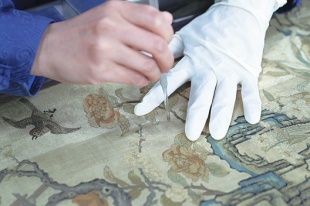
A modern technical approach is helping the conservators work in a way that could not be imagined by ancient artisans, like analysis of specific material. In the old days, people could only refer to their eyes, fingers and experiences.
"A basic principle in our work is not to touch the textile until it is necessary," Chen Yang, a leading conservator in the studio, says. "But even with the help of analytical machines, we cannot be absolutely sure we chose the right material or drafted the perfect conservation plan. Maybe someone in the future will fix our errors."
So, all the fixing on the textiles are "reversible", Chen says. Newly added materials will not be directly sewed with the original fibers. They will be made into liners that can be later removed if necessary. If some parts of paintings on textiles are worn out, the conservators will not use their needles to remake the missing images as a way to retain historical information.
"Conservation is not to bring the perfect appearance to a textile like tailors," Wang says. "Our duty is to 'consolidate' these relics and make them survive as long as possible."
But experienced tailors and artisans can still offer these conservators a helping hand. For example, kesi (literally meaning "cut silk"), a technique representing the highest level of Chinese textile art, is commonly seen on luxurious silk pieces in the Forbidden City, and the technique, which mainly served the royal court during the Qing Dynasty, is now only grasped by some leading artisans in Jiangsu province.
"We refer to them to make the materials," Chen says. "It's also a way to revive traditional craftsmanship through the conservation of cultural relics."
There is a wood-framed loom in the studio. In their spare time, the conservators often practice traditional weaving, even kesi technique. Now, in most cases, they can make the needed materials by themselves.