Green Games make Western media see red









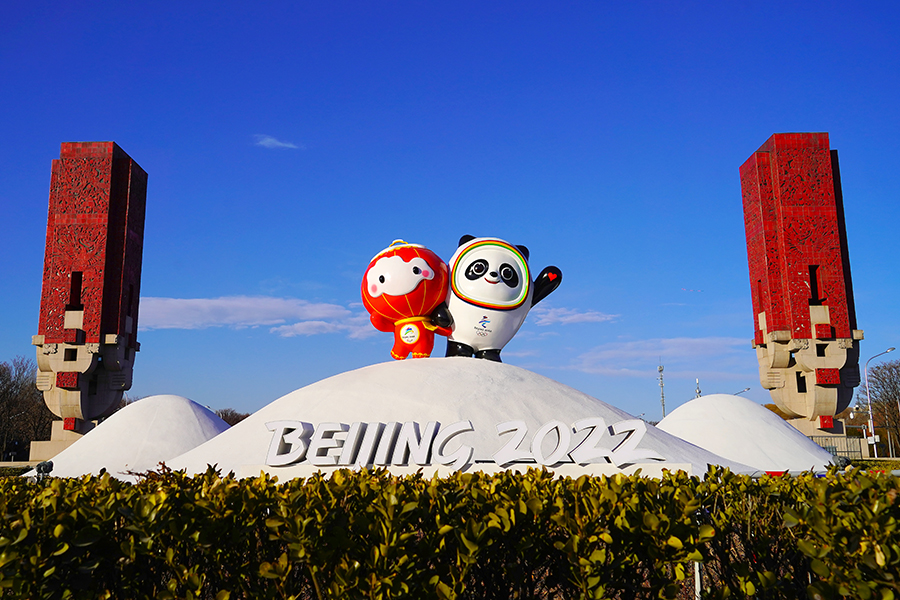
The most important story from the Beijing 2022 Winter Olympic Games is not about a sporting event or an athlete's performance-not one of the many moments of brilliance from athletes which made their countries proud.
The biggest story is one which media outlets in the United States and elsewhere pretend doesn't exist, the one with the biggest implications for the future of our planet-the Beijing Winter Olympics was the first to be completely carbon neutral.
Vehicles transporting personnel between cordoned-off areas of the Olympic "bubble" ran on clean fuels, with a majority of them powered by hydrogen fuel cells. Key buildings from the 2008 Summer Olympics, thanks to excellent maintenance and regular use, were transformed according to green specifications for the Winter Games. Construction of new facilities, comparatively few, met the highest environmental standards.
The Beijing Winter Olympics pioneered carbon dioxide as a natural alternative to refrigerants like hydrofluorocarbons, which alone mitigated 26,000 tons of carbon emissions. And a new grid operating entirely on wind and solar power was built for all 25 sporting venues.
Did any of that matter to the naysayers in the corporate media? No.
If the Winter Olympics' commitment to the environment was brought up without the US media's typical disdain and condescension-a miracle unto itself-it was little more than a footnote.
Conversely, the moaning started right away. The Western media ignored all the city's achievements to tar and feather one of the new sites, the Big Air Shougang ramp for aerial stunts. Some thought it was a nuclear plant (it's not, but more on that later). Others dismissed the scene as a post-apocalyptic eyesore, using desaturated photographs to make the area look like something out of Cormac McCarthy.
What got lost in all the recriminations over the "dystopian" scenery was what the venue really represents. Big Air Shougang was built on the site of a former industrial zone, a Shougang Group steel mill which was shifted out of Beijing's Shijingshan district to reduce pollution before the 2008 Summer Olympics. The abandoned site was repurposed into a public park and scenic area, with the cooling towers of the mill as its most prominent features.
The view those narrow-minded prigs decried as a "hellscape" is actually a prime example of urban renewal, the transformation of a former pollution center into recreational facilities and a museum commemorating the site's history. Many of the mill's former workers found new employment at the reclaimed zone, which also housed the headquarters for the Winter Olympics.
When I visited the site in October to interview former short track speed skating champion and Beijing 2022 organizer Yang Yang, I was struck by the bold juxtaposition of disused industrial relics with clean, green spaces suitable for walking, running and cycling. Since I'd actually been there and seen how impressive it was, the level of vitriol aimed at what would in any other country be deemed an audacious, unique experiment was rankling.
To be fair, some foreign journalists took this into account. But the articles in question made sure to front-load the complaints, using potshots from random sources on social media as their source-or more prominent figures piggybacking on the moment to shore up their anti-China bona fides.
If there was any explanation of the broader significance of Shougang Big Air, it was saved for the middle or end of the story. Considering how few people read past the first couple of paragraphs of any given article-if they go past the headline at all-most readers would only see unbridled negativity.
On other environmental issues, the Western media were far less circumspect, as they seized on the use of artificial snow at the Winter Olympics to decry it as dangerous for athletes and a pox on the environment. They conveniently forgot the Pyeongchang 2018 Winter Games used an estimated 98 percent artificial snow, and the Sochi 2014 Winter Games about 80 percent. These inconvenient facts found mention, again, if at all, deep in the bodies of the stories about Beijing's snow.
Why? Because that context would diminish the Western media's scare tactics.
Reports on artificial snow used in Pyeongchang, a city, coincidentally, in the Republic of Korea, a US ally, downplayed environmental concerns and claimed many athletes preferred artificial snow surfaces because they are more consistent than natural snow. Yet you'd be hard-pressed to find this in any of the reports on Beijing.
As for the snow machines used for the Beijing Games, they ran on renewable energy, and the water they used came primarily from rainfall and surface runoff. After the Winter Olympic and Paralympic Games, the snowmelt will be stored for use in the agriculture and tourism sectors. Rather than being a massive resource guzzler, as many headlines screamed in the run-up to the Games, the snowmaking process is one big recycling loop that keeps waste to a minimum.
The number of venues that can rely on a steady flow of natural snow is getting increasingly small thanks to climate change. It is not a Beijing Winter Olympics problem, or a China problem, it is a global problem-one much of the world is dragging its feet on. But providing a broader perspective on the problem would have required those disingenuous journalists to recognize the Beijing Winter Games as a pioneer in green sporting events.
Instead of accepting reality and sharing how Beijing managed to pull off a carbon-neutral Winter Olympics in the middle of a pandemic, the Western media chose to put an electron microscope over whatever minute issues it could scrounge up-if it wasn't inventing them in the first place.
But this isn't new. It's practically paint-by-number. All China can do is continue on its way to a zero-emissions future, especially as the Winter Olympics has shown how large-scale events can be hosted keeping the environment firmly in mind.
The author is a writer with China Daily.