



50 years after Nixon's visit, time for kung fu diplomacy










Fifty years ago on February 21, 1972, then-US president Richard Nixon arrived in Beijing, breaking the ice of the Cold War. By 1979 formal relations were established. A honeymoon era of China-US relations began paralleling China's policies of opening its economy and encouraging foreign investment.
I remember those years well. As the first wave of American exchange students to study Chinese in China, it was a time of hope and anticipation. In the years that followed throughout the 1980s and 1990s, as a lawyer advising multinational corporations anxiously investing in the opportunities that China offered, everything was an adrenaline rush. In 1992, I personally closed negotiations ending the largest technology transfer dispute between China and the US at that time. It opened the floodgates for American investment into China. Then we had China's entry into WTO in 2001 and floods of international investment leading up to the 2008 Olympics anticipating America acceptance of China into the club of global powers.
So what went wrong?
Today Washington's agenda is not about engaging China but containing it. Is it all about trade deficits and technology competition? Actually, ideology permeates the thinking of Washington DC politicians. The idea of accepting another viewpoint, much less another economic or political system, is intolerable among Washington elites. Today intolerance is deeply imbedded in both Washington's international relations and own domestic party politics, where political divisions are stark and ideology itself is split along sharp lines of incompatible duality.
At a level deeper than political ideology is philosophy. Among the Washington elite, it is all about opposites, polarities, exclusion, expulsion, and conflicting ideologies. In Western thinking there is only black versus white, right versus wrong, man versus nature, good versus bad, them versus us, and so on. This is where the incompatibility of dialogue begins.
Chinese philosophy does not seek conflict but rather a constant balancing of yin and yang. This can be understood from the architecture of Beijing. Chinese culture seeks harmony and balance, equanimity and collective consciousness, and a deep recognition that man does not overcome nature, rather we exist as part of the natural world. In a nutshell, the one difference between the inherent philosophies of these two countries lies in a single concept. American ideology is all about duality. Chinese philosophy seeks non-duality.
An innate aspect of the Chinese collective unconscious that has roots in Confucian tradition. Philosophical influences that are both Taoist and Buddhist embedded in the national cultural psyche allow for adept flexibility in response to crisis and a vision of positive hope when faced with negative adversity. This ability to see positive through negative and to use that perception to turn even the most difficult situations into advantages is a deeply rooted part of Chinese culture and the collective unconscious of the Chinese people. These are three aspects of the Chinese collective unconscious that are ever-present in everyone in China always and that is a resilience that no Western country or people have.
The lens of kung fu offers insight into many Chinese values. Moreover, there are many core values inherent in kung fu that we can apply to our daily lives. It is not about fighting but about self- discipline, perseverance, concentration and focus, working hard to make oneself a better person rather than just learning to fight.
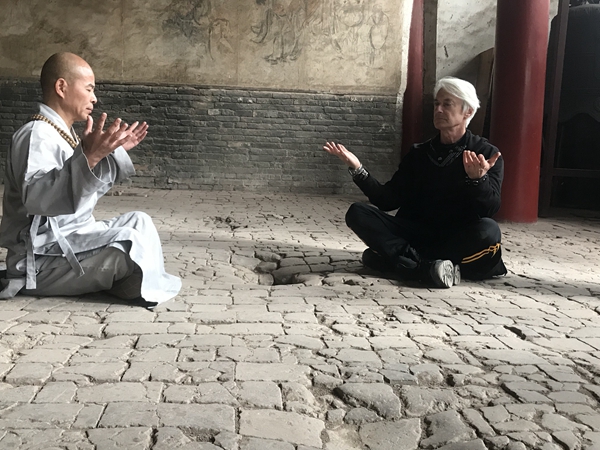
I recently had the pleasure of directing and writing the screenplay for a documentary feature film called "Searching for Kung Fu" produced by China Daily. Having over 40 years of hard martial arts training behind me in different styles, the film was an exploration into the origins of martial arts bringing me and our film team right back to the Shaolin Monastery where the legend began. The journey through China's legacy of martial arts traditions brought us to understand that it is not about fighting, but striving and there are key values that are inherent in the martial arts. These range from perseverance, loyalty, respect, roots and identity, centering, harmony with nature, flow, emptiness, and at the core of everything non-violence.
In 1971, the "ping-pong diplomacy" opened the door paving the way for Nixon's visit to China and a blueprint for forging diplomatic relations. It was pretty simple and straightforward at a time when world circumstances were quite complicated. An American ping-pong team came and played with China's. A conversation began around sports and goodwill followed. Maybe we need a new kind of ping-pong diplomacy in this era of global confusion. So how about kung fu diplomacy?
Everyone loves a Bruce Lee or Jackie Chan movie. The rap legend Wu Tang Clan built its entire music legacy on images of kung fu as symbols of the righteousness of African-Americans struggling for equality and justice. They drew from the values expressed in the Chinese traditions underlying kung fu. So if we really want to have people-to-people exchanges, let us start with cultural and sports. When all things break down in international relations, the last things that remain are culture and sports. Likewise, when it comes time to kickstart dialogue again — and that time will eventually come — then it usually begins with cultural and sports exchanges.
So if martial arts become the new ping-pong of diplomacy, then we need to understand what this term really means. The Chinese term for martial arts is wushu. Actually "martial" is a mistranslation. The character Wu (武) is composed of two radicals Zhi (止), which means to stop or halt, and Ge (戈), which means a weapon. So the literal translation of wushu is the "art of halting weapons or fighting," more precisely expressed as the "art of non-violence."
So if American values are really those that Martin Luther King stood up for, then China and the US have a lot to talk about with kung fu diplomacy.
The author is a US documentary filmmaker and a senior international fellow at the Center for China and Globalization.
The views don't necessarily reflect those of China Daily.
If you have a specific expertise, or would like to share your thought about our stories, then send us your writings at opinion@chinadaily.com.cn, and comment@chinadaily.com.cn.





