



Europe's 'third way'









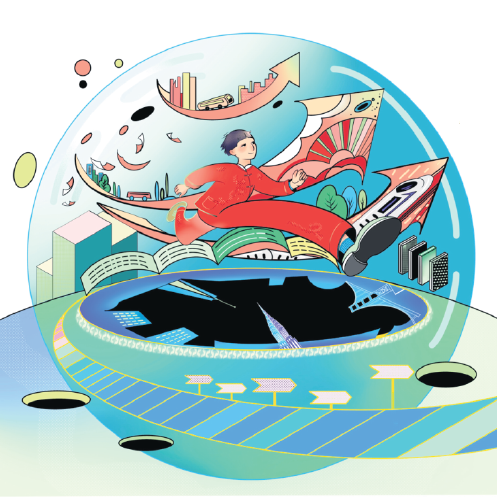
It is only by becoming a stronger global player and having strategic au-tonomy that the EU can preserve its own geopolitical interests
The European Union has a complex relationship with the United States, an increasingly complicated one with China and its views on US-China interactions are a mix of hope and trepidation.
EU officials including Josep Borrell, the bloc's high representative for foreign and security policy, have warned of the global fallout from the ongoing "intense competition" between Washington and Beijing.
The best way forward, according to many in Brussels, is to avoid falling into a "binary trap" between the US and China by developing a European "third way" in its relations with Beijing. EU governments are also building up the bloc's own global profile through more "strategic autonomy" in foreign policy as well as security, trade, connectivity and other areas.
The EU has close ties with both the US and China, although policymakers in Brussels often say that differences between the EU and Chinese political systems and the EU's lengthy common history and shared values with the US mean that Brussels is "closer to Washington than to Beijing."
But that closeness is not always on show.
Unlike the previous US administration, Joe Biden and his team certainly voice support for transatlantic solidarity and contacts between Washington and European capitals are frequent. But Biden's "America is back" slogan has prompted fears that Washington still wants the EU to play junior partner.
Ties between the EU and the US are also muddied by an array of old and new irritants, including the Biden administration's very open lobbying against the Comprehensive Agreement on Investment that the EU and China concluded at the end of 2020.
The surprise announcement late last year that Australia had jettisoned plans to buy French submarines in favor of US nuclear submarines and the subsequent establishment of the trilateral AUKUS(Australia-United Kingdom-US) security pact created anger in Europe.
Tempers cooled off but the US has once again ruffled the EU's feathers by keeping European capitals out of the loop in ongoing contacts with Russia over tensions in Ukraine, although the EU has now stepped in with its own diplomatic efforts. Transatlantic trust, also eroded by the US failure to inform allies before its rushed departure from Afghanistan last August, may therefore be difficult to rebuild, whatever the public pronouncements.
Meanwhile, EU-China ties have entered a new and more difficult phase. In March 2019, the EU described China as a "partner, competitor and systemic rival". Unfortunately, the word "systemic", while referring to the very different political systems of the EU and China, seems in translation often to have become "systematic", which is something very different-and less factual.
Since then, most EU states' attitudes toward China have hardened further following a European Parliament resolution which effectively puts on ice the ratification of the investment agreement struck with Beijing at the end of 2020. This agreement-on-hold includes provisions for China to open its market for a number of European industrial sectors and also Chinese commitments to sign up to certain International Labor Organization labor market standards. The latest row over Lithuania's relations with Taiwan, where Lithuania intends to divert from the one-China principle that both the EU and the US adhere to, is an added complication.
However, given the multi-faceted nature of EU-China ties, Beijing's enhanced geopolitical role, expanding economic outreach and position as the EU's biggest trading partner, having overtaken the US in 2020, there has been no severing of contacts between EU and Chinese leaders, policymakers and business representatives. In fact, an EU-China summit is expected in March.
European policymakers keep a close watch on relations between Washington and Beijing, and, unlike the US, the EU does not see China as an "existential threat". EU governments certainly do not want a hot conflict or another Cold War and believe that global challenges-such as dealing with the pandemic, tackling climate change and ensuring sustainable development-all require US-China cooperation.
The popular idea of the Thucydides Trap, the inevitability of hot conflict between the hegemon and a rising power that may become the new number one, is not embraced with too much enthusiasm by Europeans.
True, China's population size alone, four times the US' population, seems to make it inevitable that, one day, China's fast growing economy will be larger than that of the US. However, once that happens, China's GDP per head will still be no more than one-fourth that of the US.
Moreover, Thucydides' history writing is 2,500 years old, Eurocentric in its approach and does not reflect modern-day interconnections and interdependencies.
That said, the EU does worry that any bilateral deals between the US and China could lock them out of the Chinese market. This is very similar to the way the US worried that the EU-China Investment Agreement might lock US companies out.
The truth is that while the US and the EU can work together when their interests align in dealing with China, they are also permanent competitors and rivals, with very different priorities and concerns.
Instead of getting entrenched in the US-China dispute, Borrell, echoing views in most European capitals, has said the EU must look at the world from its own point of view, act to defend its values and interests and proceed forward in "its own way".
The coming years will be challenging for Europe as the US and China adjust, adapt, confront and compete with each other.
EU policymakers are conscious that they will have to build up their own network of friends across the world through trade, investments and conversations on security. Building up the EU's strategic autonomy is also an important element in ensuring that Europe remains a relevant geopolitical actor.
Shada Islam is founder of New Horizons Project and an independent analyst and commentator on EU-Asia relations. Jan Willem Blankert is a former EU diplomat, special adviser for relations between the European Union and the Association of Southeast Asian Nations and author of China Rising, Will the West Be Able to Cope.
The authors contributed this article to China Watch, a think tank powered by China Daily. The views do not necessarily reflect those of China Daily.
Contact the editor at editor@chinawatch.cn





