



Lower living costs to boost birth rate









Because of the declining birth rate, China may, sooner than expected, become an aged society with a shrinking birth rate and negative population growth. According to a report issued on Monday, the number of new births on the Chinese mainland in 2021 was 10.62 million, compared with about 12 million in 2020. It also has a record low fertility rate of 7.52 births per 1,000 people. This means China is facing the biggest demographic challenge in modern times.
China's natural population growth rate was only 0.034 percent for 2021, the lowest since 1960, according to the government data released on Monday.
The country has seen three baby booms since the founding of New China in 1949. The first took place in the 1950s, the second between 1962 and 1976, and the third in the 1980s, when the baby boomers in the previous periods grew up and had their own families. In particular, the first two baby booms increased the population by about 400 million, which in turn increased China's demographic dividends, facilitating its rapid economic development.
However, new births and the fertility rate have continued to decline since 1949-except for the three baby booms. Actually, China's birth rate in 2021 was much lower than the global population outlook forecasted by the United Nations in 2019, and also lower than those of many developed countries. Also, the falling fertility rate means further shrinking of the demographic dividends and inadequate resources to meet China's development demands.
To solve the problem, the government further eased the family planning policy, allowing all couples to have three children and implemented relevant supporting measures.
Demographic trends, especially falling fertility rates, are usually irreversible. Still, demographers and economists say macroeconomic development, social systems and cultures and individual choices can greatly influence people's willingness to have children.
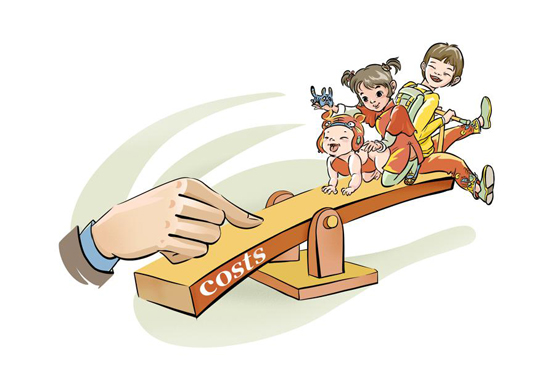
Although the government wants its pronatalist policies to succeed, it is important to know the crucial determinant factor of population growth. Having children is essentially an economic decision, with the costs and benefits of having a child playing a key role in a family making such a decision.
As for benefits, children carry forward the family name and can help strengthen the bond between a husband and wife. And having children gives an assurance to parents that they will have someone to fall back on when they grow old.
Although elderly people in China rely less on their offspring nowadays because of the improvement in the pension system, the sky-high housing prices, high costs of raising a child are still discouraging many couples from having more than one child-or any children at all.
More importantly, in most cases, women still shoulder an overwhelming majority of the responsibilities of bringing up a child, and they are tired of rushing back and forth between work and home to take care of their children. Plus, women usually face more insecurity because they find themselves at a disadvantage at the workplace after giving birth.
Moreover, the high cost of education, due mainly to the imbalanced distribution of education resources no matter in urban or rural areas, discourages many couples to have more children. The intense competition to get children admitted to the best schools means parents need to spend huge amounts of money and energy on their kids' education.
To address these problems, especially to ease the education burden of students, and by default their parents, the government introduced some policies, including the "double reduction" policy, recently. Yet many parents, especially those well educated, are still not sure whether child-raising costs, especially the spending on education, will decrease, so they may still be reluctant to have more children.
To reduce the cost of education, therefore, the central and local governments should invest more in education and balance the distribution of education resources so more children can get admitted to "good schools" and universities.
Housing is another big problem that couples, particularly young couples living in cities, face. According to official data, housing cost accounts for the highest percentage of household expenses for an average family. The more children a family has, the more rooms or bigger apartments it needs, so the fertility rate is relatively higher in areas with lower housing prices.
It is also the main reason why many young couples who cannot afford sky-high housing prices in first-tier cities do not want to have more than one child. So, to address the problem and reduce young couples' burden, local governments should provide more low-rent public housing.
Furthermore, the gender gap in employment is narrowing. At present, women's employment rate in China is 80.5 percent, and that of women of childbearing age, especially those with higher qualifications, is relatively high.
But traditionally, mothers have been sharing most of the responsibilities of raising a child, which makes it difficult for women to balance family and job. Many even pay a penalty for giving birth in the form of wage cut, demotion or dismissal from service.
And due to the rising numbers of well-educated and financially independent women, quite a few women consider marriage more of an option than a necessity.
All these factors have also played a role in the decline of the birth rate.
Therefore, reducing the cost of raising children and easing the economic, social and familial pressure on new mothers are critical to making the three-child policy a success. It is also necessary to issue more pronatalist policies.
For example, to encourage couples to have more children, the government should increase maternity benefits or reduce the individual income tax, make provisions for longer paid maternity leave or flexible working hours for working mothers, and help build more day childcare centers, which have proven to help ease the pressure on new mothers.
The government should also urge employers to provide training for working mothers and create a women-friendly culture at the workplace. And men must realize that raising children isn't only a mother's job, and fathers should shoulder their part of the responsibilities. Only with the joint efforts of families and whole society can the three-child policy be a success.
The author is a professor at the Institute of Population and Labor Economics at the Chinese Academy of Social Sciences.
The views don't necessarily reflect those of China Daily.
If you have a specific expertise and would like to contribute to China Daily, please contact us at opinion@chinadaily.com.cn, and comment@chinadaily.com.cn.





