



Continued concatenation









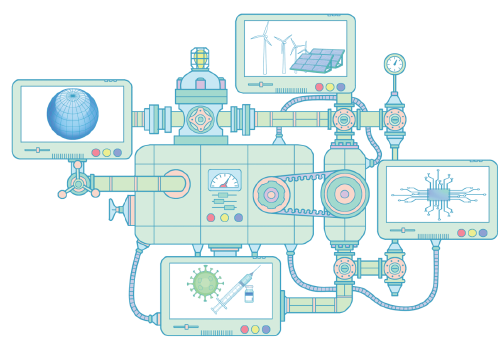
Global industrial and supply chains are undergoing some major changes, but some things remain unchanged
Great changes in the global economic landscape, the COVID-19 pandemic, technological revolution and green transformation are having a profound impact on the division of labor in the global industrial and supply chains that will affect the global economy for a long time to come.
The world's economic landscape has been undergoing seismic changes for some time. The share of emerging and developing economies in the global economy is increasing rapidly. Measured by purchasing power parity, emerging and developing economies accounted for nearly 60 percent in 2019. The influence of non-economic factors on the global industrial division and supply chain system is increasing, as is obvious in some strategic, public and national security-related industries. The global industrial chain is also becoming decentralized and multi-centralized. In the past, North America, Europe and the Asia-Pacific were considered the centers of the global economy. Now, multi-polarization has led to a balance between the developed and emerging economies. In addition, in line with changes in the economic landscape, the importance of companies from different countries in the global industrial and supply chains is also changing, with the influence of industry leaders in emerging and developing economies increasing.
The world has been battered by the COVID-19 pandemic since 2020.Its impact on the industrial and supply chains is mainly reflected in three aspects. First, the requirements of large economies for independent, secure, controllable or resilient industrial and supply chains have increased. Second, industrial differentiation has further deepened, and the distinction between strategic industrial sectors and market-oriented industrial sectors has been reinforced. Third, social governance and anti-pandemic governance capacity have become basic capabilities that determine the status and attractiveness of different countries and regions in the division of labor in the global industrial and supply chains.
At the same time, digital technology is having a profound impact on the division of labor in the industrial and supply chains. Digital technology has become highly integrated with production and life, enhancing the tradability of services and the stability of industrial and supply chains. The penetration of digital technology into the service industry is gradually deepening, and digital trade and services have become the new engine for the growth of the service trade. In 2020, despite the impact of the COVID-19 pandemic, global digital trade exports grew by 3.8 percent, accounting for 62.8 percent of the trade in services and contributing 98.3 percent to the growth of service exports. Also, digital penetration has deepened and internet platforms have emerged that can quickly restore the stability of the industrial chain through intelligent means. However, digital technology will also affect the comparative advantages of developed and developing countries in the division of labor. Because of the rapid growth of the digital economy, the importance of labor will be relatively reduced, so developed countries can regain competitiveness, and developing countries' comparative advantage of low-cost labor will be weakened.
The green transformation will also change the cost structure of the division of labor significantly, and the proportion of environmental cost in the total cost will be greatly increased. In the past, cost determined competitiveness. In the new development context of peaking carbon emissions and achieving carbon neutrality, the proportion of environmental cost will greatly increase in the future. In addition, the transformation will promote the global industrial chain to be green, low-carbon and recyclable.
But although the global industrial and supply chains are undergoing some major changes, the transformation of the world economic development pattern will remain the same in three aspects.
First, although environmental costs are increasing and new factors of production such as big data are becoming more influential, low cost will always be the fundamental determinant of competitiveness. Second, the general trend of deepening division of labor in the global industrial chain will not change. COVID-19 and the changes in the economic landscape will bring changes to the global division of labor at regional and sub-regional levels, but vertical and horizontal international division of labor in the value chain will remain unchanged. Finally, although digital technology will to some extent make it difficult for developing countries to exploit the competitive advantage of low-cost labor, they will have the opportunity to catch up and even surpass developed countries as long as they pay attention to the construction of new digital infrastructure and investment in human capital. In 2019, the digital economy in developing countries grew by 7.9 percent, far outpacing that of developed countries (4.5 percent).
Innovation ability is the key. An environment conducive to innovation will encourage production elements to pour into the real economy and help foster innovation, facilitate the transformation of small innovative businesses into big ones, and encourage the constant emergence of innovative enterprises. For an innovative economy, there must be a spirit of excellence and optimism believing that there will be more and better new technologies in the future.
The author is president of the Center for International Knowledge on Development and a research fellow at the Development Research Center of the State Council.
The author contributed this article to China Watch, a think tank powered by China Daily.
The views do not necessarily reflect those of China Daily.
If you have a specific expertise, or would like to share your thought about our stories, then send us your writings at opinion@chinadaily.com.cn, and comment@chinadaily.com.cn.





