Gansu ruins shed light on ancient civilization









Archaeological ruins approximately 5,000 years old on the Loess Plateau may provide crucial clues about the infancy of Chinese civilization.
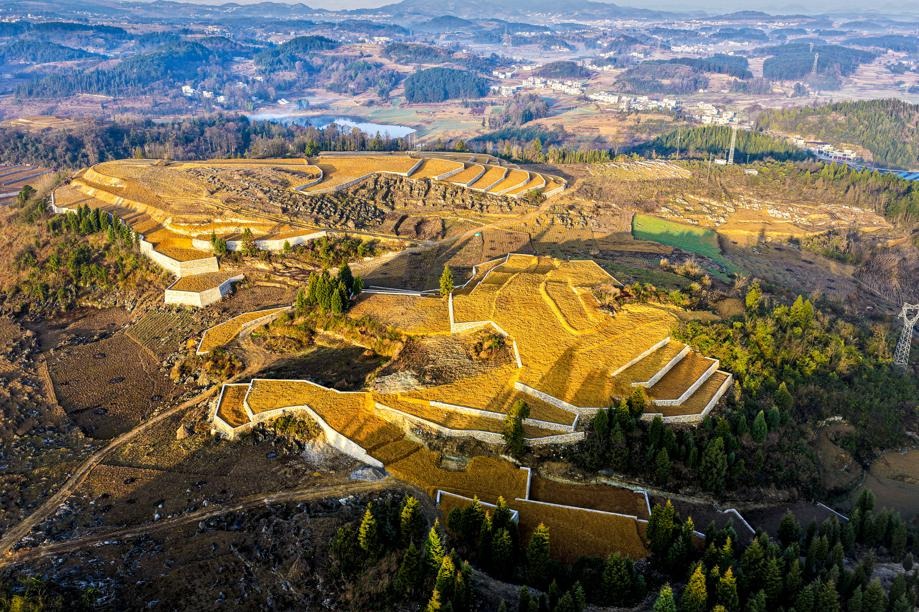
New archaeological excavations this year at the Nanzuo heritage site in Qingyang, Gansu province, have uncovered more of one of the biggest known human settlement complexes of its time in China, according to an online conference held by the National Cultural Heritage Administration on Wednesday.
"The site offers key physical evidence for the pivotal role of the middle reaches of the Yellow River in the birth of Chinese civilization," said Han Jianye, a professor at Renmin University of China who is leading the excavation.
A joint archaeological team involving the university, the Gansu Provincial Institute of Cultural Relics and Archaeology and other institutions is in charge of the ongoing excavation.
"The site is also significant to help us figure out how early states formed," Han said.
The Nanzuo site, dating back 4,600 to 5,200 years, was found in 1958, and previous excavations were undertaken at the site in the 1980s and 1990s.
A rammed earth foundation was excavated, with its structure and spacious indoor area, as large as 630 square meters, prompting archaeologists to speculate it was a "palace".
From 2014 to last year, archaeologists continued research around the "palace" and found nine rammed earth terraces in the area. Several more foundations were discovered, which were scrutinized in the latest round of formal excavation this year.
Han said the focus was the core area of the ruins, covering roughly 30 hectares. The area was surrounded by three layers of defensive moats.
The layout of the nine terraces was symmetrical and they were located in the center of the core area. Han said the strict arrangement was rarely seen in previously discovered settlements from that period.
One of the terraces was excavated this year. Despite many millenniums of erosion, the 880-sq-m terrace still stands nearly 3 meters above the ground.
"And the 'palatial' constructions and the defensive system also have extraordinary size," he said. "These findings jointly reflect a strong public power, indicating this region had entered an era of civilization."
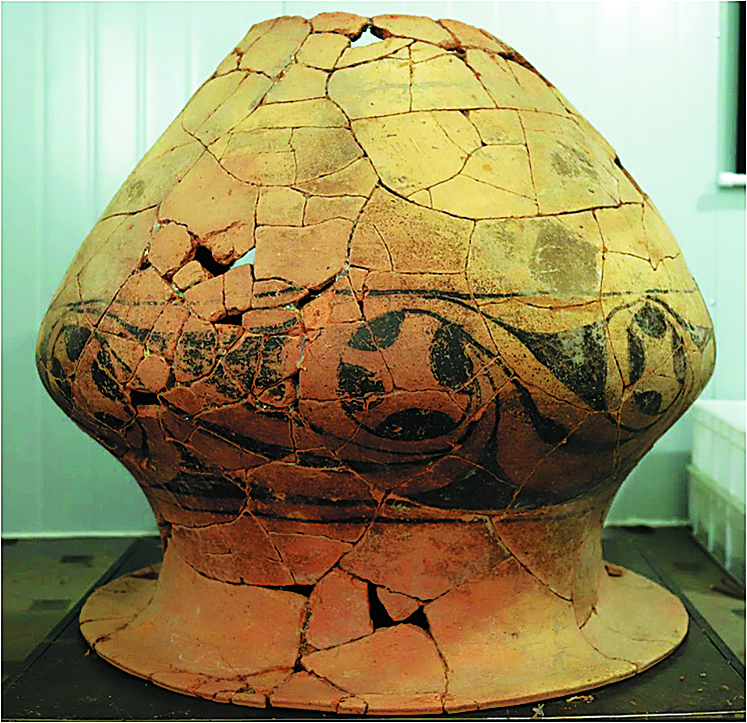
Key cultural relics unearthed this year include a large amount of painted pottery, with a 74-cm-tall jar being a highlight.
Carbonized rice showed the development of agriculture, and arrows made of stone and bones, which were dyed red, may also help archaeologists picture the ritual system at that time.
In the much later Zhou Dynasty (c.11th century-256 BC), red arrows were bestowed by kings as gifts to vassal states.
"The pottery, arrows and some other artifacts feature special patterns, and they would be used for sacrifices and ceremonies," Han said.
Investigations in recent years suggest the Nanzuo site could spread across an area of 600 hectares, 200 hectares larger than the Shimao site in Shaanxi province, the biggest prehistoric city ruins ever found in China.
"If such huge ruins could be confirmed to be of the same period through upcoming research, Nanzuo would probably be a World Heritage Site-level discovery," said Zhang Chi, an archaeology professor at Peking University.
"The discovered buildings, together with those still unknown, could compose an architectural compound whose scale is beyond our imagination."
Based on the unearthed artifacts, archaeologists now tend to believe the Nanzuo site, at least its core area, belongs to the late period of the Yangshao Culture, dating back 5,000 to 7,000 years across North China.
The discovery of the Yangshao Culture a century ago is generally considered to have been the birth of modern Chinese archaeology. In scholars' eyes, the recent Nanzuo findings are a good anniversary gift that throws new light on studies of Yangshao Culture.
Though the cultural center of Yangshao was in today's Central Chinese provinces such as Henan and Shanxi, archaeological findings showed the eastern part of today's Gansu province was probably one of its origins.
"In the late period of Yangshao Culture, its people returned to their homeland, as Nanzuo indicates," said Li Xinwei, a researcher at the Chinese Academy of Social Sciences' Institute of Archaeology.
"The site represents a type of civilization, which may have had lasting influence on the appearance of large-scale cities in the later period across Northwest China, like Shimao, but the missing links between them await unveiling," Li said.