



RCEP set to unleash great trade potential









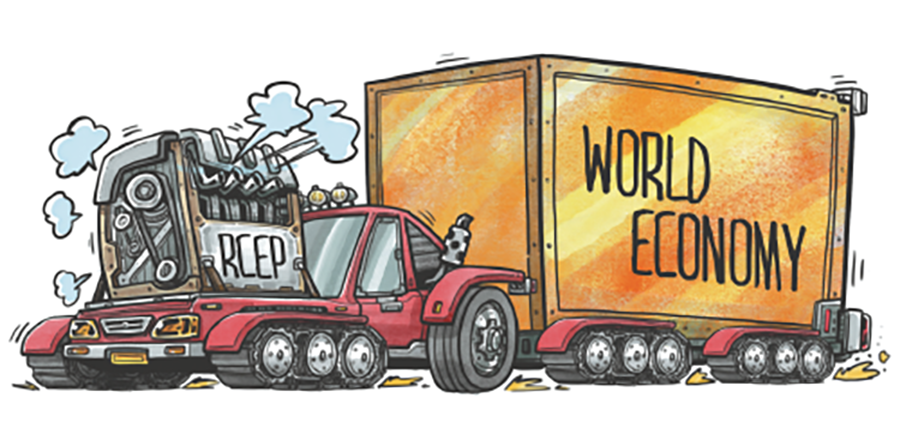
Six member states from the Association of Southeast Asian Nations, Brunei, Cambodia, Laos, Singapore, Thailand and Vietnam-along with four non-ASEAN countries, namely China, Japan, New Zealand and Australia-h(huán)ave formally submitted their Regional Comprehensive Economic Partnership agreement ratifications to ASEAN's secretariat, with the deal expected to come into force in these 10 countries at the start of next year.
The RCEP reaches beyond the concept of "regional economic integration".
Why is the RCEP considered as the free trade agreement with the highest potential in the world? What is the significance of its becoming a reality?
After the agreement takes effect, the global economy will enter a new era of "Asian times" or "Asia-Pacific times". In the future, the Asia-Pacific region will remain the economic growth powerhouse of the world, and Asia still home to the world's largest scale of production, supply and consumption.
The RCEP region will become the world's largest free trade bloc. The agreement covers 3.5 billion people, or 47.4 percent of the planet's population. The combined gross domestic product of the area now stands at $26 trillion, which accounts for 32.2 percent of the world's total, while its foreign trade takes up 29.1 percent of all international trade.
The figures above include those for India. Although the South Asian country ended negotiations regarding the agreement in 2019, the RCEP always welcomes its participation.
More importantly, the RCEP region is made up of diversified economies that have different levels of development, as well as different political and social systems.
The RCEP, reached at a difficult time with challenges from COVID-19 and anti-globalization sentiment, is expected to drive a new round of economic globalization through promoting free trade.
The implementation of the agreement will also accelerate moves by global industrial technology firms, capital and talent toward Japan, South Korea and ASEAN, as well as China.
Members of the RCEP have different development levels, and China's huge market is very attractive to others.
The agreement will also have great influence on regional economic development and industrial and supply chain layouts.
On the one hand, it will accelerate the expansion and deepening of regional industrial and supply chains. On the other, the agreement will provide institutional guarantees for the stabilization of regional industrial and supply chains.
FTAs among countries in the region mainly cover trade in goods. The RCEP extends into the areas of services trade, investment and alignment of domestic rules with the agreement, which will better conform to the trend of regional economic integration.
Personally, I think the RCEP has reached beyond the concept of "regional economic integration".
It is understandable that India withdrew from the RCEP during the final stage of negotiations, perhaps in fear of its impact on the domestic market.
In a free-trade bloc, flow of goods is free, without tariff barriers, and if a country cannot produce a product by itself, joining an FTA will only make it rely more on imports.
The RCEP welcomes India whenever it is ready, and I'm positive that once India sees the benefits of the RCEP taking effect, it will join in soon after.
Every preferential trade agreement or arrangement has its own tariff reduction list and rules of origin, or the criteria needed to determine the national source of a product, and a product will have different levels of tariff reduction and comply to different rules of origin under different FTAs.
With implementation of the RCEP, 90 percent of goods traded in the region will enjoy zero tariffs.
China has promised to completely open up 86-90 percent of goods, and promises zero-tariff treatment makes up about 90 percent of all tariffed items for the 10 ASEAN member states, as well as Australia and New Zealand.
Apart from Laos, Cambodia and Myanmar, other countries above-mentioned have promised similar or slightly higher levels of zero-tariff item treatment.
It is worthy of notice that the RCEP and other FTAs in the region complement and promote each other. The RCEP has tariff reductions for products that others don't, and vice versa.




















